the basics
Why Most Peptides Cannot Be Swallowed
Almost no peptide works as a pill, and the reason is simpler than it sounds. Your digestive system is built to take apart exactly this kind of molecule, and it is very good at its job.
You cannot take most peptides as a pill because your digestive system is built to destroy exactly that kind of molecule. A peptide is a chain of amino acids. Taking chains of amino acids apart is one of the main jobs your gut does every day, and it is extremely good at it. So a swallowed peptide is usually in pieces long before it could reach your bloodstream and do anything. That is not bad luck. It is the system working precisely as designed.
Your body cannot tell a peptide from food
This is the idea that makes everything else fall into place, so it is worth sitting with for a moment.
A peptide is a chain of amino acids joined end to end. The protein in a piece of chicken is also a chain of amino acids joined end to end. The links between the beads are the same links. The beads come from the same set of twenty. On the level your gut works at, there is nothing to tell apart.
If you have read our piece on amino acids, you already know the consequence. Protein you eat never becomes protein in your body directly. It is taken to pieces first, absorbed as loose amino acids, and rebuilt into whatever your cells actually need. Dismantle, absorb, rebuild. That is the normal route for every gram of protein you have ever eaten.
Now put a peptide into that same machinery. Nothing about it announces that it was meant to stay whole. It looks like lunch.
So it helps to stop thinking of digestion as an obstacle course that peptides are unlucky enough to fail. It is better described as a dismantling system, built specifically to reduce chains like this to their parts, because that is how animals get nourishment out of protein 4. The peptide is not an unfortunate bystander in that process. It is the exact thing the process was built to handle.
It is a little like dropping a letter into a paper shredder and hoping it comes out readable. The shredder is not broken. Shredding is the whole point of the machine, and it does not stop to ask whether this particular page was one you wanted to keep.
What happens to a swallowed peptide
It is worth walking through this in order, because each step does something different.
First comes your stomach, which holds a genuinely strong acid. Acid alone starts pulling chains apart. No enzyme is needed for this part; the chemistry does it on its own, and the links between amino acids simply begin to give way.
Then the cutting begins. Your stomach releases an enzyme — an enzyme being a protein that speeds up one particular chemical reaction — whose entire job is to cut protein chains into shorter pieces. It is one of the very few enzymes that can work in acid that harsh. It goes to work on whatever chains are present.
Next comes the small intestine, and here the conditions change completely. The acid is neutralized, the stomach enzyme stops working, and a fresh set of enzymes arrives from the pancreas. There are several of them and they have different preferences about where to cut. Between them they cover nearly every kind of amino acid there is. A chain that dodged one of them will not dodge them all.
Even that is not the end. The lining of the intestine carries yet more cutting enzymes on its surface, whose role is to finish anything the earlier ones left.
And then there is the last problem, which would matter even if the peptide had somehow survived everything above. The wall of your intestine is not a filter with a big hole in it. It is a sheet of cells sealed tightly together, with specific doorways that carry single amino acids and pairs across into the blood. There is no doorway sized for a whole peptide. Nothing in the wall is built to carry one across, because in ordinary life nothing needs it to be.
- Stomach acid starts breaking the chain apart on its own, before any enzyme gets involved.
- A stomach enzyme built to work in acid starts cutting the chain into shorter pieces.
- In the small intestine, a different set of enzymes from the pancreas cuts almost anywhere on a chain.
- More enzymes sitting on the intestinal lining finish off whatever fragments are left.
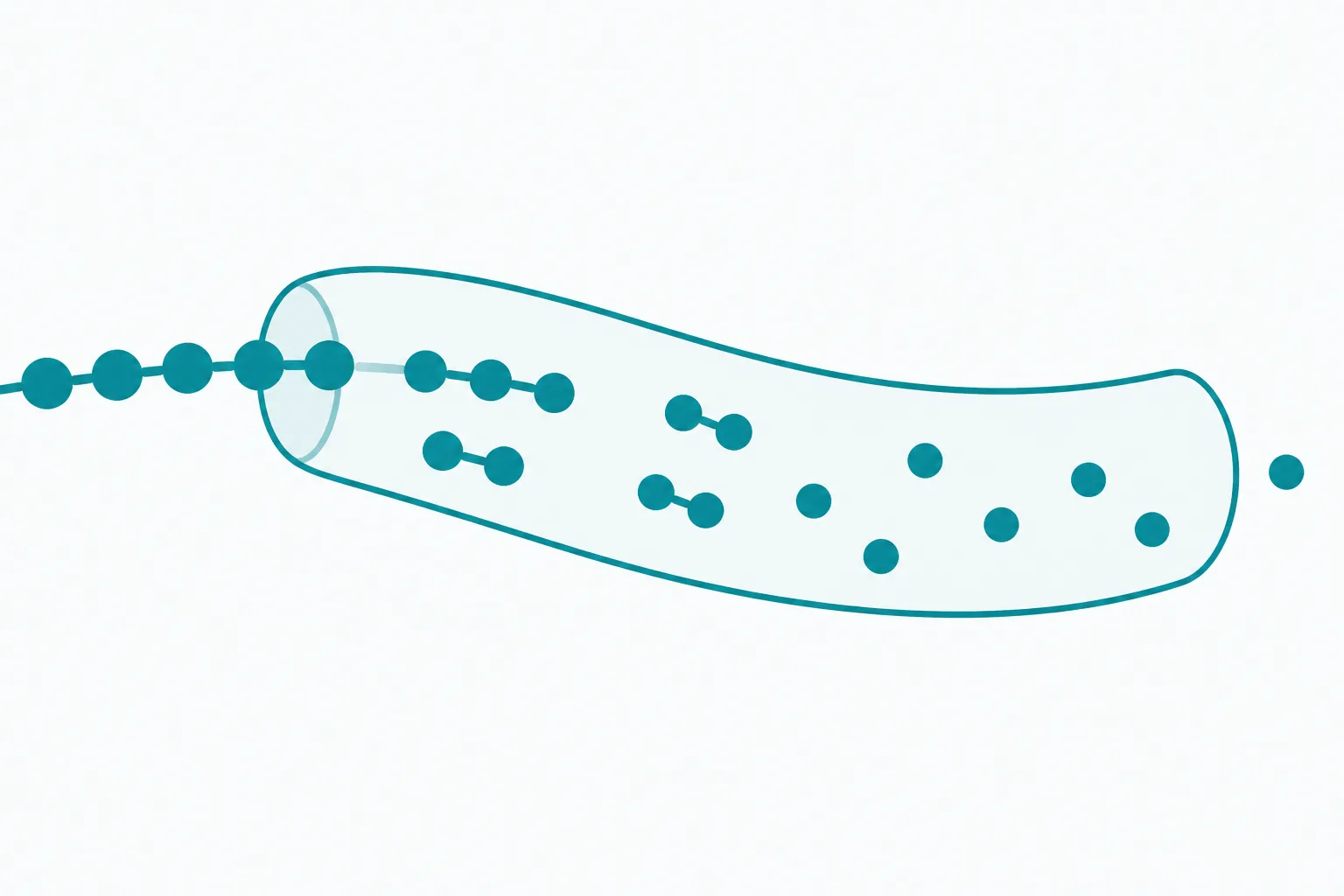
- The wall itself only has doorways for single amino acids and pairs. A whole peptide has no way through.
How much actually gets through?
A number does this better than any adjective. For most peptides, less than one percent of a swallowed dose reaches the bloodstream intact, and it is often a tenth of that 14.
It is worth translating that into something you can picture. If you swallowed a hundred identical copies of a peptide, fewer than one would arrive in your blood in one piece. The other ninety-nine and more would be cut up in your gut, or would never cross the wall at all. In everyday terms, essentially none of it gets in.
For comparison, an ordinary tablet — the kind of small, sturdy molecule most medicines are made of — often delivers half or more of what it contains. Some deliver ninety percent. Against that, a peptide taken by mouth is not merely worse. It is in a different category of outcome.
There is a second problem hiding inside the first. When the amount getting through is that tiny, small everyday differences swing it enormously 1. What you ate, how much water you drank, how quickly your stomach emptied — each can change the sliver that arrives by a large proportion. So a route that already loses almost everything is also unreliable about the little that remains.
Why an injection gets around this
Once you see the problem clearly, the usual answer stops looking dramatic and starts looking obvious.
An injection works because it skips the digestive system entirely. The peptide never meets the stomach acid, never meets the cutting enzymes, and never has to find a way across the intestinal wall. None of those barriers were beaten. They were simply never encountered.
That is the whole reason nearly every peptide medicine is injected rather than swallowed 34. It is not a preference and it is not tradition. It is the only route that reliably delivers the molecule intact.
The one that did work, and what it took
There is an exception, and it is genuinely interesting — partly because of how it works, and partly because of how inefficient it still is.
An oral form of semaglutide exists. It is a real tablet, and the peptide really does reach the bloodstream from it. But the tablet is not simply the injected peptide in a capsule. It contains a helper ingredient mixed in with the peptide, and that ingredient is doing almost all of the difficult work 2.
The helper does two things at once, in a very small space. As the tablet dissolves against the stomach lining, it creates a little pocket where conditions are different from the rest of the stomach. Inside that pocket it makes the surroundings less acidic, which takes the stomach's cutting enzyme out of action, so the peptide is protected. At the same time, it makes the nearby stomach wall temporarily easier to cross 2.
That last part surprised people. Absorption happens in the stomach, not in the intestine where most absorption normally occurs. And the effect is deliberately limited: it works only right where the tablet is dissolving, only while enough of the helper is present, and the wall returns to normal once it disperses 2.
Here is the honest part, and it is the part most worth remembering. Even with all of that, only about one percent of the peptide in the tablet reaches the blood 12. The other ninety-nine percent is lost, exactly as the plain chemistry predicts. So the tablet has to contain far more of the peptide than an injection does to achieve a comparable effect — material that is made, purified, paid for, and then destroyed on the way in.
That took roughly a decade of work, a purpose-built helper ingredient, and studies just to establish where in the gut the absorption was happening. The result is a working oral peptide that still wastes almost all of itself. That is what success looks like here.
What "oral" and "acid stable" really tell you
You will run into peptides described as "oral," "orally active," or "acid stable." These phrases sound like they settle the question. They usually do far less than that.
Start with what acid stability actually is. It means the peptide was put in something resembling stomach fluid — dilute acid, at body temperature, often with the stomach enzyme added — and came back out largely intact. That is a real result about a real barrier. It is also one barrier out of several.
Surviving the stomach says nothing about the enzymes waiting in the small intestine, which are the harder problem. It says nothing about the enzymes on the intestinal lining. And it says nothing at all about crossing the wall, which is a separate question that acid has no bearing on 13.
So when a claim of oral activity comes up, one question is worth more than all the others. Did anyone measure what arrived in the blood? A measurement means the intact compound was actually found in the bloodstream, in some amount, at some time. Anything short of that is an assumption dressed up as a finding 1.
There is one more trap, and it is easy to fall into. Something can produce a noticeable effect after being swallowed without ever entering the blood at all, by acting on the gut itself. That is a legitimate way for a medicine to work. It is simply not the same claim as being absorbed.
This is chemistry, not a failure of effort
It would be easy to read all this as a gap someone ought to have closed by now. That is not the situation.
The limit is a real property of the molecules and the body. Peptides are chains of amino acids, and your gut exists in large part to take chains of amino acids apart. Those two facts pull against each other directly, and no amount of interest or funding changes either one. People have worked on this problem for the better part of a century, with real ingenuity and real money behind it 34.
What that century produced is a small number of narrow, molecule-specific solutions and a much better understanding of why the general case is so hard. That is progress, and it is also a boundary.
So when you notice there is no pill, you are not looking at neglect or at a marketing decision. You are looking at a well-understood piece of chemistry that has been tested against for a hundred years and has mostly held.