the basics
What Is the Difference Between a Peptide and a Protein?
There is no chemical difference between the two. They are the same kind of molecule, and the only thing separating them is length — plus a line that people agreed to draw.
The difference between a peptide and a protein is length, and nothing else. Both are chains of amino acids, the small molecules your body links together to build things. A peptide is a short chain. A protein is a long one. That really is the whole distinction, and it is more interesting than a tidy rule would be, because nothing in nature marks the spot where short becomes long. Scientists agreed on a rough line so they could talk to each other clearly. The molecules themselves never got the memo 1.
They are made of exactly the same thing
Start with what the two have in common, because it is nearly everything.
Amino acids are small molecules, and your body builds from a standard set of twenty of them. It links them together into chains, end to end, like beads on a string. The link between one amino acid and the next has its own name — the peptide bond — and it is the same link every single time 1. It does not become a sturdier kind of join in a protein or a flimsier one in a peptide. There is one type of connection, and both molecules use it.
So a peptide is not made of different material than a protein. Cut a protein into pieces and the pieces are peptides. Keep adding amino acids to the end of a peptide and at some point people will start calling the result a protein. Nothing about the chain itself changed at that moment. The word changed.
This catches people off guard, and it is worth sitting with for a second. Most categories in chemistry mark something real. Ice is not water with a different label attached — something physical is genuinely different. Peptide and protein are not like that. They are two words for two ends of one smooth, continuous range, in the way that "stream" and "river" describe the same water at different widths.
So where is the line?
The number most people use is fifty. Under about fifty amino acids, a chain is usually called a peptide. Over about fifty, it is usually called a protein 12.
Notice the word "about." It is doing real work in both of those sentences.
Different fields put the line in slightly different places, and each has a sensible reason. Chemists who build these chains think in terms of what they can practically make. Scientists who study structure care less about the count and more about whether a chain folds into a fixed shape.
None of them are wrong. A line drawn for one purpose does not have to match a line drawn for another. The mismatch can look like confusion from the outside. It isn't. Everyone is simply putting a few words onto a range that has no natural joints in it.
- Two amino acids joined together make a dipeptide. Three make a tripeptide. The counting names go on for a while.
- A handful joined together, up to roughly twenty, is usually called an oligopeptide. "Oligo" just means "few."
- Longer than that, but still short of protein territory, and you will hear polypeptide. "Poly" means "many."
- Longer still, folded into a settled shape and doing a job that depends on that shape, and almost everyone says protein.
- Where exactly one word gives way to the next is a matter of habit, and habits differ from field to field.
The difference that actually matters is shape
Here is where length stops being trivia and starts to matter a great deal.
A long chain does not stay stretched out. It folds. Some parts of the chain pull toward each other and some push apart. Water shoves certain parts inward and draws others to the outside. The chain collapses in on itself and settles into a specific three-dimensional shape. The remarkable part is that the same chain arrives at the same shape nearly every time, on its own, with nothing guiding it there.
A short chain has far less to work with. There simply are not enough parts to hold each other in place. So it stays loose. It keeps changing form, drifting among many shapes rather than settling into one.
Picture a long chain necklace dropped onto a table. It does not land flat. It settles into a particular tangle, and a long enough necklace tends to fall into much the same tangle each time you drop it. Now drop a two-inch piece of that same chain. It just flops. There is nothing there to hold a shape, and no two drops look alike.
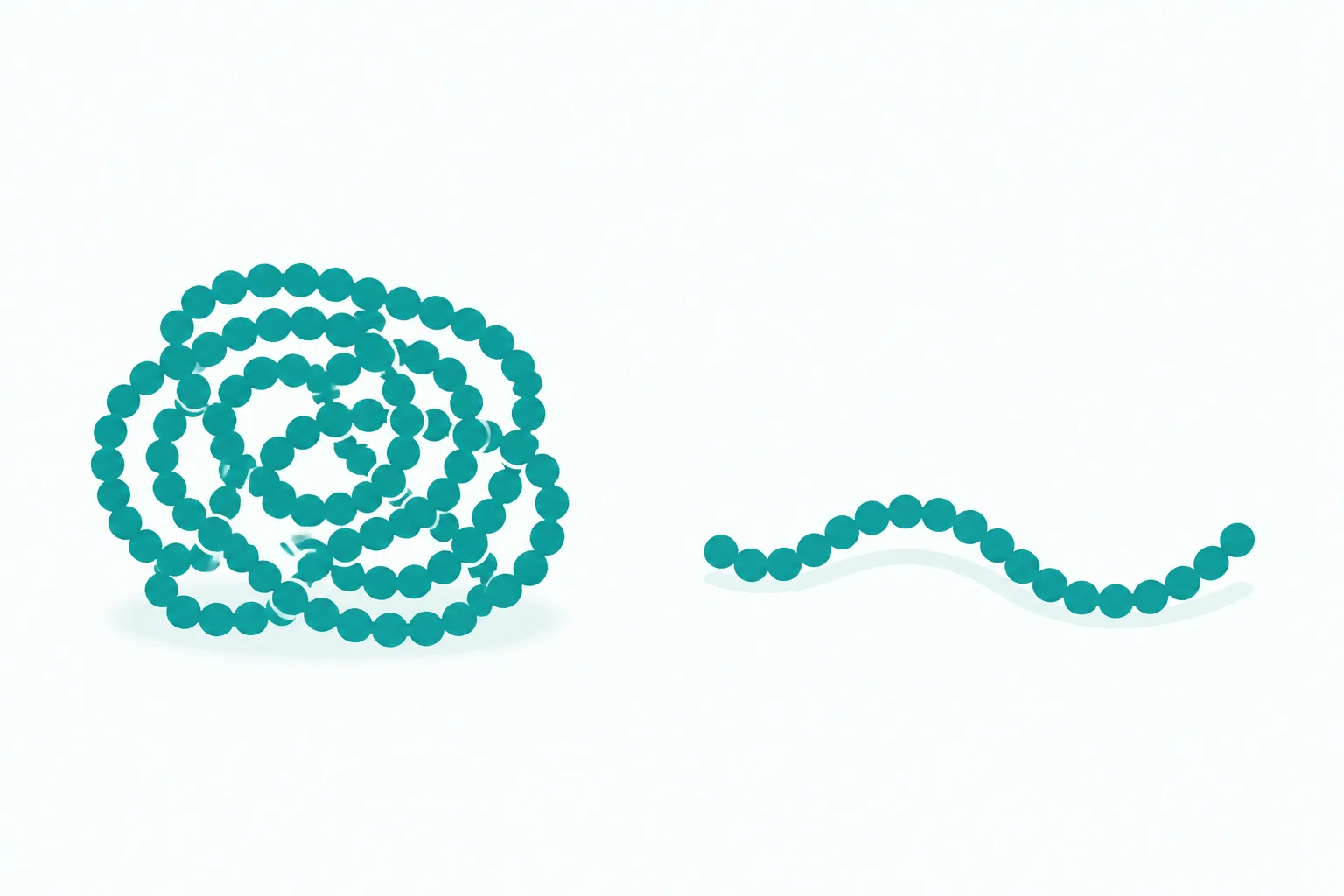
For a protein, the tangle is the entire point. Its job depends on that exact shape and not on anything else.
Take an enzyme, which is a protein whose job is to speed up one particular chemical reaction. It works because a pocket on its folded surface fits one specific molecule, the way a lock accepts one key. Change the fold and you change the pocket, and the enzyme stops working. It still holds every amino acid it had before, in the same order. Only the shape was lost, and the shape was doing the work.
This is why heat ruins a protein, and the most familiar example is sitting in your kitchen. Crack an egg into a hot pan. The clear part turns white and firm within seconds. Nothing was added and nothing was taken away. Heat shook the protein chains hard enough that the folds came apart, and the loose chains promptly snagged on each other in a new arrangement. That new arrangement is the white. Let the pan cool and it stays exactly as it is. A cooked egg does not go back.
Very short peptides are often tougher, for the plain reason that they have less to lose. You cannot unfold something that was never folded. That does not make short chains indestructible — your body carries enzymes whose whole job is cutting such chains apart, and they handle short ones very efficiently. It means only that heat alone is less of a threat when there is no delicate structure there to wreck.
Insulin sits right on the line
Insulin is the example everyone reaches for here, and it earns the spot.
Insulin is a hormone, meaning a molecule released by one part of the body to carry a message to another part. It is built from 51 amino acids, arranged as two separate chains held together by chemical bridges 2. Fifty-one. The conventional line sits at about fifty.
So insulin lands one amino acid past a line that was never precise to begin with. In practice it gets called both. You can find it described as a protein and as a peptide hormone in the same textbook, sometimes within a few pages of each other.
That is not sloppiness, and nobody involved is confused. Insulin folds into a definite shape and holds it, which is protein-like behavior. It is also small, and it works by carrying a message, which is peptide-like behavior. Both words say something true about it. Insisting on one would throw information away rather than add any.
If you want one fact that shows the boundary is a human convenience rather than a natural border, this is it. One of the most studied molecules in all of medicine sits directly on top of the line, and the field simply shrugged and kept using both names.
Short chains are built, long ones are usually grown
One practical difference deserves a paragraph, because it helps explain why the line landed near fifty. Short chains can be built from scratch in a lab, one amino acid at a time, using an approach worked out in 1963 that anchors the growing chain to a solid bead so the leftovers can be rinsed away after each step 4. Every step is very slightly imperfect, and those small losses pile up as the chain gets longer. Past roughly fifty amino acids the yield falls far enough that building becomes impractical. Longer chains are usually grown instead, by handing living cells the instructions and letting them do the assembly 23. So the rough working rule is that peptides are the ones you can build and proteins are the ones you have to grow.
Why the word "peptide" does not tell you much
This is the part worth carrying out of the article, because it will save you disappointment later.
"Peptide" is a size word. It tells you that a molecule is a chain of amino acids and that the chain is on the short side. That is the entire content of the term. It is a description of length, in the same way that "tall" is a description of height and says nothing about whether a person is kind.
It does not tell you the molecule is natural. Plenty of peptides are designed and assembled in a lab, and some are deliberately built with parts that no living cell would ever use 3.
It does not tell you the molecule is gentle. Some of the most dangerous substances known are short chains of amino acids. Several snake and cone snail venoms are precisely that, and they are dangerous in tiny amounts.
It does not tell you the molecule is safe, and it does not tell you the molecule works. Those are claims about one specific compound. Each one has to be demonstrated for that compound, and it can never be inferred from the category the compound belongs to.
The reverse trap is worth naming too. "Protein" is not a warning label, and long does not mean harsh. Insulin is a long chain by the usual convention, and it is one of the most important medicines ever made.
So when you meet the word being used as though it were a promise, translate it in your head. It means "a shortish chain of amino acids." Then ask the questions that carry real information. Which one, exactly? What is it made of? Who has it been studied in, and what happened?
What this leaves you with
Three things, in order of how much use they will be to you.
First, peptides and proteins are the same kind of molecule. Amino acids, joined end to end, by one kind of link. If you understand one, you already understand the other.
Second, the difference is length, and length changes behavior in one big way. Long chains fold into a settled shape and their jobs depend on it. Short chains stay loose. Nearly every practical difference between the two traces back to that.
Third, the boundary is a convention. It sits near fifty amino acids, it moves a little depending on who is drawing it, and insulin sits right on top of it. That is not a flaw in the science. It is what happens whenever people put a few words onto a smooth range.
None of which tells you whether a particular peptide does what someone claims it does. That question is always about the specific molecule in front of you. It is never about the family it belongs to.