the basics
What Is a Peptide?
A peptide is a short chain of amino acids. Here is what each of those words means, why the order of those amino acids decides everything, and why your body is making peptides as you read this.
A peptide is a short chain of amino acids. That single sentence is the whole answer, and the rest of this article unpacks it, because every word in it is doing work. Amino acids are small molecules. A chain means they are joined end to end, in a line, in a particular order. And short means short compared with the much longer chains of the very same building blocks, which we call proteins. A peptide is not an exotic substance. It is a small piece of the material your body is built from.
What an amino acid is
An amino acid is a small molecule. A molecule is simply a group of atoms held together — water is a molecule, and so is sugar. On their own, amino acids do not do very much. Their importance comes from what they can be joined into.
Your body uses twenty different amino acids to build things. Nature contains many more than twenty, but these are the twenty your cells reach for when they assemble a chain. Each has a name — glycine, lysine, tryptophan, and so on — and each has a slightly different shape and personality. Some are drawn to water. Some avoid it. Some are bulky and some are tiny.
You already eat these. When you eat something containing protein — eggs, beans, fish, lentils — your digestive system pulls those long chains apart and hands the loose amino acids to your bloodstream. Your cells then build whatever chains they need. The blocks get recycled, all your life.
Why they work like letters in an alphabet
Twenty building blocks, joined in a line, in an order that matters. That is the same arrangement as an alphabet, and the comparison is worth taking seriously rather than treating as decoration.
Consider the letters t, a and e. Arrange them one way and you get ate. Arrange them another way and you get eat, or tea. Three letters, three words, three meanings. Nothing about the letters changed. Only their order did.
Amino acids behave the same way. Take the same handful of amino acids, join them in a different order, and you have a different peptide with a different shape and a different job. The order is not a detail. It is the identity of the molecule.
The comparison holds in one more useful way. Words have a direction. You read them from one end to the other, and pot read backwards is top, a different word. Chains of amino acids also have a direction. They have a defined beginning and a defined end, and scientists always write them beginning first. A chain written backwards is a different molecule, not the same one described differently. There is an international set of naming rules covering how these chains are written down, and it exists because this kind of detail matters 1.
So if a peptide is like a short word, a protein is like a long sentence. Both are made from the same letters. Both are read in one direction. A sentence is simply much longer, and being longer lets it do more complicated things.
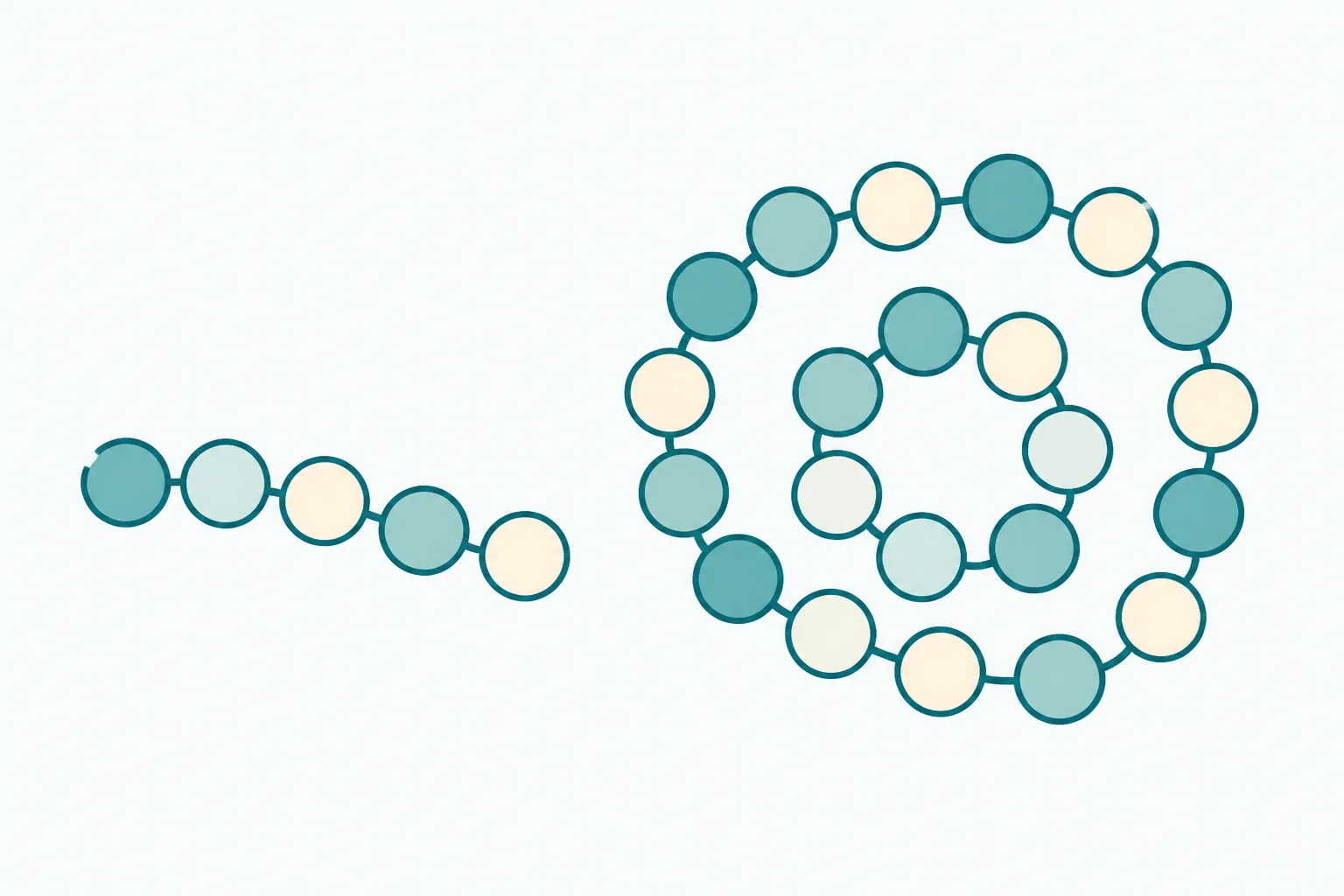
How two amino acids join together
The join is a chemical link called a peptide bond. That is where the word peptide comes from, and it is the most important thing to know about how these chains are built.
Here is what happens. Every amino acid has two ends that can react. Think of them as a hook at one end and an eye at the other. When the hook of one amino acid meets the eye of the next, the two lock together, and something small is pushed out: a single molecule of water. The two are now one unit, and that unit still has a free hook at one end and a free eye at the other. So a third amino acid can join on. Then a fourth. The chain grows one link at a time.
The water is worth holding on to, because it makes the whole thing concrete. Join two amino acids, and one water molecule leaves. Join ten amino acids into a chain, and nine water molecules leave, because ten beads on a string have nine links between them. Building a peptide literally squeezes water out.
Because every link is made in the same way, the spine running through every peptide is the same repeating structure. What differs from one peptide to the next is which amino acids are hanging off that spine, and in what order.
How short is short?
This is a place where honesty is more useful than a clean answer. A chain of roughly fifty amino acids or fewer is usually called a peptide. Longer than that, and most people say protein.
But that number is a convention — an agreement people settled into — and not a boundary that exists in nature. There is no point along a growing chain where the chemistry changes. Nothing snaps or switches over. A chain of forty-nine amino acids and a chain of fifty-one are made of the same things, joined the same way.
Different groups even draw the line in different places. One part of United States drug regulation puts the cut-off at exactly forty, because a legal definition needs a precise number even when nature does not supply one. Other writers pick a different figure, or none at all. If that sounds unsatisfying, it should. It is a naming habit, and naming habits are allowed to be untidy.
There is still a reason the line sits roughly where it does. Short chains tend to stay loose and floppy. Longer chains fold up into a particular three-dimensional shape and hold it, and that folding is what lets proteins do their more complicated jobs. Around fifty amino acids is where chains generally become long enough to fold and stay folded. So the convention tracks a real difference in behavior. It just does not have a sharp edge.
Your body is making peptides right now
Peptides are not a laboratory invention. Your body builds them constantly, and it uses them for real, specific jobs. Most of those jobs involve carrying a message from one place to another.
A peptide made in one organ can travel through the blood and deliver an instruction somewhere else entirely. Molecules that do this are called hormones, and a great many hormones are peptides.
- Insulin tells your cells to take sugar out of the blood. It was also one of the first medicines of any kind based on a peptide.
- Oxytocin, involved in childbirth and in social bonding, is a chain of just nine amino acids.
- Glucagon works in the opposite direction to insulin, telling the body to release sugar it has stored away.
- Vasopressin tells your kidneys to hold on to water instead of losing it.
Insulin is also a neat illustration of the fuzzy boundary above. It is built from fifty-one amino acids in two short chains held together, which puts it right on the line. You will see it called a peptide hormone in one book and a small protein in the next. Neither book is being careless. Insulin simply sits on top of a blurry line.
Peptides can be made in a laboratory too
Chemists can build peptides from scratch. The usual method adds one amino acid at a time to a growing chain that is anchored in place, so leftover ingredients can be washed away between steps. It is slow, repetitive work, and it is how most of the peptides you might read about are produced.
That raises a fair question. Is a peptide made in a laboratory the same thing as one made by a body? If the sequence is identical, yes. Sequence is the word for the order of the amino acids in the chain, written from its beginning to its end. It is the peptide's recipe and its identity at once.
A molecule carries no memory of where it came from. If a laboratory joins the same amino acids in the same order, the result is the same molecule and behaves the same way. Insulin has been produced outside the human body and used as a medicine since the 1920s, and modern versions match the human sequence exactly 2.
Two cautions belong here, though. First, a laboratory can also build sequences that exist nowhere in nature — chains no living thing has ever made. Being a peptide does not mean being natural. Second, being the same molecule says nothing about purity. What matters in practice is whether a particular batch contains what its label claims, in the amount claimed, and how carefully anybody has checked.
Why anyone cares about peptides
Two properties explain most of the attention peptides receive, and they pull in opposite directions.
The first is precision. Because a peptide's shape comes from its exact sequence, it can be built to fit one target and largely ignore everything else, the way a key fits one lock and rattles uselessly in every other. A medicine that precise tends to do its job without disturbing as much around it. That is a large part of why more than eighty peptide medicines have been approved for use around the world 3.
The second is fragility. Your body is extremely good at taking chains of amino acids apart, since that is what digestion is for. It cannot easily tell a peptide you would like to keep from a peptide that arrived in your lunch. Enzymes — the molecular tools your body uses to cut things up — go to work on both. This is why most peptide medicines cannot simply be swallowed as a tablet. They would be dismantled before reaching anywhere useful, and many that do reach the bloodstream disappear from it within minutes 4.
So peptides are appealing and awkward at once. A great deal of research effort goes into managing the awkwardness: building chains that survive longer, resist being cut, or reach the body by some route other than swallowing 24. That is where much of the interesting work in this field happens.
Where to go from here
You now have the foundation everything else on this site is built on. Amino acids are the building blocks. Peptide bonds are the links between them. Order is identity. And length is the loose, negotiable line between a peptide and a protein.
If the amino acids are the part you want to slow down on, there is a companion explainer here devoted to them alone — what one actually looks like, why there are twenty, and what people mean by calling some of them essential. The peptide-and-protein boundary also rewards a closer look than the short version given above. And if you arrived because you saw a particular peptide named somewhere, the individual explainers all begin from the same place: what the thing is made of, what it appears to do, and how much is genuinely known.
If you take one habit away, take this one. Whenever you meet a peptide you have not heard of, ask three questions. How long is the chain? What is it supposed to do? And who has actually tested it, in what? The first two are usually easy to find. The third separates a well-studied molecule from an interesting idea.