the basics
Where Do Peptides Come From?
Some peptides your body makes, some come from other living things, and many are built from scratch in a laboratory. Here is how each of those actually happens, and why the word "synthetic" tells you far less than most people assume.
Peptides come from three places: your own body, other living things, and laboratories. Your body is making them right now, without being asked. Other organisms make them too, and a few make them in astonishing variety. And many of the peptides people read about are built from scratch by chemists, one amino acid at a time. Those three origins matter far less than most people expect. A peptide is a short chain of amino acids, and what it does depends on the order of those amino acids, not on where it was made.
How does your body make one?
Start with the route your body already uses. Every cell carries a set of instructions, written in DNA — a very long molecule inside the cell that stores the plans for building things. A stretch of DNA that spells out one product is called a gene.
The instruction is more literal than people expect. It specifies an order of amino acids: this one first, then this one, all the way to the end.
The cell makes a working copy of that stretch of DNA, rather as you would photocopy one page instead of carrying the book around. The copy travels to a piece of machinery called a ribosome. What the ribosome does is mechanical: it moves along the copy, taking the amino acid each position calls for and attaching it to the growing chain, then shifting along and doing the same again.
One last step rarely gets mentioned, and it matters: what comes off the ribosome is often not the finished article. Many peptides are built first as a longer chain, then cut down to size by enzymes — the molecular tools cells use to cut and join things. Insulin works this way. Your body builds something bigger, cuts pieces out, and what remains is insulin.
What about other living things?
Everything alive makes peptides — bacteria, plants, fungi, animals. This was never a human specialty.
Some organisms make them in quantities that are hard to believe, and venom is the standout case. A venom is not one substance but a mixture, and that mixture is mostly peptides and proteins. A single snake or scorpion may carry dozens to hundreds of different ones. Cone snails — slow sea snails that hunt fish — are the extreme case, and one species can produce many hundreds.
There is a reason venom is built this way. A peptide's shape comes from its exact sequence, so it can be shaped to jam one specific piece of machinery in the victim: a particular channel in a nerve cell, a particular step in blood clotting. Evolution has had a long time to refine those shapes, and researchers noticed.
- A widely used blood pressure medicine traces back to a peptide in Brazilian pit viper venom.
- A painkiller given in hospitals for severe pain came from a cone snail.
- A drug that stops platelets clumping was modeled on a peptide in rattlesnake venom.
- A family of diabetes medicines began with a molecule in the venomous saliva of a desert lizard.
Notice what this does to the word natural. Venom is entirely natural, and so is the peptide that lowers blood pressure. Natural describes where something came from, and it says nothing at all about whether it is good for you.
How does a laboratory build one?
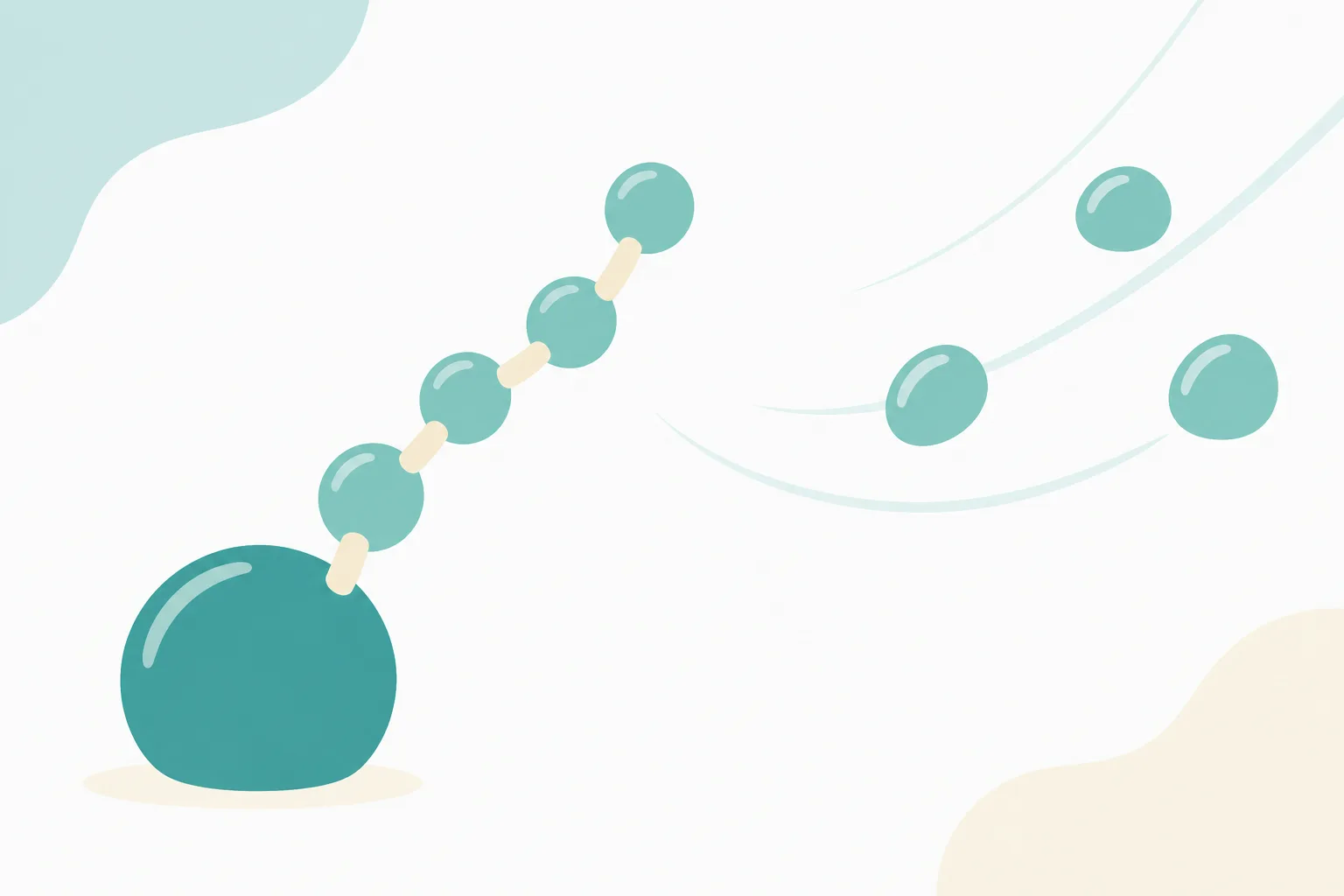
This is the part almost nobody has pictured, so it is worth going slowly. A chemist does not tip ingredients into a beaker and hope they line up. The chain is built one amino acid at a time, and the whole time it stays anchored to something.
That something is a tiny solid bead — a grain of plastic-like resin, smaller than a grain of sand. Thousands sit packed together in a narrow column. The first amino acid of the chain is attached to those beads, which pins it in place. That is the whole trick 1.
Here is the cycle. Wash in the next amino acid along with the chemicals that persuade it to join on. Give it time to react, then flush the column through with solvent. Everything loose runs out of the bottom: leftover amino acids, spent chemicals, byproducts. What stays behind is the bead and the chain attached to it.
Then do it again. And again. One amino acid, one rinse, one amino acid, one rinse. A chain of thirty means roughly thirty rounds of the same routine. Machines run it unattended now, but the cycle has barely changed since the 1960s 1.
So why not build anything you like this way? Because no step is perfect. Say each addition succeeds on ninety-nine chains out of a hundred, which sounds excellent. But the one that missed its turn is still on the bead, still growing, now missing an amino acid in the middle. It is very nearly the same shape as the chain you actually want.
Run that fifty times and the failures accumulate. At ninety-nine percent per step, only about six chains in ten come out correct. The bead carries your target plus a crowd of near-misses, each wrong in a different place. Purification means separating your molecule from a crowd that looks a great deal like it.
Past roughly fifty amino acids, the mixture usually becomes too messy to purify at a sensible cost. That is a practical ceiling rather than a wall — chemists push beyond it by building two halves and joining them. But it sits close to the length where people stop saying peptide and start saying protein.
How are the longer ones made instead?
When a chain is too long to build step by step, the job gets handed to a living cell.
The approach is to write the instruction rather than the molecule. Researchers make the genetic instruction for the sequence they want and put it inside a cell, often a bacterium. The cell reads it with the same ribosome machinery described earlier and builds the chain itself. The cells are grown in large tanks, and the product is collected and purified.
Human insulin was the landmark: in 1979, researchers put chemically made instructions for the human insulin chains into bacteria, and the bacteria produced them 2. Before that, insulin used as medicine came from animal pancreases, and since the early 1980s it has mostly been made this way instead.
Short chains get built on beads, and long ones get grown.
So what does "synthetic" actually mean?
Most people meet the word synthetic with an instinct already attached. Synthetic sounds like artificial, and artificial sounds like a substitute — a cheaper stand-in for the real thing. Natural sounds like the opposite: original, gentle, the way things are meant to be. That instinct is doing a lot of unexamined work.
Synthetic has a narrow and rather boring meaning. It means made by chemical synthesis rather than harvested from something alive. It describes a manufacturing route, and that is all it describes.
And here is the part that matters. A peptide built in a laboratory with the same sequence of amino acids is the same molecule. Not similar. Not close enough for practical purposes. The same. Molecules of a given kind are identical to one another, and they carry no record of their history — there is nothing inside a molecule to write one on.
Your body cannot check either, because your cells recognize molecules by shape and surface chemistry, and that is the only information available to them. A receptor — the part of a cell that a signaling molecule slots into — responds to shape the way a lock responds to a key. It cannot ask where the key was cut.
That should be reassuring, and it is. But it also moves the question, and this is the part worth carrying away. If where a molecule was made tells you almost nothing, then asking whether something is synthetic is not a useful question. Three better ones take its place.
- Is it the molecule it claims to be? A label names a sequence. Whether the contents match is a separate fact.
- How pure is it? Every method leaves other things behind: near-miss chains, leftover chemicals, fragments. Purity is a number, not a yes or no.
- Has anyone actually checked? A claim of purity is not a test result, and a test from an independent laboratory is not the same as one from whoever supplies the material.
None of those questions have anything to do with nature versus laboratory, and all three are about evidence rather than instinct.
Some lab-made peptides are not natural at all
There is a second half to this, and it cuts the other way. You will often see the reassurance that peptides are natural substances your body already makes. For some peptides that is exactly right, and for others it is plainly false — the sentence gives you no way to tell them apart.
A great many peptides made in laboratories are deliberately not identical to anything in nature. Changing them is the point.
The reason is covered elsewhere on this site: natural peptides usually do not last. Your body is extremely good at taking chains of amino acids apart, and many peptide messengers vanish from the blood within minutes. A molecule that disappears that fast makes a poor medicine.
So chemists change them on purpose 34. A few of the usual moves:
- Swap an amino acid for its mirror-image version. Enzymes recognize shapes, and a mirrored piece can block a cut.
- Use an amino acid from outside the standard set of twenty. Hundreds of others exist.
- Join the two ends into a ring, so there is no loose end for an enzyme to start on.
- Attach something bulky, such as a fat molecule, so the chain circulates longer before it is cleared.
- Cut a natural peptide down to the smallest fragment that still does the job.
So the word peptide, on its own, tells you almost nothing about how close a substance is to anything your body produces. Some lab-made peptides match a human sequence exactly, and some differ at a single position. Some are heavily rebuilt, and some match no natural molecule at all.
The honest version of that reassurance is longer than one sentence. Some peptides are things your body already makes. Some are not. Telling which is which means looking at the specific molecule, and the category name will never do it for you.
So does where it came from matter?
Your body reads instructions in your DNA, assembles amino acids in that order, and trims the result. Other living things do the same, and venomous ones have turned it into an art. Laboratories build short chains on beads, one amino acid at a time, and hand the long ones to living cells growing in tanks. Different routes, the same kind of product.
Where a molecule was made says very little. What it is, and whether anyone has verified it, says a great deal. So when you meet a substance described as synthetic, do not stop there and feel uneasy. Ask what sequence it is supposed to be. Ask whether anything was changed on purpose. Ask who checked the contents against the label. Those answers tell you something. Its birthplace does not.