What Is an Assay? The Lab Word for "a Test That Measures"
An assay is a test that measures how much of something is present, or how active it is. It is a different question from purity, and the two are easy to confuse on a certificate.
An assay is a laboratory test that measures how much of a particular thing is present, or how active it is. The word is used for everything from weighing the gold in a coin to counting how much of a hormone is in a drop of blood. If you have met it on a certificate or in a paper, the short version is this: an assay answers the question "how much?", while purity answers the question "how clean?".
Those two questions sound alike, and in everyday speech they blur together. In a laboratory they are separate, and a single document can give a good answer to one and say nothing about the other. This article explains what an assay is, where the word comes from, the main kinds, and how to tell an assay from a purity figure. It is an explanation of a word, not guidance about using any substance.
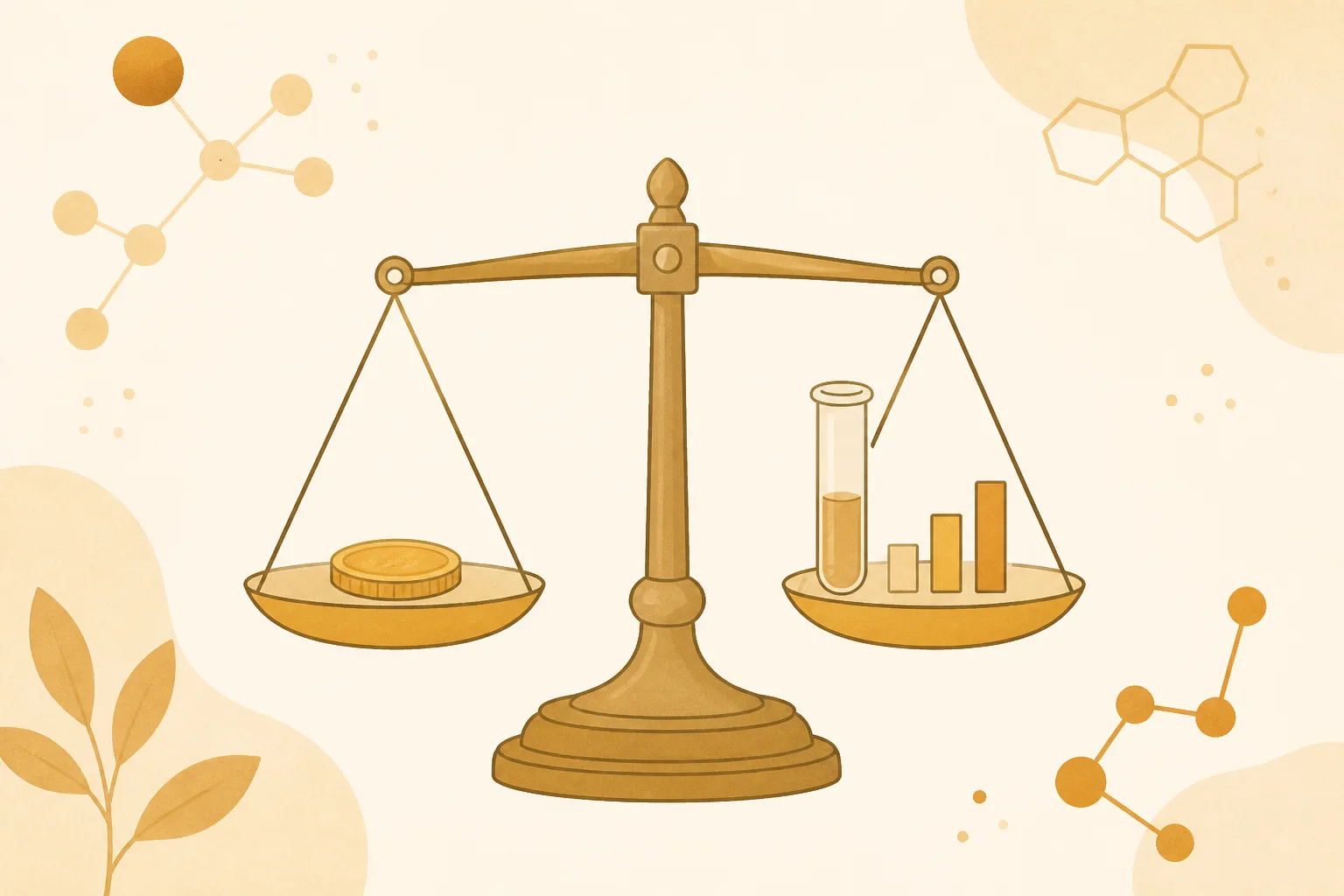
A test that answers "how much" or "how active"
Start with the plainest definition. To assay something is to measure it. The thing being measured is sometimes called the analyte, which just means whatever the test is looking for. An assay might measure how much of one substance is in a mixture, or it might measure what a substance does, such as how strongly it makes living cells respond 13.
Notice that both of those are measurements of a quantity. That is what separates an assay from some other laboratory tests. A test that asks "is this substance the one on the label?" is an identity test. A test that asks "is there any bacterial contamination?" is a limit test or a safety test. An assay is the one that puts a number on the amount or the activity.
Think of a baker checking a delivery. Looking at the sack and agreeing that it is flour is an identity check. Sifting the contents to see how much grit is mixed in is a purity check. Putting the whole sack on the scale and finding out how much actual flour is in it is the assay. All three are useful, and none of them replaces the others.
Where the word comes from
The word is a very old one. It comes from the same root as the word "essay", meaning an attempt or a trial, and it was used for centuries in the testing of metals. A coin or a bar of precious metal was tested to find out how much of the real thing it contained, as opposed to the cheaper metals mixed in. The official who did this was an assayer, and the workshop was an assay office 1.
That origin explains a lot. From the beginning, an assay was never about whether a coin was gold or not in some yes-or-no sense. It was about how much gold, as a measured share of the whole. The word carried that meaning into chemistry, where it came to describe measuring how much of a named compound a material contains, and later into biology, where it came to describe measuring how active something is.
So when the word turns up in a modern certificate, it is carrying a long history of one idea: take a sample, measure how much of the valuable thing is in it, and report it as a number.
Kinds of assay
There is no single assay. Laboratories use dozens, and they fall into a few broad families, depending on what is being measured and how 3.
A chemical assay measures the physical amount of a substance using the substance's own chemical or physical properties. For example, a compound may absorb a particular kind of light, or may travel through a column at a characteristic speed. An instrument reads that property and the amount is worked out from it. Techniques such as chromatography belong in this family. Chromatography is a way of separating a mixture into its parts so that each can be measured, and the earlier article on HPLC explains how.
A biological assay, often shortened to bioassay, measures activity rather than amount. It uses living material, such as cells in a dish or a tissue sample, and watches how strongly that material responds. The result tells you how active a substance is in that particular system, which is not always the same thing as how much of it is there. Two samples with the same amount of a compound can differ in activity if one has been damaged.
An immunoassay uses antibodies, which are proteins that recognise and grab onto one specific target. Because the grip is so selective, an immunoassay can pick out one particular molecule from a very crowded mixture, such as blood, and report how much is there. Many everyday medical tests work this way.
| Family | What it uses | What it reports |
|---|---|---|
| Chemical | Physical or chemical properties of the substance, read by an instrument | How much of the named substance is present |
| Biological (bioassay) | Living cells or tissue responding to the sample | How active the sample is in that system |
| Immunoassay | Antibodies that grip one specific target | How much of one particular molecule is present, even in a mixture |
Assay versus purity: two different questions
This is the distinction that matters most for a first-time reader, so it is worth going slowly.
Purity looks inside the sample and asks what share of the detectable material is the thing you want, compared with other detectable material that is not. If you imagine a bag of flour with some grit in it, purity describes how much of what is in the bag is flour rather than grit. A purity figure is a ratio inside the sample.
An assay asks something different. It asks how much of the thing you want is present in total, as a share of the whole contents, or measured against what was expected. In the flour picture, it weighs the bag and reports how much real flour there is.
Here is why the two can come apart. Imagine the bag is not only flour and grit. Suppose it also holds a good deal of moisture and a little packaging material that your instrument cannot see. The flour could be a very large share of the visible solid material, which gives an excellent purity figure, and yet the bag as a whole could contain a good deal less flour than you assumed, because so much of its weight is something else. An assay, which counts the flour against the whole bag, would catch that. A purity figure on its own would not.
Peptides show this clearly. A freeze-dried peptide powder is not only peptide. It usually also holds water and small partner ions that stay attached to the chain, which earlier articles explain. A purity figure from a separation instrument generally describes the peptide relative to other peptide-like material. A separate content measurement describes how much of the powder is peptide at all. Both numbers can be correct, and they answer different questions.
What "assay" on a certificate is claiming
A certificate of analysis is a document that lists the tests run on a particular batch and the results. When it has a line headed "assay", the line is making a specific claim: that someone ran a test to measure the amount of the named substance, and this was the result.
How much that claim is worth depends on several things you can ask about. What method was used? Was it a chemical measurement of amount, or a biological measurement of activity? What was the result compared against: a share of the whole sample, or a share of the amount the label says should be there? Was the figure worked out on the sample as received, or after allowing for water? Different laboratories report it differently, and the differences are legitimate, but they mean the numbers are not always directly comparable.
There is also the matter of validation. In regulated pharmaceutical work, a method is checked before it is trusted. International guidance on this, produced by a body that brings regulators and industry together, sets out the qualities a method has to be shown to have, such as accuracy, precision and specificity, and it treats the assay of a substance as one of the standard types of procedure that needs such checks 2. Specificity just means the method measures the thing it claims to measure and not something similar.
Not every document that uses the word has gone through that kind of scrutiny. A line reading "assay" tells you a number is being claimed. It does not by itself tell you how carefully the number was obtained.
Why an assay needs a reference standard
An instrument does not produce "amount" directly. It produces a signal: a height on a chart, a colour intensity, a count. To turn a signal into an amount, you need something to compare it with.
That something is a reference standard: a sample of the same substance whose identity and amount have already been established and are trusted. You measure the standard, see what signal a known amount produces, and then measure your unknown sample and read off how much it must contain. Quality guidance for the manufacture of active ingredients defines the term and distinguishes between primary standards, which are established independently, and secondary ones, which are checked against a primary 4.
The picture to hold is a ruler. A measurement of length is only meaningful if the ruler itself is correct. An assay result is only as trustworthy as the standard used to calibrate it, and a standard is only as trustworthy as the chain that checked it. For a well-established substance, certified standards exist. For a brand-new research compound, a certified standard may simply not exist yet, which is a real limit on how firmly any number can be stated. A separate article in this series covers reference standards in detail.
Reading the word in a paper and on a label
The same word can mean quite different things depending on where you meet it, and it is worth knowing the common patterns.
In a research paper, "assay" very often means a laboratory experiment of the bioassay or immunoassay type: a procedure that detects or measures some biological effect. A paper might describe a cell-based assay, a binding assay, or an enzyme assay. In this setting the assay is a tool for studying biology, and the number it produces is a finding about biology, not a statement about what is in a vial. Papers are also careful to say what sort of material the assay used, and that matters, because results in cells, in animals and in people are different tiers of evidence that should never be merged into one claim 3.
On a product certificate, "assay" more often means the quality-control sense: a measurement of how much of the named substance the batch contains. Here the number is a statement about the contents of a container, not a finding about biology.
- Ask what was measured: amount, or activity.
- Ask what it was measured against: the whole sample, the label, or a reference standard.
- Ask how it was measured: which method, and whether that method was validated.
- Ask whether the figure is a purity number wearing a different name, since the two are sometimes confused.
None of these questions needs a chemistry degree. They are the same questions a careful reader would ask of any measurement: measured how, against what, and how sure are we.
In one sentence
An assay is a test that puts a number on how much of something is there, or how active it is, always by comparison with something already trusted. It is not the same as purity, which asks how clean a sample is, and a certificate that gives one without the other has told you only half of the picture.