What Does In Vitro Mean? Cells in a Dish vs a Living Body
In vitro means "in glass": an experiment done in a dish or a test tube rather than in a living body. It is where much research starts, and it is the weakest rung for saying anything about people.
In vitro is Latin for "in glass", and it means an experiment carried out in a dish, a flask or a test tube instead of inside a living body. If a headline says a compound "worked" in vitro, it means something happened to cells or molecules in a laboratory container. It does not mean anything happened in an animal, and it certainly does not mean anything happened in a person.
That distinction is one of the most useful things a first-time reader of research can learn, because the in vitro stage is where a very large share of studies begin and end. This article explains the term, what a cell culture is, what in vitro experiments can and cannot show, and how to find the phrase in a study so you know what rung of evidence you are standing on. It is an explanation of a term, not guidance about using any substance.
Two Latin phrases, one simple idea
Science has borrowed a pair of Latin phrases that are used constantly and rarely explained. In vitro means in glass, from the old habit of doing such experiments in glass vessels. In vivo means in the living, an experiment done in a whole living organism 12.
The idea is a matter of location. In vitro, the biology has been taken out of the body and put in a container where it can be watched. In vivo, the biology is left where it lives, inside an animal or a person, and the researcher observes what happens to the whole. That is the full difference, and everything else follows from it.
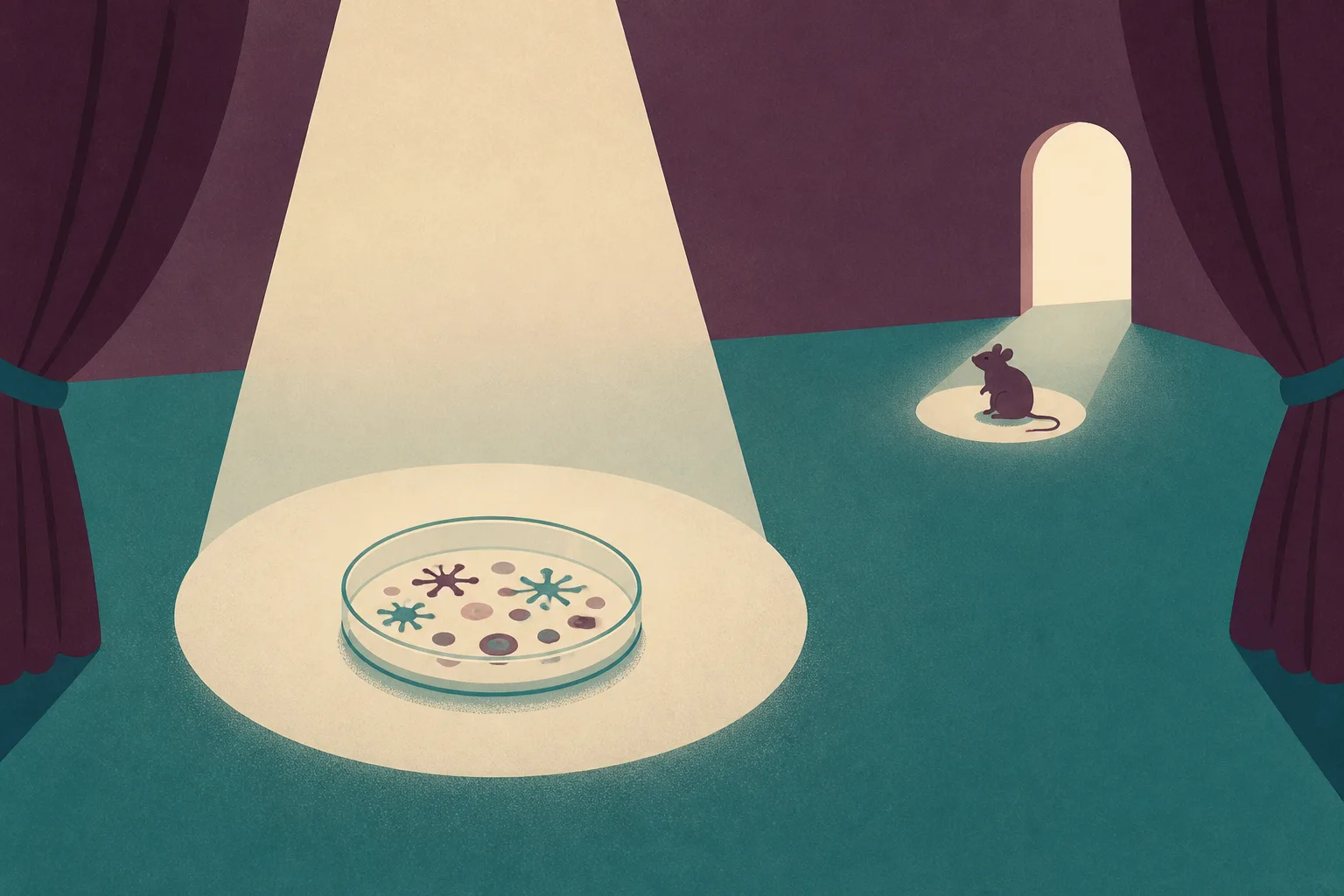
Think of a rehearsal in an empty theatre. You can learn whether the actor knows the lines, how the voice carries, and whether the timing works. You cannot learn how the play will go with an audience, an orchestra and a leaking roof. An in vitro test is the empty-theatre rehearsal: clean, controlled and genuinely informative about one thing, but a long way from opening night.
What a cell culture is
Many in vitro experiments use a cell culture. A cell culture is a collection of living cells, taken from an animal or a person and kept alive and multiplying in a dish, bathed in a liquid containing the nutrients they need. The dish is kept warm and carefully managed, because cells outside a body are fragile and need their world rebuilt around them 23.
A cell line is a culture that has been kept going for a long time, often for years, so that laboratories all over the world can work with essentially the same cells. That consistency is valuable: if two laboratories get a similar answer from the same cell line, it is easier to trust. But it comes with a cost. Cells that have been kept going this long are often altered from the cells in a real body, sometimes quite a lot. Many cell lines originate from tumours, because tumour cells tend to keep dividing indefinitely, which makes them convenient but also unusual.
Not all in vitro work involves whole cells. Some experiments use only a purified molecule, such as an enzyme or a receptor, in a test tube, to see whether a substance interacts with it. These are called cell-free or biochemical experiments. They isolate the question even further, and they are even more remote from a living body.
What in vitro can show
None of this is a criticism of the method. In vitro experiments are valuable precisely because they are simple, and simplicity is what lets a researcher ask a clean question.
They can show whether a substance binds to a particular receptor, which is a molecule that a substance can attach to a bit like a key in a lock. They can show whether cells respond in some measurable way when exposed to it. They can reveal something about the mechanism, meaning the step-by-step way a substance acts. And they allow the researcher to hold everything else constant, so that one change can be tied to one result 24.
They are also faster, cheaper and easier to repeat than animal work, and they use no animals, which is one reason the field encourages them as a first step wherever they can answer the question 4. Seeing a result first in a dish is often how a research programme decides whether a question is worth taking further.
What in vitro cannot show
A body is not a dish of cells, and the gap between the two is large. Several things that matter enormously simply do not exist in a dish.
- Absorption and distribution. In a dish, the substance is added straight to the cells. In a body, it has to get from wherever it enters to wherever it acts, and many substances never arrive in useful amounts.
- Breakdown and clearance. A living body contains enzymes that break substances down, and organs that remove them. A dish usually lacks these, so a substance can seem stable in glass and vanish quickly in an animal.
- Many systems at once. In a body, the nervous, immune and hormonal systems all respond together and influence each other. A dish contains one cell type, or a few.
- Long time and real exposure. A dish experiment often lasts hours or days. A body lives for years, and effects can build up or fade over that time.
- Safety. Whether something causes harm in a whole organism cannot be read off a dish.
This is why so many promising laboratory findings never carry forward. Something can look striking in a dish and do nothing in an animal, because it never reaches its target, or is destroyed on the way, or is outweighed by other effects. It is a very common story in research, and it is nobody's fault. It is simply what the stage tells us.
Ex vivo, in situ and in silico, briefly
Once you know the first pair, a few relatives are easy to recognise. They turn up in the same sort of paper and are sometimes confused with in vitro.
| Phrase | Literal meaning | What it usually means |
|---|---|---|
| In vitro | In glass | In a dish or test tube, outside a living organism |
| In vivo | In the living | Inside a living organism, such as an animal or a person |
| Ex vivo | Out of the living | Using tissue taken freshly from an organism and studied outside it, with as little change as possible |
| In situ | In its original place | Studied in the position where it naturally sits, often a tissue sample examined without being moved |
| In silico | In silicon | By computer simulation or calculation, rather than in any physical material |
Ex vivo is the one closest to in vitro, and it is a half-step nearer to real biology, because it uses a real piece of tissue that has just been taken from an organism rather than a long-kept cell line. In silico, the joke on the Latin, refers to work done on a computer, such as a simulation of how a molecule might fold or bind. Each is a different tier, with different strengths and different limits.
How to find the words in a study and what to do with them
You do not need to be a scientist to place a study on the ladder. The information is nearly always in plain view if you know where to look.
- Read the title and the abstract, which is the short summary at the top. The phrase in vitro, or the name of a cell line or a cell type, usually appears there.
- Look at what the experiment was done on. Words such as "cells", "cultured", "cell line" or "enzyme assay" point to a dish. Words such as "mice", "rats" or "animals" point to in vivo animal work. Words such as "participants" or "patients" point to human studies.
- Check the methods section for the container: a plate, a dish, a flask, a tube.
- Note the tier and keep it attached to the claim. "In cultured cells, the compound did X" is a different sentence from "the compound does X".
- Watch for a headline that drops the tier. The qualification in the paper often disappears by the time the finding reaches a news story or a product page.
The last point deserves emphasis. The commonest error in this whole field is to take a result from a dish and describe it as though it applied to a body. A careful writer keeps the qualifier. A careless one removes it.
The ladder from dish to mouse to human
It helps to picture research as a ladder. At the bottom rung sits in vitro work: cells and molecules in glass. The next rung is animal studies, which add a whole living body, with everything that implies for absorption, breakdown and the interaction of many systems. Above that sit studies in people, which begin small and carefully controlled and grow larger.
Each rung adds something real that the one below cannot supply, and each rung is where a good number of ideas fall off. That is not failure. It is the process working as designed: an idea has to survive an increasingly demanding test at each stage. A separate article in this series covers the animal rung and why a mouse result is not a human result, and another explains how clinical trials in people are organised.
So when you read that something worked in vitro, hold the sentence at its true size. It is an early, useful and quite limited piece of information: in a dish, under those conditions, something happened. The interesting question is what comes next, and the honest answer is usually that the next rung has not yet been climbed.
In one sentence
In vitro means done in glass, outside a living body; it is a real and valuable starting point, but a result in a dish describes the dish, not an animal and not a person.