What Does 99% Purity Mean on a Label?
Purity is a proportion, not an amount. Those are two completely different questions, and mistaking one for the other is the single most common confusion in this corner of the subject.
A purity figure on a label is a proportion. It says what share of the material is the substance being named, and what share is something else. It does not say how much material there is. Those are two separate questions, and almost everything confusing about purity figures comes from the two being quietly rolled into one.
Ninety-nine per cent purity sounds like a claim about a container. It is not. It is a claim about a ratio, and a ratio holds whether the container is nearly full or nearly empty. Once you have that idea firmly, the rest of this article is mostly detail.
So we are going to take the long way round with a jar of beads, because it makes the distinction impossible to lose again.
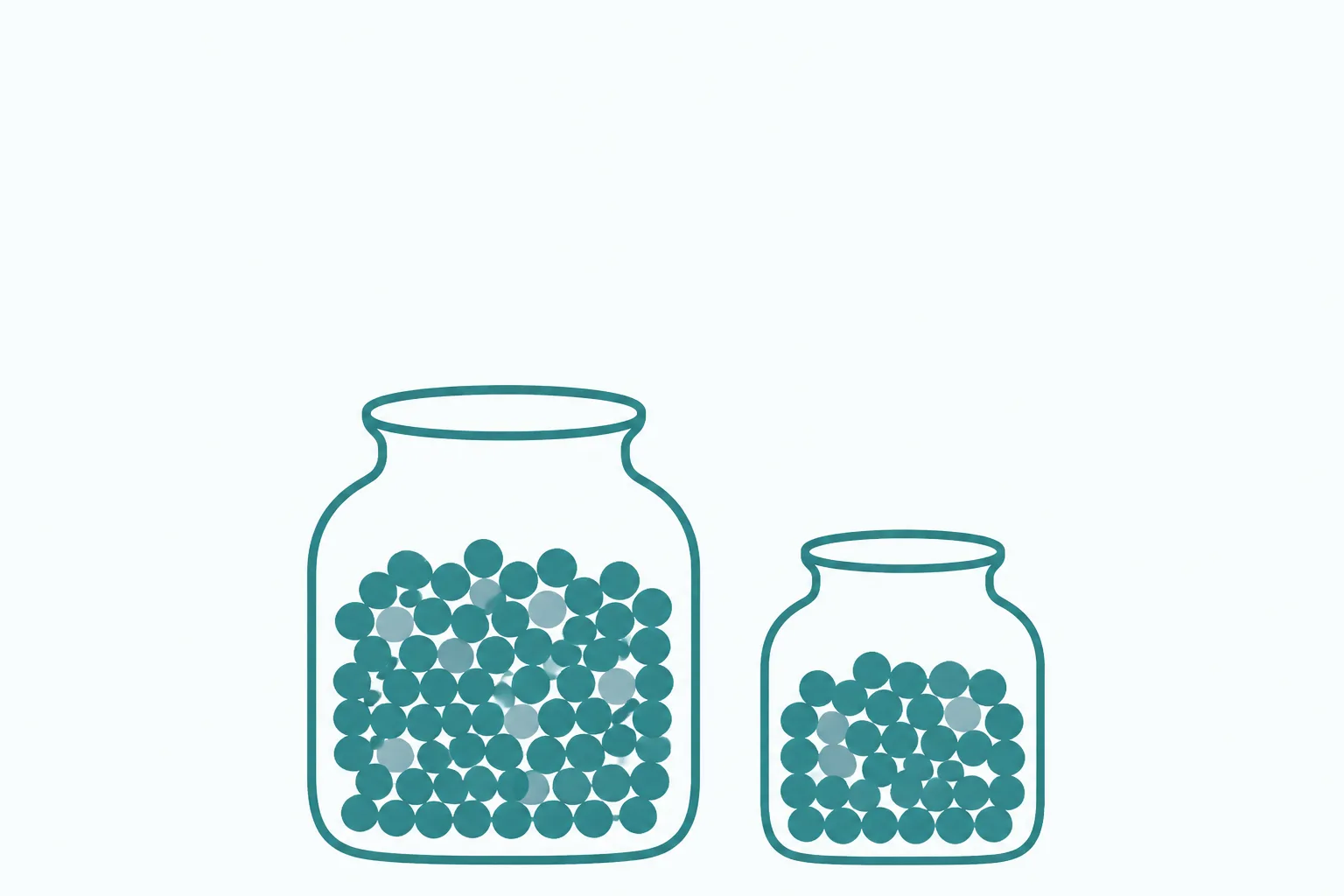
Purity is a proportion, and nothing else
Imagine a jar of beads. You tip it out and count: a thousand beads, of which nine hundred and ninety are blue and ten are various other colours. The jar is ninety-nine per cent blue. That is a purity figure, and you now understand exactly what one is.
Now put a second jar next to it. This one is much smaller and holds only a hundred beads: ninety-nine blue, one odd. It is also ninety-nine per cent blue. Same figure. Ten times less blue in it.
That is the entire lesson, and it is worth pausing on. A purity figure is calculated by dividing one part of the contents by all of the contents. Dividing makes the size of the jar disappear. Whatever you knew about how much was in there, the percentage does not carry it forward.
In everyday life this rarely trips anyone up, because we usually see proportions and amounts written together. A coffee bag tells you it is a hundred per cent arabica and that it weighs two hundred and fifty grams. Nobody confuses the two, because both are printed. The trouble starts when only the proportion is printed, and the amount is left to assumption.
What is the other one per cent?
The leftover share has a name — impurities — and the name makes it sound like a single substance. It is not. It is a category, and it usually contains several quite different kinds of thing at once.
- Closely related molecules. Building a peptide is a step-by-step assembly, and steps occasionally go wrong. The result is a molecule almost identical to the intended one, missing a piece or carrying an extra one. These are the commonest impurities and the hardest to separate out, precisely because they are so similar.
- Leftover chemicals from the making. Manufacturing uses solvents and reagents, and traces of them can remain in the finished material.
- Salts. Purification steps often leave the material paired with a salt, which adds weight without adding any of the named substance.
- Water. Dried material draws water out of the air, and that water is part of what sits on the scale.
- Contamination from outside the process. This is the category that includes things nobody intended to be present at all, including metals.
Those categories carry very different weight. Related molecules are a normal consequence of how the material is made. Contamination is not. A 2018 analysis of falsified peptide products taken from an unregulated market found purity ranging from around five per cent to around seventy-five per cent across the samples, alongside contamination including heavy metals — which shows both how far the figure can travel from what a label says and how varied the leftover fraction can be 3.
This is why a bare percentage is less informative than it looks. Ninety-nine per cent pure with one per cent related molecules and ninety-nine per cent pure with one per cent of something that should never have been in the building are the same number describing very different material.
Purity and quantity are different questions
This is the heart of it, so here it is stated plainly. Purity asks: of the material present, what share is the named substance? Content asks: how much of the named substance is present? A percentage answers the first. Only a measured amount answers the second.
Formal specifications treat these as separate tests with separate methods and separate acceptance limits — identity, purity and assay each stand on their own line 2. That is not bureaucratic fussiness. It is because knowing one genuinely does not give you the other.
| The question | What answers it | Does purity answer it? |
|---|---|---|
| Is this the substance named on the label? | An identity test, usually mass spectrometry | No |
| What share of the material is that substance? | A purity test, usually HPLC | Yes — this is the one |
| How much of that substance is in the container? | An assay or content test | No |
| Is the material free of bacteria or bacterial residue? | Sterility and endotoxin tests | No |
| Is it safe in a person? | Trials in people | No |
The gap between purity and content matters in a specific and practical way. Dried peptide material is rarely pure peptide by weight, even when it is genuinely pure in the purity sense — because salts and water are sitting alongside it, and neither shows up as an impurity in a purity measurement that only compares peptides with other peptides 1. The percentage can be honest and high while the amount of named substance on the scale is meaningfully lower than the total weight.
And in the other direction, content can be wrong regardless of purity. The 2024 study of products bought from online sellers found containers holding more of the active ingredient than the label stated 4. A purity figure would not have flagged that at all, because the ratio can be perfectly fine while the amount is not.
How can something be 99% pure and still not what you expected?
Here is the part that surprises people most. A purity figure describes how uniform the material is. It does not, by itself, describe what the material is.
Go back to the beads. Suppose you are told a jar is ninety-nine per cent one colour. You now know it is overwhelmingly consistent. You have not been told which colour. If you were expecting blue and the jar is green, the ninety-nine per cent figure was accurate the whole time and told you nothing useful.
That is exactly the relationship between purity and identity. Identity is the test that asks whether the main component really is the molecule named at the top of the page, and it is usually settled with mass spectrometry, a machine that weighs molecules very precisely. Purity assumes the answer to that question and measures consistency around it.
So a purity figure with no identity result beside it is answering a narrower question than it appears to. It is a statement about uniformity, presented in a place where people read it as a statement about correctness.
There is a third way a high figure can mislead, and it is subtler. Purity is only ever measured against what the method can see. A measurement that separates peptides from other peptides is not looking for salt, water, or a solvent. Something invisible to the method does not appear in the percentage — not because anyone hid it, but because it was never in the frame.
What is the figure measured with, and how should you read it?
Almost always HPLC, which stands for high performance liquid chromatography. You do not need to understand how it works, and this article is not going to explain it properly. What is worth knowing is the shape of what it produces.
The machine pushes the material through a packed column so that its components emerge at different times rather than all at once. A detector at the far end registers each one as it arrives, producing a trace with a series of peaks. The named substance is the large peak. The impurities are the small ones.
The purity figure is then the size of the main peak as a share of all the peaks added together. Which means it is a proportion of measured signal, not a headcount of molecules — a distinction that matters, because different molecules do not all register equally strongly at the detector. It is a very good approximation, arrived at by an established and well documented family of methods, and it is still an approximation 1.
One consequence follows directly. The figure depends on the method used to produce it. A different column, a different setting, a different run time — any of these can separate two components that another method would have merged into a single peak. Merged peaks read as higher purity. This is why a certificate that names its method is worth more than one that prints a number alone, and why the same material can honestly yield slightly different figures in two different laboratories.
So how should you read a purity figure in the end? As one measurement among several, with a clear and narrow meaning. It tells you what share of the material, as seen by a particular method, was the named substance. That is a real and useful thing to know.
It does not tell you how much is in the container. It does not confirm that the substance is the one named. It says nothing about sterility, and nothing whatsoever about whether anything is safe in a person. Each of those is a different question with a different answer, and a percentage will never be that answer.
If you take one thing from this article, make it the jar. Two jars, the same percentage, wildly different contents. The number describes the mix. It has never described the amount, and it was never trying to.
References
- HPLC analysis and purification of peptides
- Q6A Specifications: Test Procedures and Acceptance Criteria for New Drug Substances and New Drug Products: Chemical Substances
- Impurity profiling of the most frequently encountered falsified polypeptide drugs on the Belgian market
- Multifactor Quality and Safety Analysis of Semaglutide Products Sold by Online Sellers Without a Prescription: Market Surveillance, Content Analysis, and Product Purchase Evaluation Study