the lab in plain words
What Is HPLC, in Plain English?
HPLC is a very slow race through a narrow tube. Everything in a sample runs it, nothing runs it at the same speed, and a sensor at the finish line writes down who arrived and when. That is the whole machine.
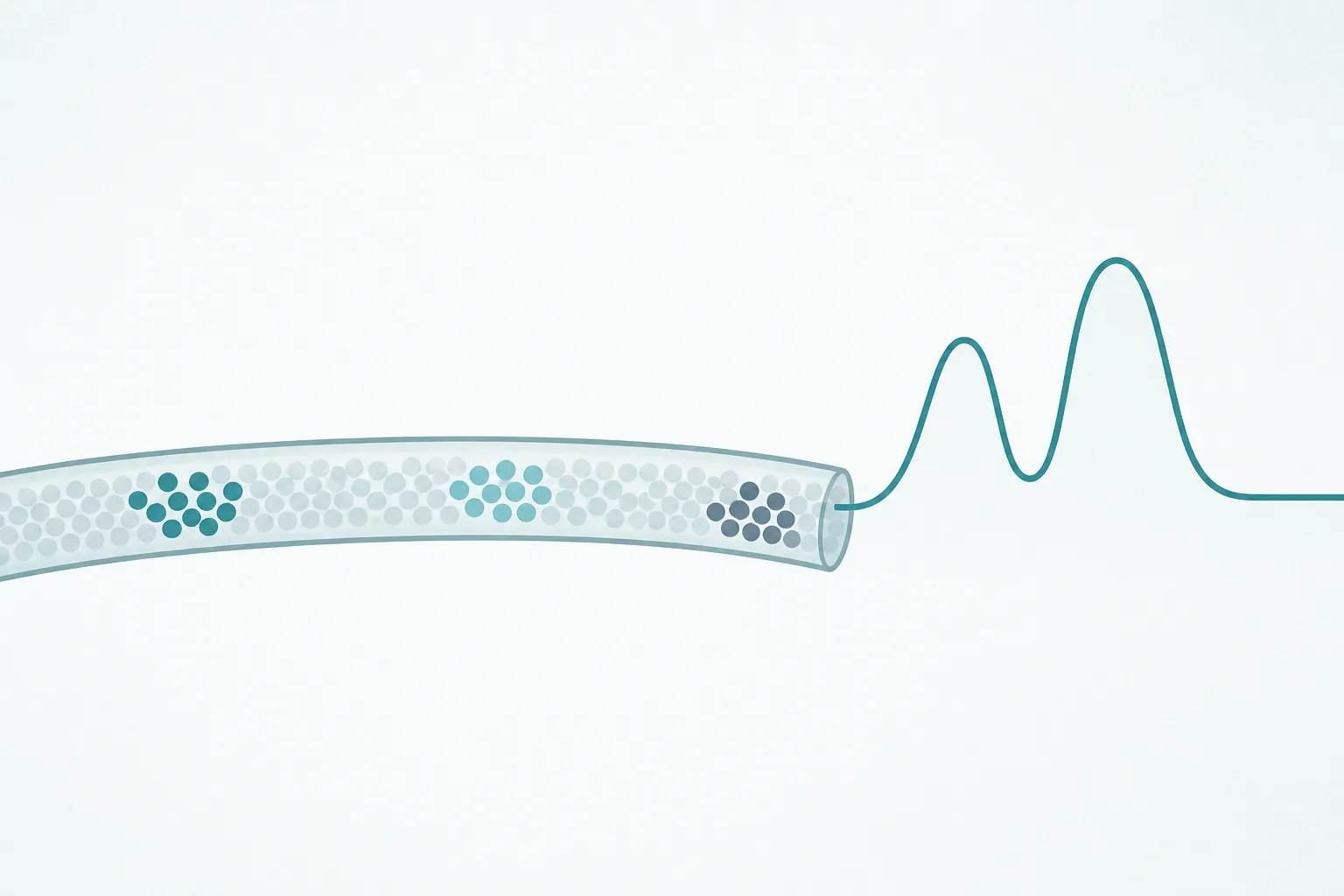
HPLC is a way of pulling a mixture apart so that each thing in it can be seen on its own. You push a small amount of the mixture through a narrow tube packed with tiny beads. Different molecules travel through the tube at different speeds. A sensor at the far end notices each one as it comes out. That is really all it is: a very slow race through a tube, with someone at the finish line writing down who arrived and when.
This site already has a separate article on what a purity figure on a label means. That one is about the number. This one is about the machine that produces it — what actually happens inside the tube, why things come out at different times, and what the bumps on the printout are. You do not need any chemistry for it. You need a race, a crowded corridor, and a little patience.
What the letters stand for
Start with the long word at the end. Chromatography is the formal name for a family of separation methods. The official chemistry definition describes it as a way of separating the parts of a mixture by sharing them out between two things: one that stays still, and one that moves in a set direction 1. The part that stays still is called the stationary phase. The part that moves is called the mobile phase. Phase, here, just means a distinct region of material. Nothing more mysterious than that.
The name itself means colour writing. The earliest versions were used, over a century ago, to separate the coloured pigments in plant leaves, which spread out into visible bands of green and yellow as a liquid carried them down a tube of powder. The colours were the point then. Today almost nothing being separated is coloured, but the name stuck.
Liquid tells you what the moving part is. In HPLC the mobile phase is a liquid, usually water mixed with a solvent. Other kinds of chromatography use a gas instead, which is why the word liquid is there at all.
High performance is the modern bit. Older versions let the liquid drip through by gravity and took hours. HPLC packs the tube with far smaller beads and uses a pump to force the liquid through under high pressure. That combination separates closely related molecules much more sharply, and in minutes rather than an afternoon 2. You will sometimes see the P read as pressure instead of performance. Both describe the same machine.
A very slow race through a tube
Here is the picture to carry. Imagine a long, narrow corridor, packed wall to wall with people standing still. They are the stationary phase. Now a steady stream of walkers is pushed in at one end and has to squeeze all the way through to the exit. The stream is the mobile phase. Somewhere among the walkers are the runners you actually care about: the molecules in your sample.
Every runner gets the same push from behind. What differs is how sociable they are. Some runners barely notice the crowd and slip straight through. Others keep stopping to chat, lingering with each person they brush past, before the stream carries them on again. A chatty runner and an aloof one start at exactly the same moment. They do not finish at the same moment.
That is the entire principle. Nobody is sorting the molecules by hand. Nothing inside the tube knows what anything is. The separation simply falls out of the fact that different molecules spend different fractions of their journey stuck to the beads, and a molecule that is stuck is not moving.
The column is the tube itself. In a typical machine it is roughly the length of a pen, packed very tightly with beads far finer than grains of sand. Fine beads mean a huge amount of surface for molecules to cling to, which is what makes the separation sharp. It is also why a pump is needed. Try pushing water through a tube full of flour and you will see the problem.
Why things finish at different times
So what makes one molecule chattier than another? It depends on what the beads are coated with, and for peptides there is one arrangement that is used far more than any other. It has an awkward name, reversed-phase, and a simple idea behind it 3.
In reversed-phase HPLC the beads are coated with a thin, oily layer. The liquid flowing past them starts out mostly water. Now think about oil and water in a salad dressing. Things that are a bit oily themselves prefer the oily coating and cling to it. Things that are happy in water stay in the stream and move on. The chemistry word for oily in this sense is hydrophobic, which means water-avoiding.
A peptide is a chain of amino acids — small building blocks strung together — and some of those building blocks are oilier than others. So every peptide has its own overall level of oiliness, set by which building blocks it contains and in what order. That is the chattiness from the corridor. A peptide with more oily building blocks clings harder and arrives later 3.
There is one more trick, and it matters. If the liquid stayed the same the whole time, the most clingy molecules might never let go. So the machine slowly changes the liquid as the run goes on, adding more and more solvent and less water. The stream gets steadily better at coaxing oily things off the beads. One by one, in order of how tightly they were holding on, the molecules let go and head for the exit. This gradual change has a name: a gradient 4.
Back in the corridor, it is as if the crowd slowly thins out and loses interest in conversation. The least chatty runners were already gone. The most chatty ones are finally released right at the end.
The finish line: the detector and the trace
At the exit of the column sits a detector. The most common kind shines ultraviolet light, which is light just beyond what our eyes can see, through the liquid as it flows past. Most molecules in a peptide sample absorb a little of that light. When nothing but the plain liquid is passing, the light gets through unchanged. When a group of molecules passes, some of the light is absorbed, and the detector registers the dip 2.
The machine draws this as a line across a screen. Time runs along the bottom. The height of the line shows how much light is being absorbed at each moment. Most of the time the line is flat. When a group of molecules arrives, it rises into a hill and falls back again as they pass. Each hill is called a peak. The whole drawing is called a chromatogram.
The moment a peak appears is its retention time — literally, how long that molecule was retained in the column. Under the same conditions, the same molecule comes out at the same time, run after run 2. That is useful. It means a laboratory can run a known reference sample, note when it appears, and then look for a peak at that same time in a new sample.
| Word | What it means in plain terms |
|---|---|
| Column | The narrow packed tube where the race happens. |
| Stationary phase | The coated beads inside the column. They stay put and hold on to molecules. |
| Mobile phase | The liquid pumped through the column, carrying the sample. |
| Gradient | The slow change in the liquid during a run, which releases clingy molecules in turn. |
| Detector | The sensor at the exit that notices molecules as they pass. |
| Retention time | How long after the start a particular molecule came out. |
| Peak | The hill on the trace that marks one arrival. |
| Chromatogram | The whole trace: every peak from one run, laid out in time. |
What a peak means, and what it does not
A peak tells you three things. Something arrived. It arrived at this particular time. And it absorbed this much light while passing, which is shown by the size of the hill — strictly, by the area under it rather than its height alone.
It does not tell you what the something was. This is the most important point in the whole article, so it is worth saying slowly. The detector does not read names. It sees light being absorbed, and nothing else. A peak at the expected retention time is a strong hint that the expected molecule is there, because that is where it usually turns up. But it is a hint based on timing, not a confirmation of identity.
Think of watching a race from a distance through fog. You know your friend usually finishes in about forty minutes. A figure crosses the line at forty minutes. It is very probably your friend. It could also be a stranger who happens to run at the same pace. To be sure, you would need to see a face. In laboratory terms, seeing the face is a different technique, usually mass spectrometry, which is the subject of the next article in this set.
There is a second limit, and it follows from the first. Two different molecules can run at almost exactly the same pace. If they do, they arrive together and the detector draws a single hill where there should be two. Nothing on the trace warns you. Laboratories reduce this risk by changing the column, the liquid or the gradient and checking whether the single peak splits, but a lone run cannot rule it out 4.
How a race becomes a purity figure
This is where HPLC meets the paperwork. For a peptide sample, a good run usually shows one large peak and a scattering of small ones. The large peak is taken to be the intended peptide. The small ones are other things: mostly near-copies of the peptide that came out slightly wrong when it was built, missing a building block here or carrying an extra one there 4.
A purity figure is then worked out by adding up the areas of all the peaks and asking what share of that total belongs to the big one. If the big peak makes up ninety-eight parts in every hundred of the total area, the figure reads ninety-eight per cent. What that figure does and does not mean on a label is covered in the separate purity article, so here is only the part that follows directly from the race.
The figure can only include what the detector saw. Anything that does not absorb the light, or never came out of the column, or hid under the main peak, is simply not in the sum. That is not dishonesty. It is the edge of the method. A purity figure is a statement about one race, run one way, watched by one kind of sensor.
What HPLC cannot tell you
It helps to have the limits in one place, because they are exactly the questions people most often assume HPLC has answered.
- What a peak is. HPLC separates and times. Naming a molecule needs a second technique, usually mass spectrometry.
- Whether two things are hiding in one peak. Molecules that run at the same pace arrive together and look like one.
- How much material is in a container. A share of peak area is a proportion, not an amount.
- Anything the detector cannot see. Water, many salts and some leftover chemicals give little or no signal with ultraviolet light, so they do not appear in the sum.
- Whether anything living is present. Bacteria and their leftovers are questions for separate tests entirely.
- Whether the result would be the same elsewhere. A different column or gradient can split peaks that this run merged, so the method used matters.
None of that makes HPLC weak. It is one of the most widely used measurements in chemistry because it is very good at the job it actually does 2. The trouble only starts when it is asked to answer questions it was never built for.
The one picture to keep
If you forget everything else, keep the corridor. A mixture goes in at one end. A packed tube slows each kind of molecule by a different amount, depending on how strongly it clings. They come out one after another, and a sensor at the exit draws a hill each time something passes.
From that one picture, the rest follows on its own. Things finish at different times because they cling differently. A peak is an arrival, not a name. Two runners at the same pace can cross the line as one. And a purity figure is a share of the hills, which is a real and useful thing to know, and a narrower thing than it looks.
The next article in this set picks up exactly where the fog in the race leaves off: how a laboratory sees the runner's face, by weighing a molecule.