words you keep seeing
What Is an Agonist?
An agonist is a molecule that fits a receptor and switches it on. That one line is true, and it hides nearly everything interesting about the word: switching on comes in degrees, it can even run backwards, and it tells you much less about a drug than it seems to.
An agonist is a molecule that fits a receptor and switches it on, so that the cell does whatever that receptor normally tells it to do. A receptor, as a quick reminder, is a structure a cell builds, usually on its outer surface, that one particular kind of molecule fits into. When the right molecule settles in, the receptor changes shape and the cell responds. The word agonist comes from the Greek for a contestant: someone who steps into the arena and takes part, rather than watching from the stands.
If you have read our piece on receptors, you have already met this word in a single line, next to its opposite, antagonist. This article is about what that single line leaves out. Switching on is not all or nothing. A molecule can turn a receptor up a little, all the way, or even below where it started. And agonist, one of the most precise words in any drug description, tells you surprisingly little about whether that drug does anyone any good.
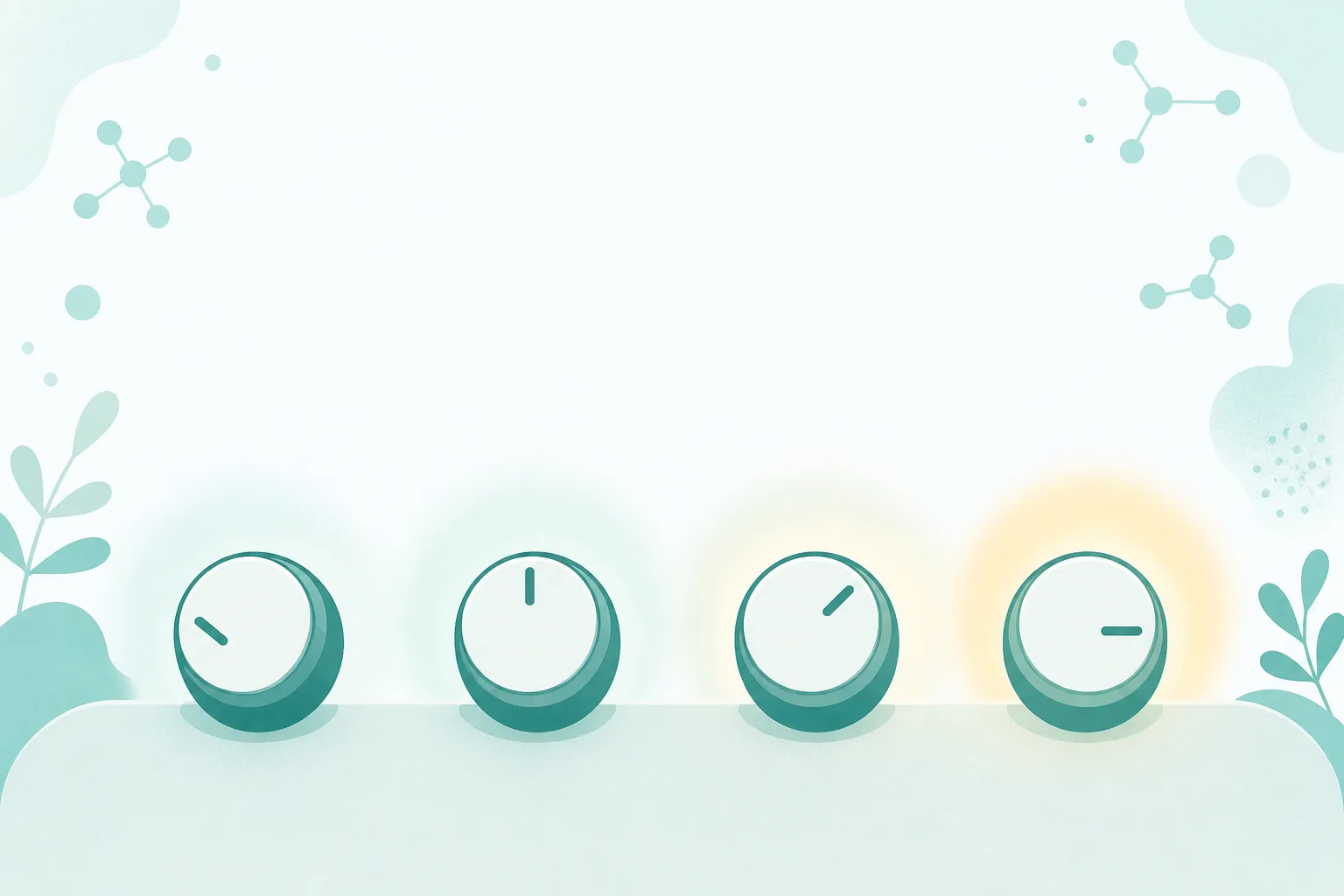
A dimmer, not a light switch
Most explanations picture a receptor as a light switch. The agonist arrives, the switch flips, the light comes on. That picture is fine for a first meeting, and it quietly misleads you about everything that comes after.
A better picture is a dimmer. A dimmer has a whole range, from dark to fully bright, and it can sit anywhere along it. Receptors behave much more like that. An agonist turns the dimmer up. How far up depends on the molecule.
There is one more detail that makes the dimmer picture even more useful. Many receptors are never completely dark. Even with nothing sitting in them, they flicker on now and then by themselves, giving the cell a faint background glow. Pharmacologists call this constitutive activity, which simply means activity the receptor has on its own, without being asked 4. Keep that faint glow in mind. It becomes important in a moment.
Holding on and turning up are two different things
Here is the idea that unlocks the rest of the subject. What an agonist does depends on two separate properties, and they are measured separately 23.
The first is affinity: how strongly the molecule holds on to the receptor. A molecule with high affinity finds the receptor and stays put. One with low affinity drifts in and out, and spends much of its time elsewhere.
The second is efficacy: once the molecule is sitting in the receptor, how far it turns the dimmer. High efficacy means a big response every time it lands. Low efficacy means a small one.
Think of guests arriving at a quiet party. Affinity is how long a guest stays. Efficacy is how much that guest livens up the room while they are there. Some guests stay all evening and barely say a word. Others drop by for five minutes and have everyone laughing. The two qualities are unrelated, and you would describe each guest by both.
Molecules work the same way. A molecule can grip a receptor tightly and turn the dimmer hardly at all. Another can grip loosely but turn it all the way whenever it lands. The extreme case of the first kind is a blocker, which holds on firmly and turns nothing. That is exactly what an antagonist is: all affinity, no efficacy 2.
A third word gets mixed in with these two, and it causes a great deal of confusion. Potency describes how little of a molecule is needed to produce a given response. A potent molecule gets there at very low concentrations, concentration meaning how much of something is dissolved in a given amount of liquid. Potency comes from affinity and efficacy together, which is why it can mislead 2. A very potent molecule is not necessarily one that can produce a large response. It may simply produce a modest response at a tiny concentration.
| Word | Plain meaning | What it does not tell you |
|---|---|---|
| Affinity | How strongly a molecule holds on to its receptor | Whether holding on switches anything on |
| Efficacy | How far the receptor is turned up once the molecule is in place | How easily the molecule finds and stays in the receptor |
| Potency | How little of the molecule is needed to get a response | How big the biggest possible response is |
Full, partial and inverse: the whole range
With the dimmer in hand, the family of agonist words sorts itself out neatly.
A full agonist turns the dimmer all the way up, to the brightest response that particular cell can produce. A partial agonist is defined by the International Union of Pure and Applied Chemistry, the body that standardises chemical vocabulary, as an agonist that cannot fully activate the receptors it acts on, however much of it is present 1. It fits perfectly well. It simply cannot turn the dimmer past a certain point.
That limit has a consequence that surprises almost everyone. Imagine a room where a full agonist has the dimmer turned right up. Now add a partial agonist. It competes for the same receptors, and every receptor it occupies is turned up less than before. The room gets darker. So the same partial agonist can act like an on-switch in a quiet room and like a brake in a bright one. Whether it seems to switch things on or hold them back depends on what else is already there 3.
Then there is the antagonist, which fits the receptor and holds the dimmer wherever it already was. Its effect comes from occupying the space, so that nothing else can turn the receptor up while it sits there 1.
Last comes the strangest member of the family. Remember the faint background glow that many receptors have on their own? An inverse agonist turns the dimmer below that resting level. It is defined as a molecule that acts at the same receptor as an agonist but produces the opposite effect 1. Once researchers could measure background activity reliably, some drugs that had been filed as plain antagonists for years turned out to be doing this all along 4.
- Full agonist: turns the receptor all the way up.
- Partial agonist: turns it part of the way, and no further however much is present. Can act as a brake when a full agonist is around.
- Antagonist: fits and holds the receptor where it is, keeping everything else out.
- Inverse agonist: turns the receptor below its own background level.
Your own body is full of agonists
Agonist sounds like a word from a pharmacy. It is not. The first agonist at any receptor is the body's own messenger, and the standard definition covers both cases on purpose: an agonist can be an endogenous substance, meaning one made inside the body, or a drug 1.
Insulin is an agonist at the insulin receptor. GLP-1, a hormone your gut releases when you eat, is an agonist at the GLP-1 receptor 5. Every hormone you have heard of is an agonist somewhere. The body invented the job long before chemists did.
A drug described as an agonist is simply an outside molecule doing the same job as one of those inside ones. Sometimes it is a close copy of the natural messenger with a few deliberate changes. Sometimes it looks quite different on paper and still manages to turn the same dimmer. Either way, the word describes the effect at the receptor, not what the molecule is made of.
Why every GLP-1 article uses the word
If you have read anything about the newer diabetes and weight medicines, you have seen the phrase GLP-1 receptor agonist over and over. Now it reads as a plain sentence: a molecule that fits the GLP-1 receptor and turns it up, the way the body's own GLP-1 does. Semaglutide and liraglutide are described this way 5.
The newer names add a count. Tirzepatide was designed to switch on two receptors: the GLP-1 receptor and the receptor for GIP, another gut hormone released around meals. That is why it is called a dual agonist 6. Retatrutide was built to switch on a third as well, the receptor for glucagon, a hormone that tells the liver to release stored sugar, which is why the trial that introduced it called it a triple agonist 7.
There is a subtlety worth knowing here. A molecule that switches on two or three receptors does not have to turn every dimmer the same distance. Designers tune the balance deliberately, making a molecule stronger at one receptor than another, and that balance is part of what separates one multi-receptor molecule from the next 6. The words dual and triple give you the count. They do not give you the balance.
And none of these labels tells you about outcomes. A triple agonist is not three times better than a single one, and a dual agonist is not twice as good. The count is a description of the mechanism, and the only way to learn what a mechanism achieves is to test it.
Same molecule, different verdicts
One more thing makes agonist a slippery word. It is not really a property of a molecule on its own. It describes a relationship between one molecule and one receptor.
So the same molecule can be an agonist at one receptor and an antagonist at another. Receptors come in families with similar shapes, and a molecule that turns one family member up may simply sit in a cousin and block it. Calling a molecule an agonist without naming the receptor is like calling someone a goalkeeper without saying which team.
It goes further than that. The very same molecule, at the very same receptor, can look like a full agonist in one tissue and a partial agonist in another 3. Tissues differ in how many receptors their cells carry and in how much amplification sits behind each receptor, amplification being the way a small signal at the surface grows larger as it is passed along inside the cell. In a tissue crowded with receptors, a modest push at each one can add up to the maximum response, and a partial agonist looks full. In a tissue with few receptors, the same molecule falls visibly short.
This is one reason results from a dish of cells do not always carry over to a living animal. The cells in the dish were often engineered to carry large numbers of the receptor being studied, which flatters any agonist placed on them.
What the word does not tell you
Agonist is a precise word about one small event: a molecule meeting a receptor and turning it up. Everything that decides whether that event matters happens outside the word.
- How long the molecule lasts before the body clears it away.
- Whether it reaches the tissues that carry the receptor, in a living body rather than a dish.
- Which other receptors it also touches, and what it does at each of them.
- How far it turns the dimmer in real tissue, rather than in cells engineered to carry extra receptors.
- Whether the resulting change is large enough to matter, and whether anyone wants it.
- Whether any of this was measured in cells, in animals, or in people.
Reading the word from now on
When you next meet a sentence like "this compound is a receptor agonist", you can unpack it into something much more useful. Which receptor? Full or partial? Measured in what: cells, animals, or people? And was anything measured beyond the receptor being turned up?
Those four questions turn a word that sounds like a conclusion back into what it really is: a description of the first step. The first step matters. Every medicine that works through a receptor has to take it. But it is the beginning of the story, and the word agonist, for all its precision, stops right there.
References
- Glossary of terms used in medicinal chemistry (IUPAC Recommendations 1998)
- International Union of Pharmacology Committee on Receptor Nomenclature and Drug Classification. XXXVIII. Update on terms and symbols in quantitative pharmacology
- Principles: receptor theory in pharmacology
- Constitutive activity and inverse agonists of G protein-coupled receptors: a current perspective
- Mechanisms of Action and Therapeutic Application of Glucagon-like Peptide-1
- LY3298176, a novel dual GIP and GLP-1 receptor agonist for the treatment of type 2 diabetes mellitus: From discovery to clinical proof of concept
- Triple-Hormone-Receptor Agonist Retatrutide for Obesity — A Phase 2 Trial