words you keep seeing
What Is an Analogue?
An analogue is a copy of a natural molecule with deliberate edits. Here is why the edits are made, how far a copy can drift before it stops being a copy, and how drug names quietly tell you which family an analogue belongs to.
A peptide analogue is a copy of a natural peptide with deliberate edits. It starts from the sequence of something the body already makes, a hormone for example, and changes a small part of it on purpose: one amino acid swapped for another, a piece trimmed off, something attached. The formal definition is broader. An analogue is any drug whose structure is related to that of another substance, while its chemical and biological properties may be quite different 1. That last clause is the one worth remembering.
The word appears constantly in descriptions of modern medicines, usually as GLP-1 analogue or insulin analogue, and it is easy to read it as "basically the same as the hormone". It is not. This article is about what an analogue keeps, what it changes and why, and how to tell from a name alone which family an analogue belongs to. The spelling analog means exactly the same thing. It is simply the American form of the word.
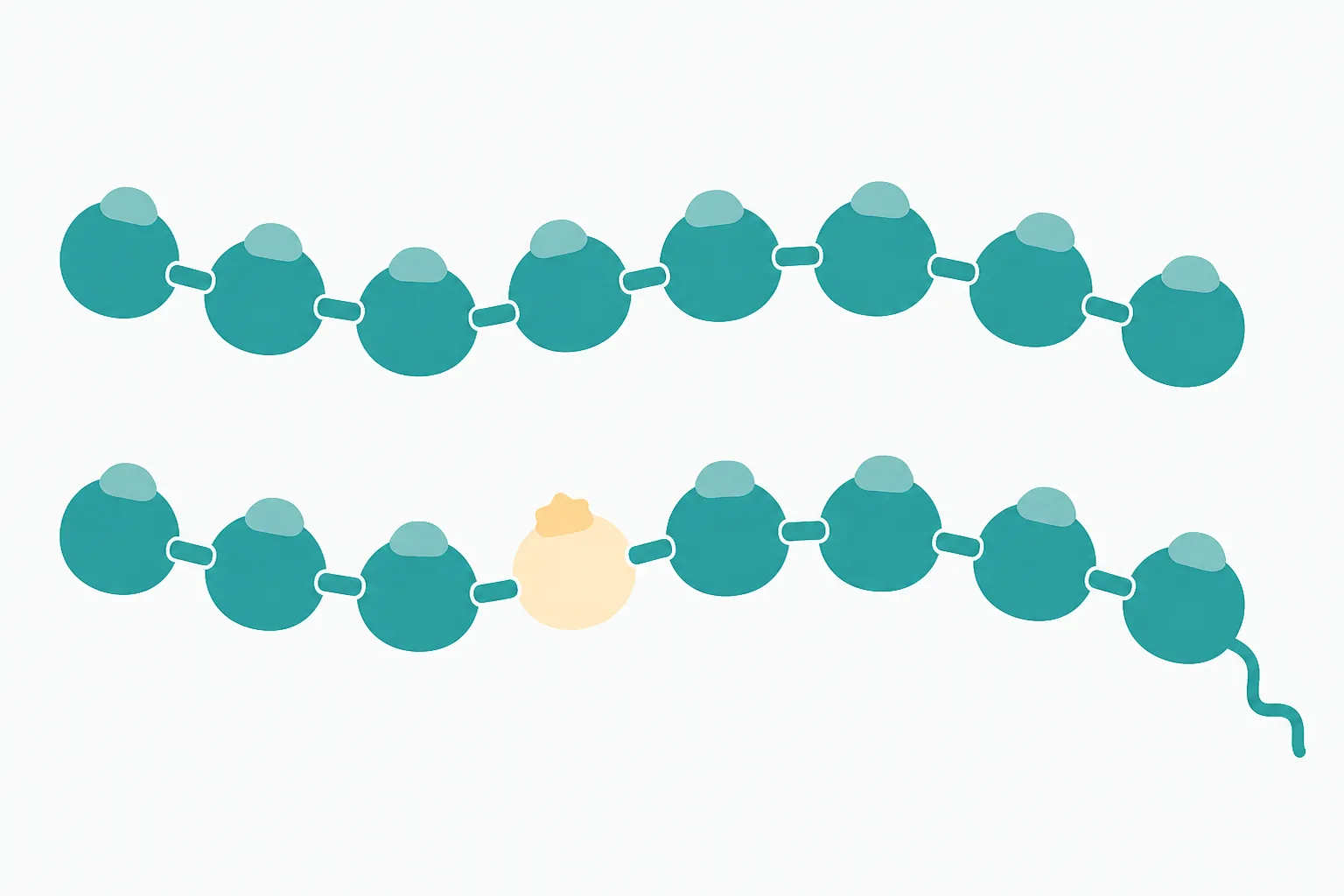
A copy with edits
Imagine a recipe that your family has cooked the same way for generations. It works beautifully, but it spoils within a day. So someone keeps almost everything, the ingredients, the order, the method, and changes one step so the dish keeps for a week. Everyone still recognises it. But it is no longer the original recipe, and anyone who wants to know whether the new version is as good has to taste it, not just read the old reviews.
A peptide analogue is that edited recipe. The starting point is the natural sequence: the exact order of amino acids, the small building blocks that link together to make peptides. The analogue keeps most of that order, because the order is what lets the molecule fit its receptor, the structure on a cell that a particular molecule fits into. Then it changes a few carefully chosen places.
The kinds of edit are few, and they come up again and again:
- Swap. One amino acid is replaced with a different one, sometimes one of the standard twenty, sometimes an unusual building block that does not occur in nature.
- Trim. The chain is cut down to the shortest stretch that still does the job.
- Attach. Something extra is fixed to the chain, often a fatty tail that makes it cling to proteins in the blood.
- Close. The two ends are joined into a ring, so the chain has no loose end for enzymes to start on.
Each edit is small on paper. Their effects can be very large.
Why anyone edits a hormone
If the body's own molecule already works, why change it? Almost always because it works too briefly, too broadly, or at the wrong speed.
Too briefly is the most common reason. Natural peptide messages are built to disappear quickly. Enzymes, proteins whose job is to cut other molecules apart, snip them within minutes, and the kidneys filter away what is left. That fleeting life is exactly right for a signal that says "a meal has just arrived", and hopeless for a medicine. So most analogues are edited, first and foremost, to survive.
Somatostatin is a good example. It is a natural hormone that, among other things, holds back the release of growth hormone, and it lasts only minutes in the blood. In the early 1980s, chemists built a much shorter ring-shaped analogue, only eight amino acids long, that kept the part of somatostatin responsible for its effect, resisted being cut apart by enzymes, and acted for far longer than the natural hormone 3. That molecule became the medicine octreotide.
Too broadly is the second reason. Many natural hormones act on several related receptors at once. An analogue can be edited so it fits one of those receptors well and the others poorly, which narrows what it does. The same early octreotide work described the new molecule as selective as well as long-acting, meaning it favoured some of somatostatin's effects over others 3.
The wrong speed is the third. Insulin shows this neatly. Natural human insulin molecules tend to cluster together in small groups after injection, and they have to separate before they can be absorbed, which slows them down. Some insulin analogues swap just one or two amino acids so that the molecules cluster less and are absorbed faster. Others are edited the opposite way, to be absorbed slowly and steadily 4. Same hormone, same receptor, different clocks.
There is a fourth possibility that surprises people. An edit can change not just how long a molecule works, but what it does at the receptor. A molecule that switches a receptor on is called an agonist. A molecule that fits the same receptor but blocks it is called an antagonist. A small change in sequence can be enough to turn one into the other, which is why some analogues of natural hormones are used to block the very receptor the original hormone switches on.
GLP-1 analogue versus the hormone
The most talked-about analogues today copy GLP-1, a hormone your gut releases when you eat. The natural hormone lasts about two minutes in the blood. Liraglutide and semaglutide are GLP-1 analogues: they keep most of the natural sequence, so they fit the same receptor, and they carry edits that let them last far longer 2.
Our article on GLP-1 medications explains the edits themselves. The point for this article is what follows from them. An analogue is a different molecule from the hormone. It lasts differently, it moves around the body differently, and it may reach tissues in different amounts. The development story of these two molecules is a long record of exactly that: each edit had to be tested for what it changed, not assumed to be harmless 2.
So when you read that the natural hormone does something, that tells you only a little about what an analogue does, and the reverse is true too. The same caution applies between analogues. Two GLP-1 analogues share a family and a receptor. They do not share a body of evidence. Each has to be studied on its own.
| Usually kept | Usually changed |
|---|---|
| The receptor it fits | How long it survives in the body |
| Most of the amino acid sequence | A few chosen positions in the sequence, or an attachment |
| The broad kind of message it sends | How strongly or selectively it sends it, and sometimes whether it switches on or blocks |
| The family name | The evidence, which has to be gathered again for each new molecule |
How close does a copy have to be?
There is no fixed rule for how many edits a molecule can carry and still be called an analogue. The word covers a spectrum.
At one end sit analogues that differ from the natural hormone by a single amino acid. Some insulin analogues are like this, differing from human insulin by one or two positions out of about fifty 4. At the other end sit molecules that have been edited so heavily that they share little with the original beyond the receptor they fit. Octreotide, eight amino acids long, is modelled on a hormone several times its length 3.
Further still along the spectrum is a related word you may meet: peptidomimetic. That describes a compound that contains parts which are not peptide at all, yet still copies or blocks the action of a natural peptide 1. Think of it as a copy of the recipe that swaps some of the ingredients for different ones entirely, while still producing something that tastes like the dish.
Remember the formal definition from the start of this article: an analogue's structure is related to the original's, while its properties may be quite different 1. The word promises resemblance in structure. It promises nothing about behaviour.
Names that tell you the family
Here is a small piece of knowledge that makes drug names far less mysterious. Medicines are given official generic names through a system run by the World Health Organization, and those names are built from pieces called stems. A stem is a shared word ending, or sometimes beginning, that marks every member of a family 5.
Peptides in general tend to end in -tide. GLP-1 analogues have their own, more specific stem: -glutide 5. That is why liraglutide, semaglutide and dulaglutide all end the same way. The ending is not a coincidence or a marketing choice. It is the naming system telling you, in plain sight, that these molecules belong to the same family of analogues.
Other peptide families have their own stems, and once you know to look for them you will start to see them everywhere. They make it possible to place an unfamiliar name in a family at a glance. What they cannot do is tell you how that particular family member differs from its siblings. The stem gives you the family. The molecule still has to be looked up.
Reading the word from now on
When you next meet the phrase "an analogue of", it helps to hear it as "a deliberately edited copy of". Then three questions follow naturally. What was the original? What was changed, and why? And has the edited version been studied in its own right, or is it borrowing its reputation from the molecule it copies?
The first two questions are usually easy to answer. The third is the one that matters most, and the one most often skipped. An analogue is a family resemblance, not an identity. The resemblance is why it fits the receptor. The differences are the whole reason it exists.
References
- Glossary of terms used in medicinal chemistry (IUPAC Recommendations 1998)
- The Discovery and Development of Liraglutide and Semaglutide
- SMS 201-995: a very potent and selective octapeptide analogue of somatostatin with prolonged action
- Insulin analogues
- Use of stems in the selection of International Nonproprietary Names (INN) for pharmaceutical substances, 2024