words you keep seeing
What Is a Peptide Bond?
It is the link that joins one amino acid to the next. Here is how it forms, why a molecule of water leaves when it does, why it gives every chain a front and a back, and why it can last centuries in a bottle yet be cut in seconds in your gut.
A peptide bond is the link that joins one amino acid to the next in a chain. It forms when the acid end of one amino acid connects to the amino end of the next, and as the two join, a single molecule of water is released 1. Every peptide, and every protein in your body, is a string of amino acids held together by these links, one after another.
If you have read our piece on amino acids, you already know the beads: what an amino acid is, why there are twenty, and what makes each one different. This article is about something else. It is about the clip between the beads. How the clip forms, why it is flat and stiff rather than floppy, why it gives every chain a front and a back, and why the same link that survives for centuries in plain water can be snipped in seconds inside your gut.
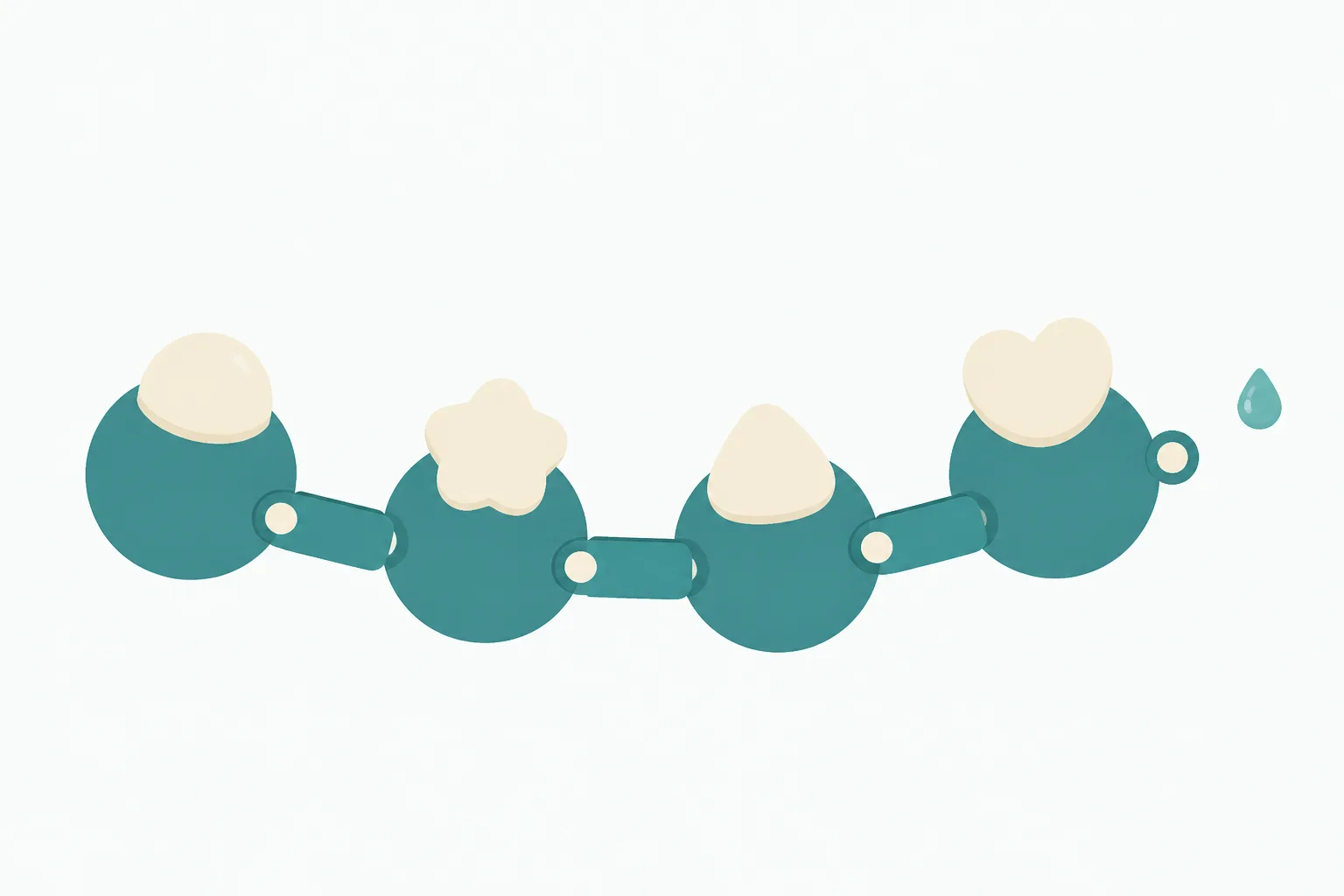
The beads and the clip
The easiest way to picture a peptide is as a string of beads. The beads are amino acids, and they differ from one another. The clips between them do not. Every clip in every chain is the same link, formed the same way, whether it joins the smallest amino acid to the largest or two identical ones side by side.
That sameness has a name. The unbroken spine made of repeated links, running the whole length of the chain, is called the backbone 6. The side chains, the parts that make each amino acid different, hang off that backbone like charms off a bracelet. Two peptides can have completely different charms and still share an identical bracelet underneath.
Chemists have a more general name for this kind of link: an amide bond. An amide bond forms whenever an acid group joins a nitrogen-containing group in this particular way. When the two partners are amino acids, the amide bond is given its own name, the peptide bond 1. So a peptide bond is a special case of something chemists meet everywhere, which is part of why they know so much about it.
What happens when two amino acids join
Every amino acid has two reactive ends. At one end sits the amino group, a small cluster built around a nitrogen atom. At the other sits the acid group, a cluster built around a carbon atom with oxygen attached.
When two amino acids join, the carbon atom of the first one's acid end bonds directly to the nitrogen atom of the second one's amino end 2. To make room for that new connection, a few atoms have to leave. The acid end gives up an oxygen and a hydrogen. The amino end gives up a hydrogen. Those three atoms, two hydrogens and an oxygen, drift away together as one ordinary molecule of water.
Chemists call this kind of reaction a condensation, meaning a reaction in which two molecules join and a small molecule, very often water, is released. Run the same reaction in reverse, pushing a water molecule back into the link, and the bond splits. That reverse reaction is called hydrolysis, from the Greek for water and loosening. Hold on to that word. It explains the most surprising part of this story.
One small piece of vocabulary falls out of all this. Once an amino acid has joined a chain, it is no longer quite a complete amino acid, because it has lost atoms to the departing water. What remains in the chain is called a residue 2. That is why research papers describe a peptide as having so many residues rather than so many amino acids. The two words mean nearly the same thing, and residue is the more exact one.
Why the chain has a direction
Look at what is left after two amino acids join. The new pair still has a free amino end on one side and a free acid end on the other. Those two ends are chemically different. So the chain, however long it grows, always has a distinct beginning and a distinct end.
The two ends have names. The end with the free amino group is the N-terminus, N for the nitrogen at its centre. The end with the free acid group is the C-terminus, C for the carbon in its acid group 2. By long-standing convention, a sequence is always written starting from the N-terminus and finishing at the C-terminus.
This matters more than it sounds. Take glycine and alanine. Join glycine's acid end to alanine's amino end and you get one molecule. Join them the other way round and you get a different one. Same two ingredients, a different arrangement of atoms, a different molecule. It is like a train with an engine at the front and a guard's van at the back: swap the order of two carriages and it is still a train, but it is no longer the same train.
Your cells respect this direction too. They build every chain starting from the amino end, adding each new amino acid at the acid end of the growing chain. Chemists making peptides in a laboratory usually do the opposite, anchoring the acid end first and working back towards the amino end. Both routes end at the same molecule. They simply start from different ends of it.
A flat, stiff link
Here is something you would never guess from a drawing on a page. The peptide bond does not swivel.
Most single links between atoms rotate freely, like a wheel on an axle. The peptide bond behaves partly like a double bond instead, because the electrons that hold it together are shared across the link in a way that locks it in place 2. The result is that the atoms immediately around each peptide bond lie flat, in one plane, like a small rigid plate.
So the backbone of a peptide is not a smooth, bendy string. It is a series of flat plates joined by pivots. The plates themselves never bend. All of the chain's flexibility comes from the joints either side of each plate, which can rotate 2. Picture a folding carpenter's ruler: the wooden sections stay straight, and the ruler takes its shape entirely from how the hinges are set.
This fact had enormous consequences. In the early 1950s, Linus Pauling and his colleagues took the flat, rigid link as a firm rule, measured from small molecules, and asked which shapes a chain of such plates could adopt. One answer was a spiral, now known as the alpha helix, which later turned up throughout real proteins 3. The stiffness of one small link was enough to predict a shape that no one had yet seen.
There is one more detail about how the plates sit. The side chains on either side of a peptide bond almost always end up on opposite sides of it, because putting them on the same side would make them bump into each other 2. That preference narrows the possible shapes still further, which is part of why a given sequence tends to fold the same way every time.
Tough in water, quick to cut
Now the puzzle that makes this link so interesting. Remember hydrolysis, the reaction that pushes water back into the bond and splits it? In the long run, water wins. A peptide bond sitting in water is always, slowly, on its way to coming apart.
But slowly is the key word. Researchers who measured how fast simple peptide bonds break in neutral water at room temperature, with nothing to help the reaction along, estimated that it takes several hundred years for half of them to break 5. Left alone, the link is one of the most patient structures in chemistry.
Then why does a protein in your lunch fall apart within hours? Because your digestive system does not wait for water to do the job alone. It uses enzymes called proteases, proteins whose whole purpose is to cut peptide bonds. A protease holds the bond in exactly the position where water can attack it easily, and the reaction that would have taken centuries happens in a fraction of a second. The gap between those two speeds is a measure of just how good enzymes are at their jobs 5.
So the peptide bond is tough and fragile at once, depending entirely on company. Dry, cool and enzyme-free, it lasts almost indefinitely. Warm, wet, acidic, or in the presence of the right enzyme, it gives way. That single fact sits underneath two very different subjects elsewhere on this site: why peptides are stored dry, and why swallowing one rarely works.
Making the bond takes work
If water pushes the link towards breaking, then making it means pushing the other way. A peptide bond does not form on its own when two amino acids happen to meet in water. Something has to supply the energy and hold the pieces in place.
In your cells, that something is the ribosome, a large molecular machine that reads genetic instructions and builds chains to match. Each amino acid arrives already primed, carried on a small adaptor molecule that holds it in an energised state. The ribosome lines up the growing chain and the incoming amino acid so the new link can form. When researchers finally mapped the ribosome's working core in atomic detail, they found that the part making the bond is built of RNA, a close chemical relative of DNA, rather than of protein 4. The machine that makes every protein in your body makes its most basic link with something that is not itself a protein.
Chemists face the same energy problem without a ribosome. Their answer has two parts. First, they treat the acid end of an amino acid with chemicals that make it eager to react, a step called activation. Second, they cover every other reactive part of the amino acid with a temporary chemical cap, called a protecting group. Without those caps, amino acids would join each other at random, in every direction, and the result would be a useless tangle. With them, only the one intended link can form, and the caps are removed afterwards.
What a peptide bond is not
Three different links turn up in writing about peptides, often in the same paragraph, and it helps to keep them apart. Only one of them is the peptide bond. The other two do different jobs and break under different conditions 6.
| Link | What it joins | How strong | What it does |
|---|---|---|---|
| Peptide bond | The acid end of one amino acid to the amino end of the next | Strong; centuries to break in plain water | Forms the backbone of every chain |
| Disulfide bridge | Two sulfur-containing amino acids, often far apart along the chain | Strong, but can be opened by certain chemical conditions | Staples a folded chain into shape, or holds two chains together |
| Hydrogen bond | Slightly charged atoms on nearby parts of the chain | Weak individually; break and re-form constantly | Holds coils and folds in place, many at a time |
The difference matters when you read about a peptide losing its shape. A chain can come unfolded, with its hydrogen bonds broken, while every peptide bond in it stays intact. The sequence is unchanged, even though the shape is gone. Breaking peptide bonds is a different and more final thing: the chain itself is cut into pieces.
One link, everywhere
A peptide bond is a small thing. A handful of atoms, one departing molecule of water, one flat plate in a chain of plates. And yet almost everything distinctive about peptides traces back to it.
It is why every chain has a direction, and why the same amino acids in a different order make a different molecule. It is why chains fold into particular shapes rather than any shape at all. And it is why a peptide can sit unchanged for years as a dry powder, then come apart within minutes once the right enzyme finds it. Next time you meet the phrase peptide bond, you can picture the clip rather than the bead: identical everywhere, stiff as a plate, patient in water, and helpless against an enzyme.
References
- peptides (IUPAC Compendium of Chemical Terminology, the Gold Book)
- Biochemistry, Peptide
- The structure of proteins; two hydrogen-bonded helical configurations of the polypeptide chain
- The structural basis of ribosome activity in peptide bond synthesis
- Rates of Uncatalyzed Peptide Bond Hydrolysis in Neutral Solution and the Transition State Affinities of Proteases
- The Shape and Structure of Proteins (Molecular Biology of the Cell, 4th edition)