words you keep seeing
What Is Bioavailability?
Bioavailability is the share of a substance that actually reaches your bloodstream, and how quickly it gets there. It sounds like a technical footnote. It is the reason the route matters as much as the molecule, and the reason the word on a label deserves a second look.
Bioavailability is the share of a substance that reaches your bloodstream intact, together with how quickly it gets there. If you took in a hundred molecules of something and forty arrived in your blood unchanged, its bioavailability by that route would be forty percent. The United States drug regulator defines it formally as the rate and extent to which the active ingredient is absorbed and becomes available where it acts 1. Extent means how much. Rate means how fast.
The word turns up in drug descriptions, in research papers, and increasingly on supplement labels, usually as a boast. This article explains what the number actually measures, why the route a substance takes changes it so much, and why a peptide swallowed as a pill scores so badly. It also explains why the same word on a label often means far less than it does in a laboratory.
A fraction, measured against a vein
Every fraction needs something to be a fraction of. For bioavailability, the reference point is delivery straight into a vein, which pharmacologists call intravenous. A substance placed directly into the blood has, by definition, skipped every barrier there is. So its bioavailability is taken to be complete, a hundred percent, and every other route is compared against it 23.
Think of it like a delivery firm judging its routes. The direct van that drives straight to the door is counted as perfect. Then every other route, whether by post, by courier or by a chain of handovers, is scored by how many parcels arrive intact compared with the direct van. Bioavailability is that score.
How do researchers actually get the number? They cannot count molecules one by one. Instead they give the substance by the route they are interested in, take blood samples over the following hours, and measure how much is present in each one. Plotted over time, those measurements make a rising and falling curve. They then do the same with delivery into a vein, and compare the total amount under the two curves 3. If the route being tested produces a curve with half the total of the vein curve, its bioavailability is about half.
The shape of the curve carries the other half of the definition, the rate. Two routes can deliver the same total amount, one in a sharp early peak and the other in a slow, flat rise lasting many hours. Their extent is identical. Their rate is not, and for some purposes that difference matters just as much 12.
Where the missing share goes
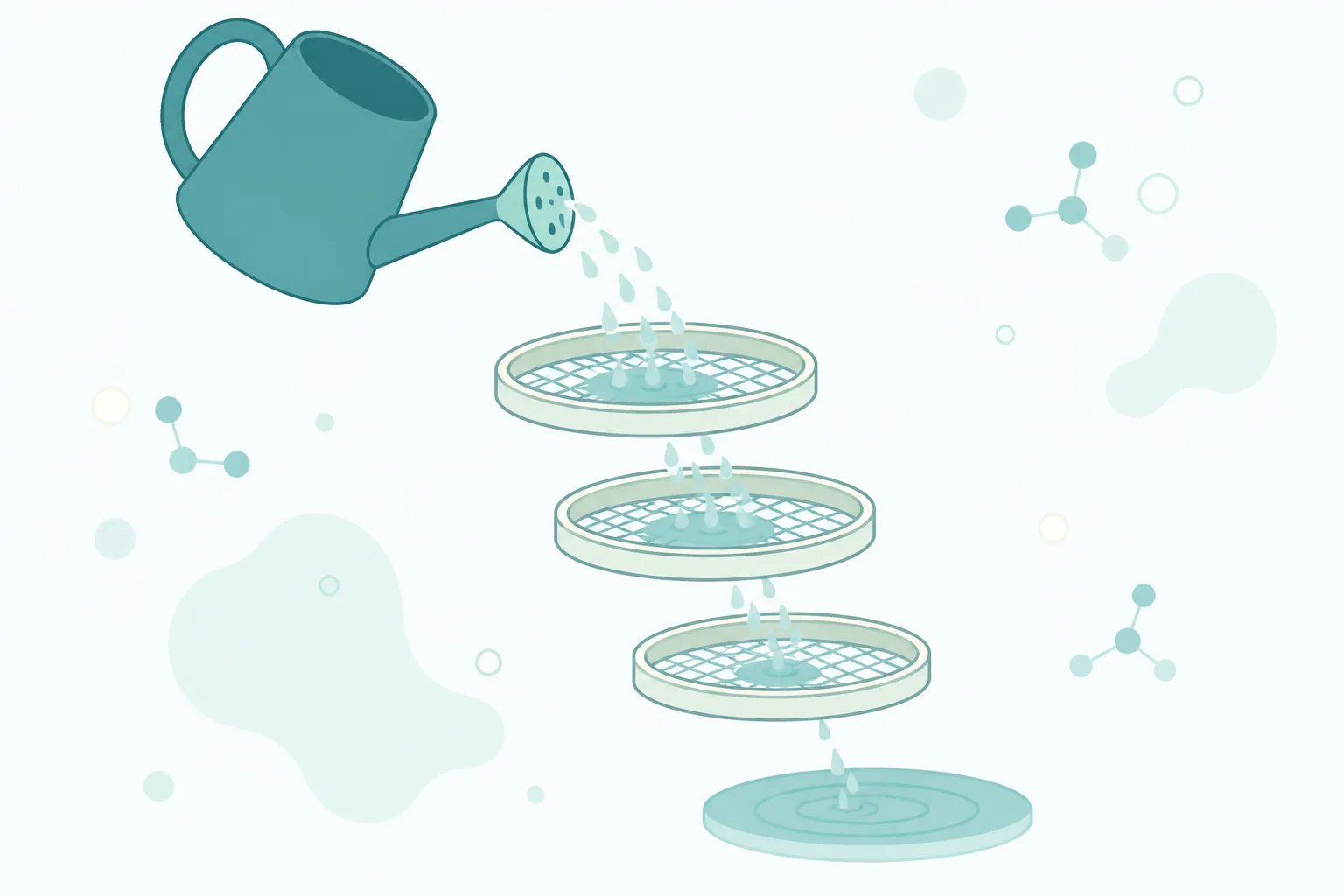
If the direct route counts as complete, then any other route's shortfall has to be going somewhere. It helps to picture a series of sieves, each one holding some of the substance back before it can reach the blood 2.
- Release. The substance has to come out of whatever it was delivered in, whether a tablet, a capsule or a gel. If it never fully dissolves, some of it never gets the chance to be absorbed.
- Survival. Before it can cross into the blood, it has to survive its surroundings, which may include acid and enzymes, proteins whose job is to speed up one particular chemical reaction, such as cutting other molecules apart.
- Crossing. It then has to pass through a living barrier, such as the wall of the gut or the tissue under the skin. Large or strongly charged molecules cross poorly.
- The first pass. Anything absorbed from the gut travels first to the liver before reaching the rest of the body. The liver can alter or remove a large share on that first trip, which is called first-pass metabolism.
Bioavailability is what is left after all of those sieves have taken their share. A substance can fail at any one of them, and it only takes one bad sieve to make the final number small 3.
Why the number is so low for a swallowed peptide
We have a whole article on why most peptides cannot be swallowed, so here is only the part that connects to this word. A peptide, a short chain of amino acids, meets the worst possible version of almost every sieve on the list. The gut is full of enzymes built to cut exactly that kind of chain. The gut wall has no doorway sized for a whole peptide. And the handful of molecules that do get across still face the liver.
The result is an oral bioavailability that is usually well under one percent for an ordinary peptide, and very often far lower than that 5. That figure is not a reflection of a bad product or a poor batch. It is what the chemistry of the gut predicts for this kind of molecule.
One quieter problem hides inside a tiny number. When the share getting through is that small, everyday differences swing it enormously. A little more or less food in the stomach, or a slightly different speed of digestion, can double or halve a sliver that was already close to nothing 5. A route with very low bioavailability tends to be an unpredictable route as well.
An injection under the skin is not a guarantee
It is tempting to assume that anything injected counts as fully available. Only delivery straight into a vein earns that by definition. Most peptide medicines are not given that way. They are placed under the skin, a route called subcutaneous, where they sit in the tissue and seep gradually into the circulation.
That seeping takes time, and it is not always complete. Small molecules can slip directly into the tiny blood vessels nearby. Larger molecules tend to drain first into the lymphatic system, a separate network of vessels that collects fluid from tissues and eventually returns it to the blood. Along the way, some of the material can be broken down by enzymes in the tissue itself 4. For large protein medicines, subcutaneous absorption has been described as relatively slow and often incomplete 4.
Peptides are much smaller than those large proteins, and many are absorbed well from under the skin. But well is not the same as completely, and the only way to know the figure for a particular molecule is for someone to have measured it. For most research peptides, nobody has measured it in people.
A product, a route and a species
One point is easy to miss and saves a great deal of confusion. Bioavailability is not a property of a molecule on its own. It describes a molecule in a particular preparation, arriving by a particular route, in a particular kind of animal 3.
Change the preparation, for example a tablet built to dissolve more slowly, and the number can change. Change the route, and it certainly changes. Change the species, and it changes again, because a rat's gut, liver and skin do not handle a substance the way a person's do. So a bioavailability figure quoted without saying which product, which route and which species is missing most of its meaning.
This is also why regulators care about it so much. Before a generic copy of a medicine can be approved in the United States, its maker usually has to show that it delivers the active ingredient into the blood at essentially the same rate and to the same extent as the original. That comparison has its own name, bioequivalence, and it is defined in the same set of regulations as bioavailability 1. The molecule alone is not enough. The way it reaches the blood has to match too.
| Bioavailability tells you | Bioavailability does not tell you |
|---|---|
| What share of the substance reached the blood unchanged | What the substance does once it gets there |
| How quickly it arrived | How long it stays before the body clears it |
| How one route compares with delivery into a vein | Whether a different product, route or species would score the same |
| Whether the route is a realistic way to deliver the molecule | Whether delivering it is useful or wanted |
Why the word appears on labels
Walk down a supplement aisle, or scroll through a product page, and you will see the word used as a selling point: highly bioavailable, enhanced bioavailability, the most bioavailable form. It sounds scientific because it is a scientific word. The trouble is that on a label it has usually lost the thing that made it scientific, which is a measurement.
In pharmacology, a bioavailability figure comes from a study: a named product, a stated route, blood samples taken over time, a comparison against delivery into a vein, all in a stated species 23. On a label, the same word is frequently attached to nothing of the kind. It may be borrowed from a study of a different preparation, or from an animal experiment, or it may simply mean the manufacturer believes the product is absorbed well.
None of that means the claim is false. It means the claim is incomplete until someone answers three questions. Compared with what? Measured by which route? Measured in whom? A label that can answer all three is reporting a result. A label that cannot is using a word.
The short version
Bioavailability is a share and a speed: how much of a substance reaches your blood unchanged, and how fast. Delivery into a vein is the yardstick. Every other route loses something along the way, to dissolving, to enzymes, to barriers, or to the liver, and the number that survives is the bioavailability for that route.
For a peptide swallowed as a pill, that number is usually close to nothing. For a peptide placed under the skin, it is usually much better, but rarely a sure thing. And for a word printed on a label, the useful response is not to be impressed or dismissive. It is to ask where the number came from.