What Does Potency Mean? Strength, Purity and Amount Untangled
Potency, efficacy and purity are three separate ideas that people often use as one. Potency is about how little of a substance it takes to notice an effect, and it says nothing about how clean a sample is.
Potency is a measure of how little of a substance it takes to produce a noticeable effect. A more potent substance needs less of it to do the same thing; a less potent one needs more. That is all the word means. It is not a measure of how pure a sample is, and it is not a measure of how big an effect can ever get.
People mix these ideas together constantly, and it is easy to see why. In everyday speech "potent" means strong, and "strong" can mean almost anything. This article pulls three words apart: potency, efficacy and purity. Once they are separate, a great deal of confusing language about peptides becomes much clearer. It is an explanation of vocabulary, not guidance about using any substance.
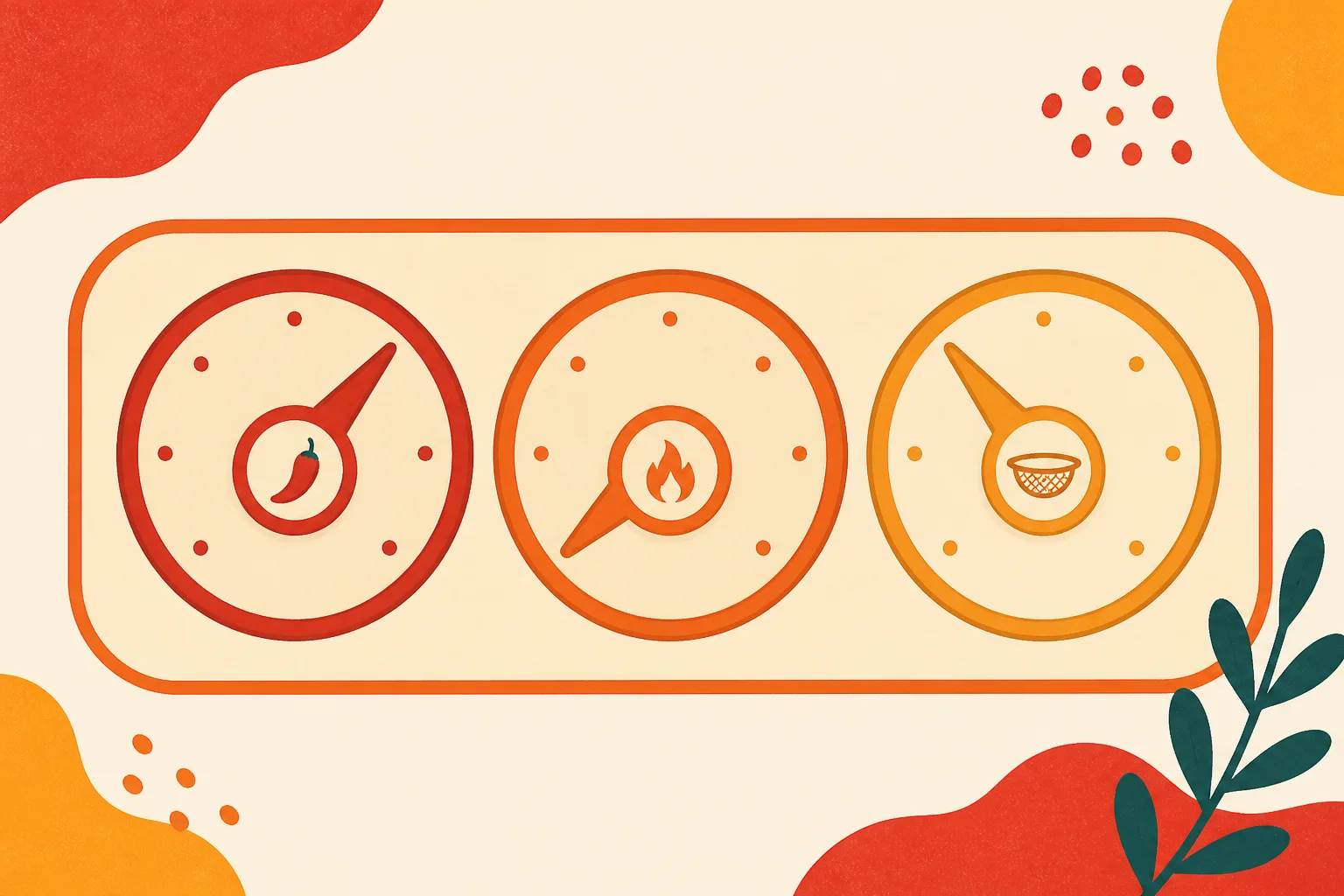
Three words people use as one
Here is a way to hold all three in your head at once: a jar of chilli flakes. Chilli heat gives us exactly the three ideas, and we already understand them from the kitchen.
Potency is how few flakes it takes before you notice any heat. A fiercely hot chilli is potent: a pinch is enough. A mild one is less potent: you need a lot more before anything registers. Efficacy is how hot the dish can ever get. Some chillies, no matter how many flakes you add, simply cannot reach a certain level of heat, while others can go higher. Purity is how much of the jar is actually chilli rather than dust, stalk or filler.
Now notice that these can be mixed in any combination. A jar of mild chilli can be perfectly pure, with no dust at all. A jar of extremely hot chilli can be very impure, half filled with stalks. Knowing one tells you nothing about the other two. That independence is the whole point, and it is where the muddle usually begins.
Potency: how little is needed
Pharmacology is the study of how substances act on living things, and it uses a precise definition. Potency describes the amount of a substance required to produce an effect of a given size 12. It is a comparison. Between two substances that produce the same kind of effect, the one that reaches it with less is the more potent.
Two details are worth noticing. First, potency only makes sense relative to a specific effect in a specific system. A substance might be very potent in one kind of cell and much less so in another, because the cells carry different numbers of the receptors involved. A receptor is a molecule on or inside a cell that a substance can bind to, a little like a lock that a substance fits into. Potency partly reflects how tightly a substance grips its receptor and how readily that grip sets off a response 3.
Second, high potency is not automatically a good thing, and low potency is not automatically a bad one. It is simply a description of how much is needed. A less potent substance that behaves predictably is not worse than a more potent one; they are just different on this one dial.
Efficacy: how big the effect can get
Efficacy is the other half of the pair, and the one most often forgotten. It describes the maximum effect a substance can produce, the ceiling, no matter how much is added 24. Once the ceiling is reached, adding more produces no further increase.
This is where the chilli picture is useful again. Two chillies might both register as hot after a similar pinch, so they have similar potency. But if one of them tops out at a gentle warmth while the other can climb to something fiery, their efficacy differs a great deal. The same pair of ideas, plotted on a graph, is what pharmacologists call a dose-response curve: how the size of an effect changes as the amount of a substance changes. Potency is where the curve rises, and efficacy is how high it eventually flattens out 13.
| Idea | The question it answers | Everyday picture |
|---|---|---|
| Potency | How little is needed to produce an effect? | How few flakes before you notice heat |
| Efficacy | What is the biggest effect it can produce? | The hottest the dish can ever get |
| Purity | How much of this sample is the intended substance? | How much of the jar is chilli rather than dust |
Purity: how clean the sample is
Purity belongs to a different category entirely. Potency and efficacy are properties of a molecule acting on a biological system. Purity is a property of a particular sample, a particular batch in a particular container.
It asks what share of the material is the substance it is supposed to be, as opposed to leftovers from manufacture, fragments of the molecule, or other unwanted material. It is measured with laboratory instruments, not with living cells, and it is reported as a percentage. An earlier article in this series explains how that figure is produced and what its limits are.
The important point is that purity tells you about the sample, while potency and efficacy tell you about the molecule. Change the sample and purity changes. Swap in a different molecule and potency changes. The two are measured by different methods, in different places, to answer different questions.
Why a purer vial is not a more potent molecule
Now the practical confusion can be addressed directly. It is common to see "potent" used as though it meant "pure", or "strong" used as though it meant either. These do not follow from one another.
A molecule has the potency that its structure gives it. Purifying a sample removes unwanted material, but it does not and cannot change how potent the molecule itself is. If a molecule is weakly potent, a sample that is nearly all that molecule is still weakly potent. If a molecule is highly potent, a sample that is partly contaminated is still made of a highly potent molecule, though now less of the material in the container is the molecule at all.
There is a subtle point in the other direction too. Contamination or damage can change how a sample behaves in a test. A sample containing fragments of a damaged molecule might show a lower measured activity because there is simply less intact molecule in it. In that case the apparent drop in activity is really a quantity or quality problem with the sample, not a change in the potency of the molecule. This is one reason laboratories report purity and activity as separate lines rather than trying to fold them into one number.
How potency is measured, in one paragraph
In a laboratory, potency is measured by exposing a test system to a range of amounts of a substance and recording how the response changes. The test system is usually cells in a dish, a piece of tissue, or sometimes an animal. The result is a curve, and a particular point on that curve, such as the amount that produces half of the maximum response, is used as a single number to compare substances 13. That is why potency is always relative to a system: the number belongs to the substance and the test together.
This also sets the tier of evidence. A potency figure obtained in cells in a dish is a finding about a dish. It is not a finding about a living animal, and still less about a person. Results from cell experiments, animal experiments and human studies are different rungs of evidence, and a careful reader never merges them into one claim. The article on what "in vitro" means in this series covers the first of those rungs.
What "high potency" on a listing does and does not tell you
When the word appears in marketing or on a product listing, the useful response is to ask what it is standing in for. A few questions help.
- Potent compared with what? Potency is only meaningful as a comparison with another substance.
- Potent in which system? Cells, animals and people can all give different answers.
- Is the word being used for purity? If the real claim is about cleanliness, the document should give a purity figure and the method behind it.
- Is a source given? A potency claim without a study or a test behind it is only an adjective.
None of this suggests that a listing is wrong to use the word. It only means that on its own, "potent" is a very thin piece of information, and that the thick pieces, a method, a system, a comparison and a source, are the ones worth looking for.
In one sentence
Potency is how little is needed, efficacy is how far the effect can go, and purity is how clean the sample is; they are three separate dials, and turning one tells you nothing about the others.