What Does Mechanism of Action Mean? The 'How' Behind a Drug
Almost every compound article has a 'mechanism of action' section. It describes how a substance is thought to work, not whether it will give any particular result. Here is what the phrase promises, what it leaves out, and why 'proposed mechanism' is the phrase to watch.
A mechanism of action is the description of how a substance is thought to do whatever it does, step by step, starting from what it physically interacts with in the body. It answers 'how?' and not 'does it?'. A mechanism section tells you the proposed chain of events inside a cell or an organism. It does not tell you that the chain happens in a living person, in what amount or with what outcome, and that gap is what this article is about.
The phrase sits at the head of a section in almost every article about a compound, and it tends to sound authoritative. Learning what it does and does not promise makes those sections far easier to read. This is an explanation of a term, not an account of how any substance works.
'What it does' versus 'how it does it'
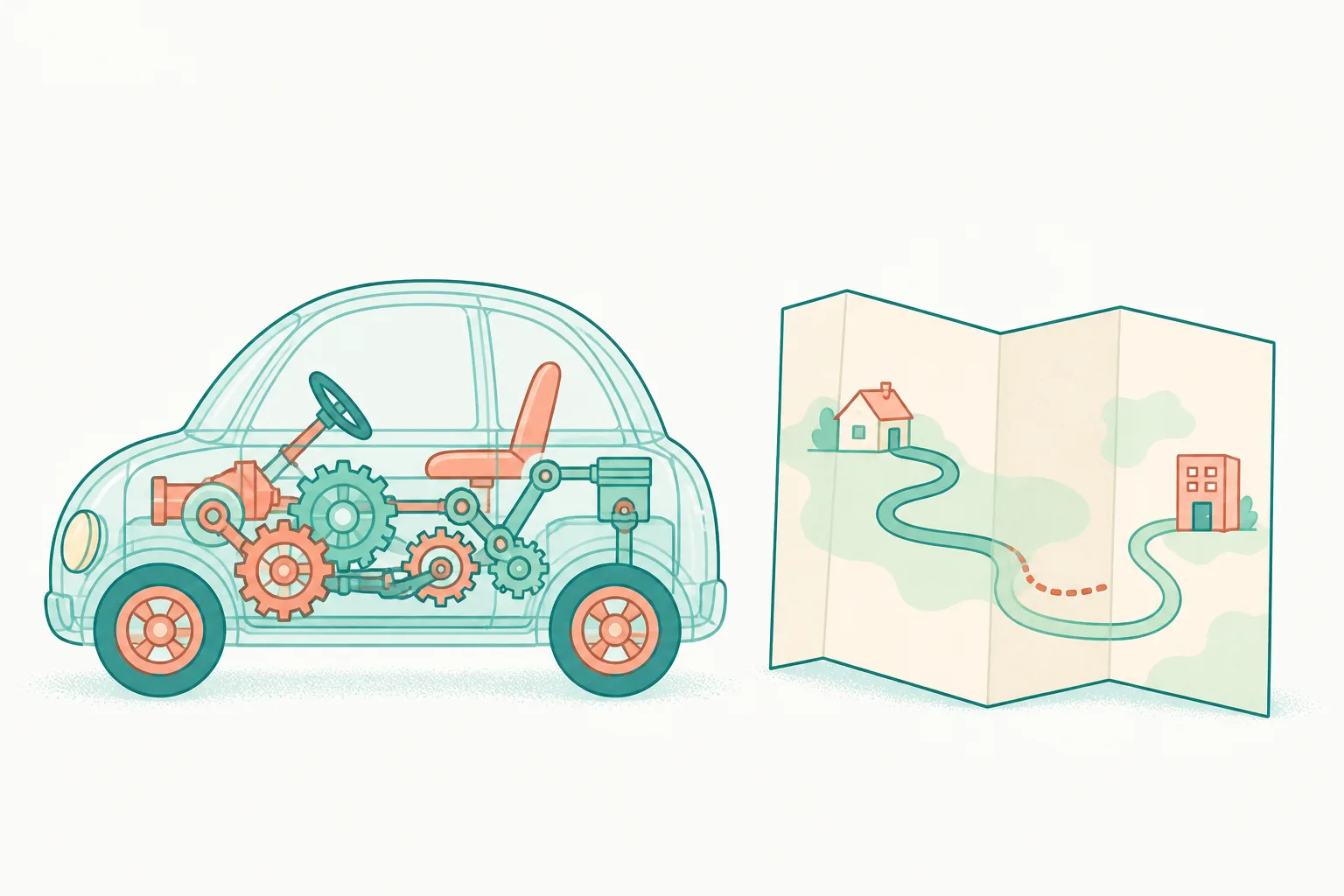
Take a car. What it does is carry people from place to place. How it does it, its mechanism, is that fuel burns, the burning pushes pistons, the pistons turn a shaft, and the shaft turns the wheels. Those are two different kinds of statement. One is about the outcome, the other is about the machinery behind it.
Scientists separate the two on purpose. The outcome, such as a measurable change in an animal or a person, is the effect. The route by which the substance produces that change is the mechanism. A study can establish an effect without knowing the mechanism, and a mechanism can be described in detail without anyone having shown the effect really occurs in the body 12.
This is where the article's analogy bites. Knowing that fuel burns, pistons move and wheels turn is real knowledge. But it is not the same as knowing the car will get you to work on time. The car might be out of fuel, the road might be closed, or a part might be broken. A mechanism describes the machinery. It does not guarantee the journey.
Target, event, effect: the three-step story
Most mechanism descriptions follow the same three-part shape. Seeing the shape makes any such section easier to parse.
| Part | Plain meaning | Typical wording |
|---|---|---|
| Target | The particular molecule in the body that the substance interacts with, usually a protein | 'binds to', 'acts on', 'targets the receptor' |
| Event | What happens at the target when the substance meets it | 'activates', 'blocks', 'inhibits', 'stimulates the release of' |
| Downstream effect | The chain of changes that the event sets off in cells, tissues or the whole body | 'which leads to', 'resulting in', 'thereby increasing' |
Some of those terms are worth unpacking. A receptor is a protein, usually on the surface of a cell, that receives a chemical message, in the way a letterbox receives post. To activate a receptor is to trigger it, as a key turns a lock, and to block it is to stop the message getting through. The chain of steps inside the cell after a receptor is triggered is called a signalling pathway: a relay in which each step passes the message to the next.
Reading a mechanism section, you can mentally label each sentence as target, event or effect. When a section jumps from the first to the third without the second, or runs on through several downstream effects with no indication of how strongly each is supported, that is a prompt for a closer look.
The lock-and-key picture and its limits
The commonest way to picture a target interaction is a lock and key. The substance is a key shaped to fit one lock, the receptor. When it fits, the lock turns and something happens. The picture is helpful because it explains selectivity: why a substance can act on one target and mostly ignore thousands of others.
But the picture hides a lot. Real molecules do not fit like metal keys; the fit is partial, flexible and a matter of degree. Many substances bind more than one target, so a single clean arrow from substance to effect is usually a simplification. And the same target can sit in different tissues doing different jobs, so one binding event can lead to several quite different consequences. A drawn mechanism is a map, and maps simplify 1.
A mechanism is a hypothesis, not a guarantee
The most important sentence in this article is this one: a plausible mechanism is a reason to run a test, not a result. It is easy to build a convincing story from the way a molecule fits a target. Whether that story actually happens in a living body, at a level that matters, is an empirical question that has to be tested.
History has a sobering example. In the 1980s, certain heart-rhythm medicines were known to suppress abnormal heartbeats, a mechanism that made good sense: abnormal beats were linked to sudden death, so suppressing them should help. A large controlled trial then compared two such medicines with a placebo. The medicines did suppress the abnormal beats, but the people receiving them died more often than those receiving placebo 5. The mechanism was real. The inference from it was wrong.
That is why researchers separate a mechanistic claim, 'it acts on this target', from a clinical one, 'it produces this outcome in people'. They are different kinds of evidence, and the first does not substitute for the second. A reader who meets a mechanism section should hear it as 'here is a reason to take the idea seriously', and not as 'here is why it works'.
How mechanisms are found, and overturned
Mechanisms are discovered in several ways, and the strength of the evidence depends on how. The tiers are worth keeping separate 1.
- In vitro binding studies: purified molecules or cells in a dish show that a substance sticks to a target. This shows interaction in a simplified setting, not what happens in a body.
- Cell-based experiments: cells are exposed to a substance and a downstream change is measured, sometimes after switching off the target to see if the change disappears.
- Animal studies: a living animal is given the substance, or bred without the target, to see whether the proposed pathway matters in a whole organism.
- Human studies: measurements in people, which are the hardest to do and the rarest, especially for newer research compounds.
Mechanisms are also sometimes found long after the effect. Aspirin-like drugs were in use for generations before a 1971 study showed they block the making of chemical messengers called prostaglandins 3. And a mechanism can be overturned or refined. The medicine thalidomide caused terrible birth defects in the 1950s and 1960s, and it was only in 2010 that researchers identified a protein it binds to that appears central to that harm 4. In both cases, the effect was known first and the 'how' came decades later, which is a reminder that mechanism and outcome are separate pieces of knowledge.
Reading a mechanism section without being dazzled
A mechanism section can be very persuasive, because detailed molecular stories sound like understanding. Here are practical checks that need no specialist knowledge.
- Ask where each step was shown. Is the target interaction from a dish, an animal or a person?
- Look for the verbs. 'Binds' is a measured fact in a particular setting; 'is thought to' and 'may' are the honest hedges.
- Check for jumps. Does the section move from a target in a dish straight to an outcome in a person with nothing in between?
- Count the targets. A substance said to act on very many targets and produce very many effects deserves extra care.
- Notice what is not said. A mechanism section rarely mentions what a substance fails to do, or the studies that did not find an effect.
Why 'proposed mechanism' is the phrase to watch
In careful scientific writing you will often see the words 'proposed mechanism', 'putative mechanism' or 'hypothesised mechanism'. 'Putative' simply means supposed or believed. These are not weaselly phrases; they are the accurate ones, and they signal that the mechanism has not been established beyond reasonable doubt 2.
Even for approved medicines, the exact mechanism is often partly unknown or later revised, a fact that surprises many people. For newer research compounds, where the evidence may rest largely on dish and animal experiments, the honest default is 'proposed'. A section that states a mechanism flatly, with no hedge and no mention of the type of evidence behind it, is telling you something about the section.
In one sentence
A mechanism of action describes the machinery, target then event then effect, and not the journey, so read it as a reason to test a claim rather than as evidence that the claim is true.
References
- Target identification and mechanism of action in chemical biology and drug discovery
- Biochemical mechanisms of drug action: what does it take for success?
- Inhibition of prostaglandin synthesis as a mechanism of action for aspirin-like drugs
- Identification of a primary target of thalidomide teratogenicity
- Mortality and morbidity in patients receiving encainide, flecainide, or placebo: the Cardiac Arrhythmia Suppression Trial