What Is a Signalling Pathway?
A message passed down a line of molecules inside a cell, where every step can amplify it, delay it or stop it dead. Once you can picture the line, the phrase activates pathway X stops sounding like a conclusion.
A signalling pathway is a message passed down a line of molecules inside a cell. One thing changes, which changes the next thing, which changes the next, until something the cell actually does is different. That is the whole idea. The interesting part is that every step in the line is a handover, and every handover can pass the message on, make it louder, hold it up, or stop it dead.
The phrase turns up everywhere in writing about peptides — activates the such-and-such pathway — and it arrives sounding like a conclusion. It is much closer to the beginning of a question. Once you can picture the line, you can ask the things that decide whether the claim means anything at all.
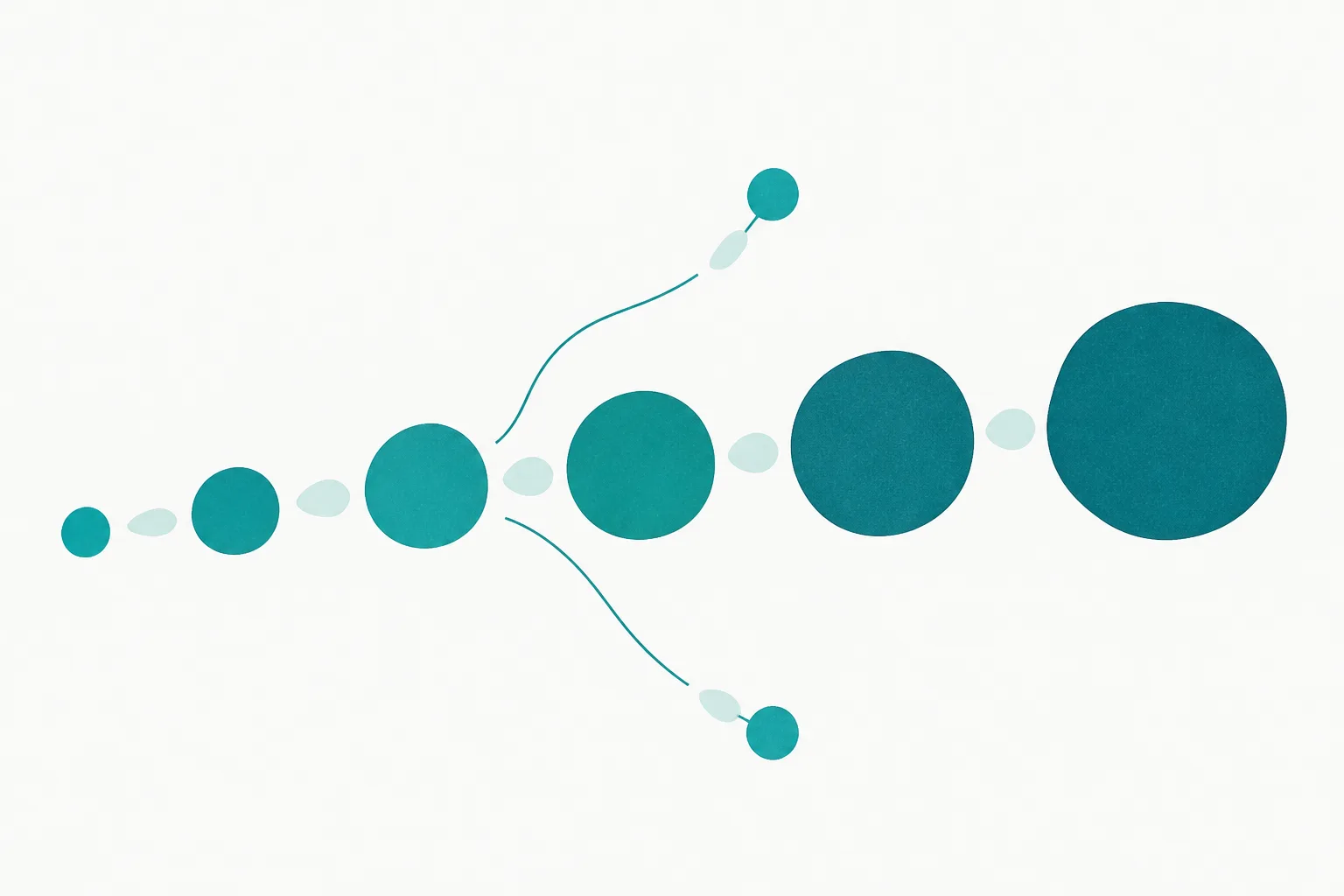
A message passed down a line
The word pathway is borrowed from maps and is slightly misleading, because nothing travels along it. A better picture is a line of people passing a message across a field. Person one hears something and turns to person two, who turns to person three.
What makes it a relay rather than a wire is that each person can do more than repeat. One can shout, so the message reaches more people than heard it originally. One can wait before passing it on. One can decide not to pass it on at all. A wire carries whatever it is given; a relay transforms it at every step, and that is the whole reason cells are built this way.
The line almost always begins at the cell's outer surface, with something arriving from outside — a hormone, a peptide, a molecule released by a neighbouring cell — and it ends with the cell doing something differently.
One warning about the diagrams. Pathways are drawn as tidy vertical chains with arrows because a page is flat and has to be readable. Inside an actual cell, the participants are jostling about in a crowded, watery space, several slightly different versions of each step exist at once, and plenty of steps loop back to influence earlier ones. The diagram is a summary of tendencies, not a wiring schematic.
Receptor, second messenger, response
Most pathways relevant to peptides share the same three-part skeleton, and it is worth walking through it once.
It starts at a receptor: a structure the cell builds, threaded through its outer wall, that one particular molecule fits into. The molecule settles into the outward-facing part and stays outside. What changes is the receptor's shape, and because the receptor runs all the way through the wall, the part hanging inside the cell changes shape too 5.
That altered inner end can now grip something it previously could not. In a very common arrangement, it grips a partner protein sitting just inside the membrane, which detaches and switches on an enzyme nearby 2. Nothing has crossed the wall. The news has been handed over.
That enzyme's job is to manufacture a second messenger — a small molecule made inside the cell, in quantity, whose purpose is to spread the message through the interior. The molecule that arrived from outside is the first messenger, and it never comes in. The idea that a separate internal molecule carries the message onwards was worked out in the 1950s and 1960s, and it reorganised the whole subject 1. The classic example is a small molecule called cyclic AMP. Calcium is another, released from internal stores when the right signal arrives.
The second messenger then activates the workhorses of most pathways: kinases. A kinase is an enzyme that attaches a phosphate group to another protein. That little chemical tag changes the target protein's shape and switches its activity on, or off. It is reversible, because other enzymes exist purely to remove the tag again. This tagging and untagging is the most common switch in biology, and once you have met it you will see it in every pathway you read about.
Finally, the response. Sometimes it is immediate — a channel opens, a stored molecule is released, an enzyme starts working within seconds. Sometimes the chain ends with a protein moving into the cell's nucleus and changing which genes get read, which takes hours and can last much longer. The same pathway often does both, on two different timescales, which is one reason short experiments and long experiments on the same compound can disagree without either being wrong.
How one molecule outside changes everything inside
Here is the question the relay answers, and it is a fair one. Hormones and peptides circulate at concentrations so low they are hard to measure at all. How can something that dilute change what a cell does?
The answer is that every step in the line multiplies. A single activated receptor can switch on many partner proteins before it settles down. Each activated enzyme can produce a great many second messenger molecules. Each activated kinase can tag many target proteins, and those targets can go on to do the same. A few dozen molecules arriving at the surface become thousands of internal events, and then hundreds of thousands 12.
That is amplification, and it is the reason receptors work by touch rather than force. Nothing has to be pushed. A tiny nudge at the surface is enough, provided the relay behind it multiplies.
Amplification also does something less obvious. A chain of several steps does not respond smoothly to a gradually increasing input. It tends to sit largely unresponsive while the input is small, then flip sharply to a near-maximal response once the input crosses a threshold 3. Cells built this way make decisions rather than drifting, which is generally what an organism wants.
This explains something that otherwise looks contradictory in the literature. A little more signal sometimes changes nothing at all, and sometimes changes everything. Both can be true of the same pathway. You are not looking at inconsistent results, you are looking at different points on a steep curve.
And amplification without a brake would be a disaster, so every pathway comes with off-switches: enzymes that strip the phosphate tags back off, second messengers that are destroyed within seconds of being made, receptors that get pulled off the surface after prolonged stimulation. The machinery for stopping is as elaborate as the machinery for starting. A signal ends because something actively ended it.
Cross-talk, and why effects are rarely clean
In diagrams, pathways run in neat parallel columns, never touching. In a cell they share parts constantly.
The same kinase turns up as a member of several different pathways. The same second messenger is produced in response to many different receptors. The same target protein collects tags from more than one source, and what it does depends on the combination it is carrying. Switch one pathway on and you have inevitably changed the conditions for several others. This is called cross-talk, and it is how the system is built rather than a flaw in it 4.
Three consequences follow, and they are the reason clean effects are rare.
- A compound described as targeting one pathway will touch others, whether or not anybody measured them. Selectivity at the receptor does not survive far downstream, because downstream is shared.
- The cell decides the outcome, not the signal. The same second messenger drives the breakdown of stored sugar in a liver cell and relaxation in certain muscle cells. Identical message, opposite result, because what is waiting downstream is different.
- Two interventions rarely add up. If they share components, the combined effect can be larger than expected, smaller, or in the other direction entirely, and there is no way to predict which without measuring it.
It is worth saying that cross-talk is genuinely difficult to study, and specialists disagree about how much of it matters in a living animal as opposed to a dish 4. Showing that two pathways share a component is not hard. Showing that the sharing changes a real outcome in a whole organism is very hard indeed. Both statements should be held at once.
Why activates pathway X is a weaker claim than it sounds
Now the part this whole article was built for.
When a write-up says a compound activates some pathway, the underlying observation is usually this: cells growing in a dish were exposed to the compound, and a marker of that pathway's activity — very often the tagged form of one protein in the chain — increased. That is a real measurement of one step in one setting. It is a reasonable thing to publish.
Look at what it leaves open. Which cells were they, and do they resemble any tissue in a body? At what concentration, and could a living organism ever reach it? For how long — was this a momentary blip or a sustained state? Did anything downstream actually change, or was only the marker measured? A tag going up is a measurement. The pathway's actual output is a different measurement, and it is frequently not taken.
There is a blunter problem too. Well-studied pathways are activated by an enormous number of things. Exercise activates several. So do particular foods, stress, a lack of oxygen, mechanical stretching, and in cultured cells, simply changing the liquid they are growing in. Being on the activator list for a famous pathway is not a distinction. It is closer to a default.
The word modulates deserves its own note, because it is weaker still. It means the number moved, in some direction, by some amount, and it is often chosen precisely because a stronger word could not be justified.
Here is a habit worth adopting. Try rewriting the claim as a full sentence with nothing left out: this compound, at this concentration, in these cells or this animal, changed this measured outcome, compared with this control. Most pathway claims cannot be rewritten that way from the information given, and the failure is the finding. It tells you what was measured and what was assumed.
None of this is a reason to be dismissive about pathway research. Working out mechanism is how the field advances, and knowing the route a signal takes is genuinely valuable — it suggests what else to look at and what might go wrong. The point is to file the claim correctly. A pathway result is a plausible explanation waiting for a demonstration. It is not the demonstration, and the gap between the two is where most of the interesting work still has to happen.
References
- Studies on the mechanism of hormone action
- G proteins: transducers of receptor-generated signals
- Tripping the switch fantastic: how a protein kinase cascade can convert graded inputs into switch-like outputs
- Crosstalk in cellular signaling: background noise or the real thing?
- The structure and function of G-protein-coupled receptors