making sense of the science
What Is a Clinical Trial?
A trial is not just a group of people trying something and reporting back. It is a comparison, arranged carefully in advance — and the care taken over that arrangement is what decides whether the result is worth anything at all.
A clinical trial is a planned experiment that tests a treatment in people, following rules written down before it begins. That last part carries most of the weight. A trial is not simply a group of people trying something and reporting back. It is a comparison, set up in advance, so the answer means something when it arrives.
A companion piece asks what a study was done in — a mouse, a person, cells in a dish. This one assumes you already have people, and asks the next question: how were they studied? Two trials of the same compound, in the same number of people, can be worth wildly different amounts. The difference is design, and design is readable without any statistics.
Why not just give someone the compound and see?
Because people get better for all sorts of reasons, and most have nothing to do with what you gave them. Time is a treatment by itself. Colds clear. Sore backs settle. Many conditions come and go in cycles, and people go looking for help at the worst point of the cycle — after which things were going to improve anyway.
Then there is the kind of person who volunteers. People who sign up rarely change only one thing. They go to bed earlier, drink a little less, walk a little more, because they are now someone doing something about it. Any of that could produce the improvement on its own.
So picture giving a compound to a hundred people, and sixty report feeling better. What have you learned? Almost nothing — unless you can say what would have happened to those same sixty if you had given them nothing. That is the whole problem a trial exists to solve. Everything else is machinery for answering it.
What is a control group?
A control group is a second set of people in the same study who do not receive the compound being tested. Everything else about them is kept as similar as possible. They are your answer to "what would have happened otherwise," and the idea sounds almost too plain to be a breakthrough.
Suppose eighteen percent of the people who got the compound improved. If eighteen percent of those who did not also improved, the compound did nothing — however impressive that first number looked alone. Everything else in this article refines that one comparison, because somebody found a way it could quietly go wrong.
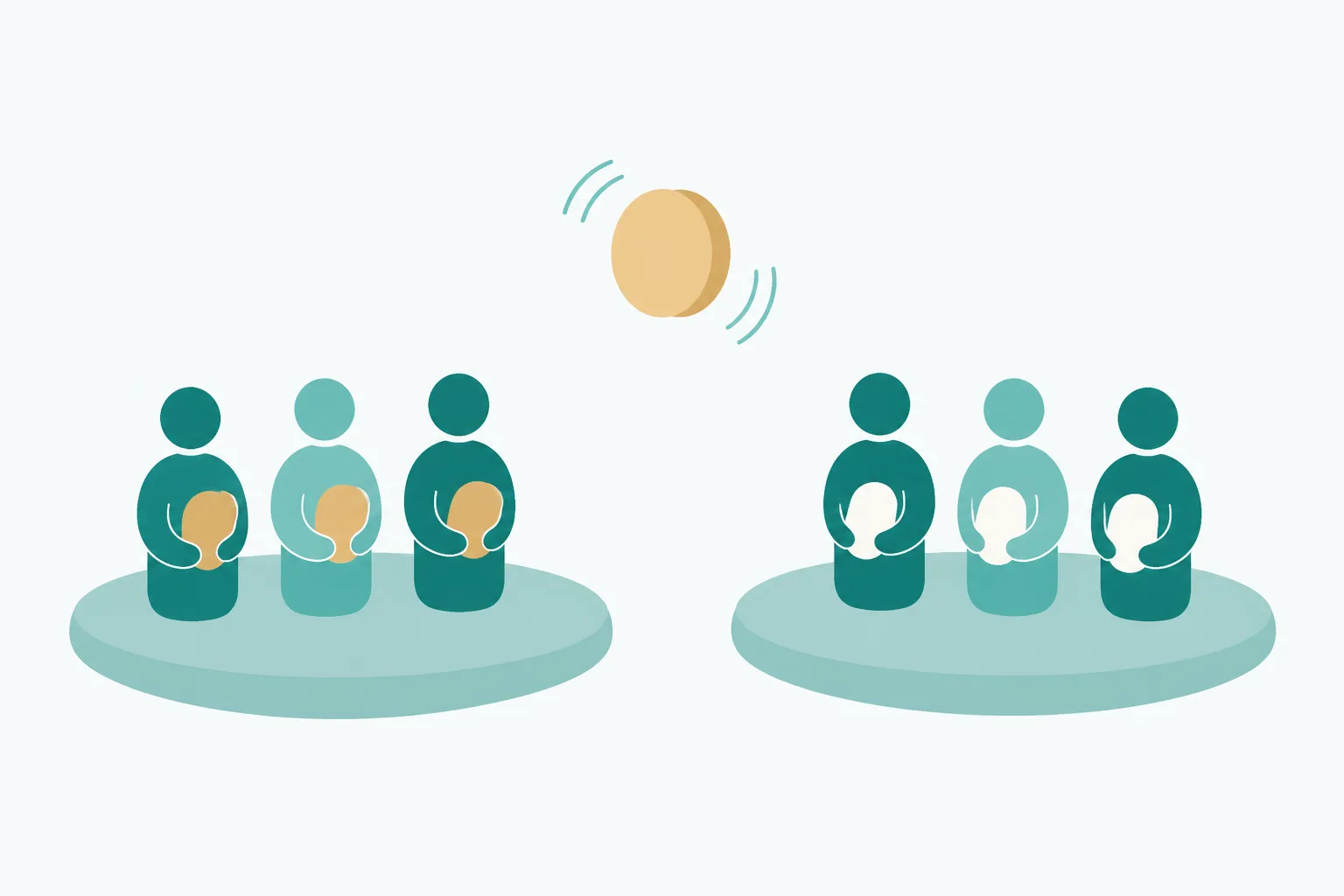
Why does a dummy treatment still work?
A placebo is a treatment with nothing active in it — a sugar pill, a saline injection, built to be indistinguishable from the real thing in every way except the one that matters. The control group usually receives one, so both groups have the same experience of being treated.
Here is the surprising part. People given something inert often improve, and measurably rather than in their imagination. Some of that is the condition running its course. Some is how people report: asked each week whether you feel better, you find things to notice. And some looks like a real effect of expecting to be helped.
The mix matters less than the consequence. A group given attention and a sugar pill will often improve. So "people improved while taking this" is not a finding. It is the starting line, and the comparison group tells you whether anything moved past it.
Why does it matter who ends up in which group?
Randomization means chance decides which group each person goes into — a coin flip, or a computer doing the equivalent. Nobody chooses. That sounds like paperwork. It is arguably the most important feature a trial has.
Imagine researchers doing the sorting themselves, with nothing but good intentions. One patient looks frail, so he goes in the gentler group. Another seems unlikely to keep to the schedule, so she goes in the control group, where it will matter less. Every decision is defensible on its own. But the two groups now differ before anything has been given to anybody, and you can no longer separate the compound from the sorting.
Chance has no opinions. Across enough people it spreads the frail and the fit, the determined and the half-hearted, evenly between both groups. It does the same for differences nobody thought to write down. That is the quiet power of it, and why the word randomized is not decoration.
Why do the researchers have to be in the dark too?
Blinding means keeping people from knowing who is in which group, and it comes in two halves. The first is the participants. If you know you got the real thing, you expect to improve, and expectation shows up in everything you report. If you know you got the dummy, you may watch for disappointment and find it.
The second half is the one most readers have never considered: the researchers. Someone assessing an outcome who knows the assignment will assess it differently, without intending to and without noticing. It takes no dishonesty, only judgment calls, and judgment calls are everywhere. Is that rash mild or moderate? Does this person's walking look steadier than last month? Each nudged a few percent the same way, a few hundred times over, becomes a result.
When both sides are kept in the dark, the trial is double-blind. Sometimes that is impossible — you cannot blind an operation. Good trials then keep at least the assessors blind: whoever measures the outcome does not know who received what.
Why does the number of people matter so much?
Here is the intuition, and it needs no statistics. Flip a fair coin ten times and seven heads would not raise an eyebrow. Flip it a thousand times and seven hundred heads would be extraordinary. Small numbers wobble; large numbers stop wobbling. With twenty people, a gap between the groups can easily be the coin landing oddly.
This cuts two ways, and people skip past the second. A small trial can show a large effect. What it cannot do is rule things out. If a compound made a real but moderate difference — the kind most useful treatments make — a twenty-person trial could easily miss it and report nothing. No finding in a small group is not the same as there being nothing to find.
The same logic applies to harm, where it matters more. Suppose a compound causes a serious problem in one person out of a thousand. In a trial of twenty, the likely outcome is that nobody has it. The trial reports no safety concerns, honestly and accurately. The problem is still there. It was never given a chance to appear.
What do the phases mean?
Human testing happens in stages, usually numbered, and each stage asks a different question.
- The earliest trials ask mainly whether people can tolerate the compound at all. Small, often a few dozen people. What is watched is what goes wrong; whether it works is barely the question yet.
- The middle stage asks whether it looks like it does anything useful — a few hundred people, usually with a control group. This is where a great many promising ideas quietly stop.
- The late stage asks whether it truly works, against a placebo or the treatment people already use, in hundreds or thousands of people. It is also the first point at which uncommon harms have enough people around them to show up.
- After approval, watching continues in ordinary use, across far more people than any trial could enroll. Some harms are rare enough, or slow enough, that only years reveal them.
So an early trial is not a miniature of a late one. It is a different question, and a compound can pass the first stage handsomely and fail the third.
What is pre-registration, and why is it worth so much?
Pre-registration means researchers publicly state, before the trial begins, exactly what they will measure and how they will analyze it. It is the least known item on this list and among the most important 4.
Here is the problem it fixes. Imagine a trial that records twenty things: weight, blood pressure, sleep quality, energy, mood, several blood markers. By chance alone, across twenty measurements, one or two will look impressive in one group. That is not misconduct. It is arithmetic — the same reason two people in a large enough room share a birthday.
Now the trial gets written up. If the researchers may decide afterwards which measurement mattered, the paper reports the one that came out well. Every word can be true and the impression still wrong, because you are shown the winner of twenty attempts as though it were the only attempt.
Saying beforehand "this is the thing we are testing" removes that freedom. If the stated measure comes out flat, the trial says so. Anything spotted along the way is still worth publishing, but labeled as a lead for somebody else to test, not a result. Reporting standards ask trials to declare that measure publicly in advance, and to flag plainly if it changed later 4.
What does a strong trial actually look like?
One example is probably familiar, because it changed how obesity is treated. The GLP-1 compounds did not arrive on encouraging early findings. They went through the whole machinery above, at scale, over years.
One trial enrolled roughly nineteen hundred adults with overweight or obesity, assigned them by chance to the compound or to a placebo, and followed them for sixty-eight weeks. Both groups received the same lifestyle counseling. The group on the compound lost around fifteen percent of their body weight. The placebo group lost around two percent 1. That second number is the point of this whole article.
Then came the harder question, because weight on a scale is not the same as avoiding a heart attack. A later trial enrolled more than seventeen thousand people with excess weight and existing heart disease but not diabetes, randomized the same way. It counted events rather than pounds: heart attacks, strokes, deaths from heart causes. Over several years, 6.5 percent of those on the compound had one, against 8.0 percent on placebo 2. An earlier trial in about thirty-three hundred people with type 2 diabetes had pointed the same way 3.
Look at what that stack contains. Thousands of people rather than dozens. Assignment by chance. A placebo group. Outcomes a person would actually care about. Years rather than weeks. It is worth saying plainly that the great majority of compounds sold as research peptides have nothing like this behind them — usually animal studies, sometimes one small early trial, occasionally nothing in humans at all. That is not a claim they do nothing. It is a statement about what is currently known, which is a different and much smaller thing.
So what do you do with "clinically proven"?
You will meet that phrase constantly, and on its own it is not held to mean anything in particular. A study in fourteen people with no control group was, technically, clinical. The useful response is not disbelief — flat skepticism is as lazy as flat belief. The useful response is a question, or rather four of them.
- Which trial? A claim that names no study behind it has already answered you.
- How many people, and for how long? Twenty for six weeks and twenty thousand for four years are not the same sentence.
- Compared with what? A placebo, nothing at all, or the treatment people already use? Those are very different claims.
- Did they say in advance what they would measure? And is the reported result that thing, or something else that turned up?
None of this requires a science background. Study summaries — called abstracts — are free to read, and they nearly always give the number of participants, the length, and the comparison group in the first few sentences.
And notice what you are doing when you ask. You are not trying to catch anybody out. You are asking how the thing was built, because how a trial is built is what decides what its result is worth.