making sense of the science
Why a Mouse Study Is Not a Human Study
You read that something "was shown to heal injuries." That sentence may be perfectly true and still be describing twelve mice. Here is how to tell the difference, and why it matters more than almost anything else you can learn about reading health claims.
A study in mice does not mean the same thing will happen in people. It means the thing happened in mice, under conditions somebody chose. That is genuinely worth knowing. It is simply not the same claim.
Here is the situation this article is about. You are reading along, and a sentence tells you that a compound "was shown to heal injuries." Or "reduced body fat." Or "improved recovery." The sentence is probably true. It may also be describing twelve mice.
Nobody necessarily did anything wrong. The writer may have read the study carefully and summarized it fairly. You read it in good faith, the way anyone would. The sentence simply left something out — and the missing piece is the part that decides what it means for you.
That missing part has a name. Once you know to look for it, you will notice it missing almost everywhere.
What does "the model" mean?
In research, the model means the thing the experiment was actually done in — not the compound being tested, but the living system it was tested on.
A model might be a mouse, a rat, a rabbit, a pig, or a monkey. It might not be an animal at all. A great deal of research is done on cells grown in a dish, which scientists call in vitro — Latin for "in glass," because it happens in glassware rather than in a body.
Each of those is a different statement about the world. A compound that does something to cells in a dish has done something to cells in a dish. That is a real observation, and often an interesting one. But it is not yet an observation about a body, where the same compound has to survive the bloodstream, reach the right tissue in a useful amount, and work there without causing trouble elsewhere.
So here is the habit this whole article is trying to hand you. Before you look at what a study found, look at what it was done in. What it found comes second. What it was done in comes first.
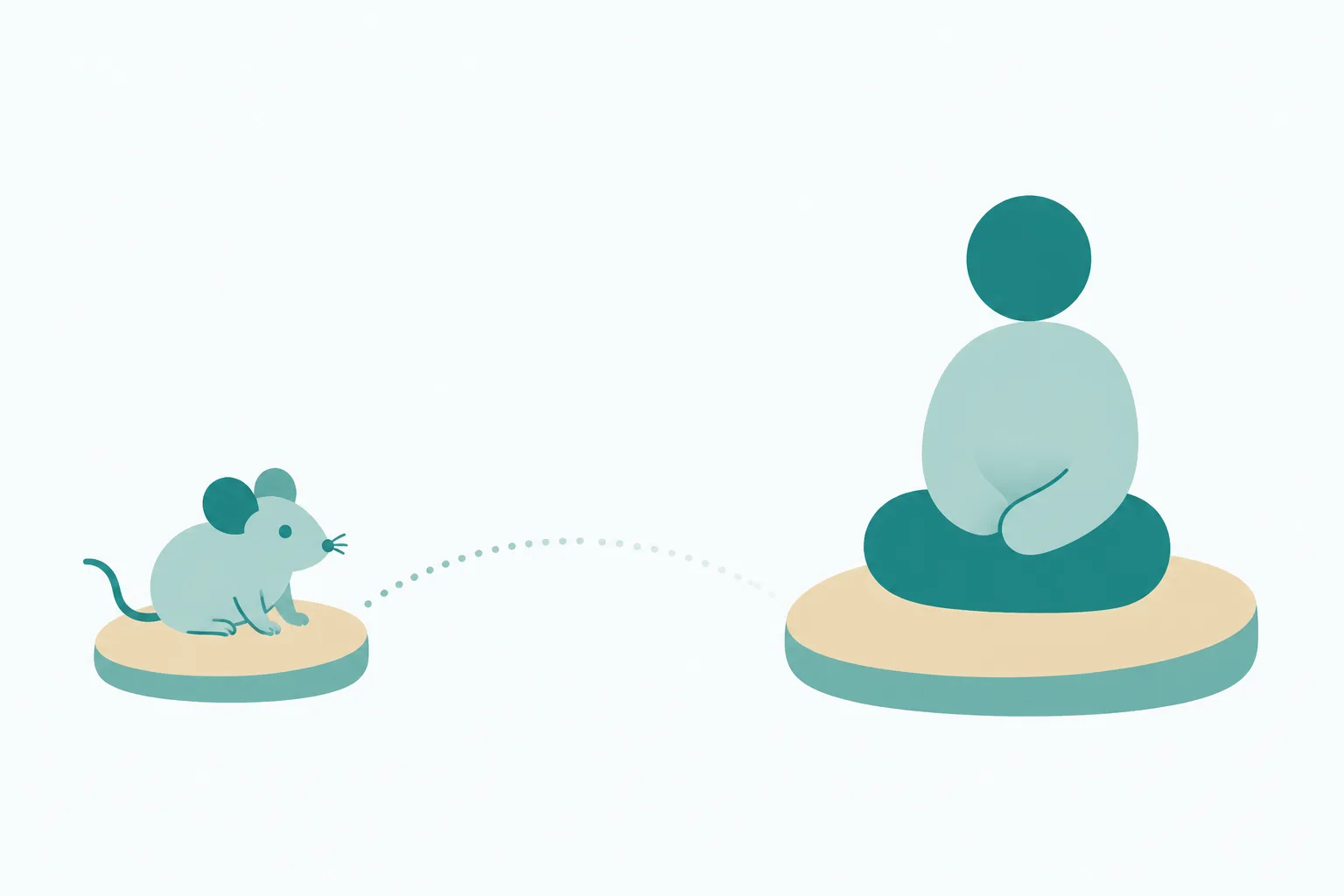
Why are mice used in the first place?
Because mice are, in several honest ways, a sensible place to begin.
They are small, so a laboratory can care for many of them properly. They breed quickly, so researchers can watch several generations in the time a human study would spend just finding volunteers. And their biology really is similar to ours. A mouse has a heart, a liver, an immune system, and hormones that work on much the same principles as yours, built from many of the same genes.
There is also a reason that has nothing to do with convenience. Testing a compound in an animal before giving it to a person is an ethical requirement, not a way of dodging one. Before anyone is asked to take something, it has to show that it does roughly what is hoped and nothing disastrous. Skipping that stage would not be braver science. It would just mean experimenting on people first.
So animal work is not a lesser imitation of human research. It is an earlier stage of the same process.
So why do the results so often fail to carry over?
If mice are that similar to us, why does so much stall at the next step? Because the differences are not only about species. They are about the whole situation an experiment is built around.
Start with variety, or rather the lack of it. Laboratory mice are usually bred to be nearly genetically identical. Picture a room full of identical twins, raised in identical rooms, fed identical food at identical times. That is deliberate, and it is clever: when almost nothing else varies, a real effect is much easier to see. A room full of people is the exact opposite. Different genes, ages, diets, sleep, stress, illnesses. An effect that stands out cleanly among near-identical animals can be swallowed by all that variation.
Then there is the injury itself. In a study of healing, the injury is usually made deliberately — in a chosen place, at a chosen moment, in a neat and consistent way. Real injuries are rarely like that. They happen in an unknown state of health, may go unnoticed for a while, can become infected, and arrive tangled up with whatever caused them. The model reproduces the damage. It does not always reproduce the problem.
Third, who the animals are. Laboratory animals are usually young and healthy, with nothing else wrong and nothing else in their system. The people who eventually need a treatment are often older, often unwell in more than one way, and often already taking other medicines. Older bodies repair more slowly. Medicines interact. An effect seen in a young, healthy, untreated animal can shrink or disappear in a body that is none of those three things.
Fourth, time. Animal studies tend to be short, measured in days or weeks. A problem that takes months or years to surface has no opportunity to surface. The study did not fail to find a slow harm. It was never open long enough to look.
None of these are mistakes. Each is a reasonable choice that makes an experiment readable: remove the noise, standardize the injury, keep it short, and a signal appears that would otherwise stay buried. But every simplification moves the experiment a step further from the situation you actually care about, and the result belongs to the simplified version. Getting from there to a person is not a formality at the end. It is a second, harder piece of work 1.
What happened when researchers went back and checked?
This is not guesswork. People have gone back, taken animal findings, and compared them against what later happened in humans.
One review, published in 2006, took 76 animal studies cited so often they counted as influential, and asked what became of each. Roughly a third were later borne out by randomized trials in people — a randomized trial being a study where people are assigned by chance to receive the treatment or not, which is the fairest test we know of. About a fifth were contradicted. The largest group, close to half, had never been tested in people at all 2.
A second review, published the following year, came at it from the other direction. It found treatments where both animal experiments and human trials existed, and compared the two directly. Agreement was inconsistent. For some, the animal work pointed where the human work later went. For others it did not 1.
Read those numbers gently. They are not evidence of a scandal, and not a reason to think badly of researchers. They are what a hard problem looks like when somebody measures it honestly. The plain summary: a result in animals is a promising lead, not a finished answer — and often nobody has yet followed that lead into people.
The second problem: sometimes the result does not even repeat
There is another layer underneath, and it surprises most people the first time they meet it.
Everything above quietly assumes the animal finding was solid to begin with. Sometimes it is not. The main check on any result is replication, which simply means another team running the same experiment independently and seeing whether the same thing happens. That matters because any one experiment can come out oddly by chance, or because of something particular to that laboratory — its animals, its equipment, its way of measuring. A result that shows up again elsewhere probably describes the world. A result that never shows up again may only have described one afternoon in one building.
When one team set out to reproduce 53 landmark preclinical cancer studies — preclinical meaning work done before any human testing, usually in cells or animals — they were able to confirm the findings in 6 of them 3. An analysis published in 2015 estimated that more than half of preclinical research cannot be reproduced, and put the cost of that irreproducible work in the United States at roughly 28 billion dollars a year 4.
This is not an accusation that the original researchers cheated. Overwhelmingly they did not. Small studies wobble. Journals are keener on exciting findings than dull ones, so experiments that found nothing tend to stay in a drawer. And the same data can honestly be analyzed several ways. But it does mean "a study found" and "we know" sit further apart than the wording suggests.
Four questions to ask about any health claim
Here is the practical part, and the reason this article exists. You do not have to judge anyone's statistics. You need four questions, and you can usually answer them in a couple of minutes.
- What was this done in? A person, an animal, or cells in a dish? This is the most useful question you can ask, and the answer usually sits right there in the study's title or first few lines.
- How many? Twelve mice and twelve hundred people are both "a study." Small numbers are not dishonest, but they wobble far more, and a dramatic result from a tiny group is the kind most likely to shrink when someone looks again.
- Compared against what? A treatment has to be measured against something — an untreated group, a dummy treatment, or the usual care. "Improved" means nothing until you know improved compared with what.
- Has anyone else found the same thing? One study is a suggestion. Several separate teams finding the same thing is much closer to knowledge. If every mention traces back to one group in one place, that is worth noticing.
These are genuinely checkable, which is the point. Short study summaries — called abstracts — are free to read online, and they nearly always name the species and the number of subjects in the first few sentences. If a claim names the study behind it, you can go and look. If it names no study at all, that is an answer of a sort too.
And notice what you are doing when you ask. You are not trying to catch anybody out. You are just putting back the half of the sentence that fell off along the way.
None of this means animal research is worthless
It would be easy to finish an article like this and decide that nothing counts unless it has been through a huge human trial, and that anyone reporting a mouse study is trying to fool you. Please do not. That is the same mistake in a different coat: another way of settling every question without reading anything.
Animal research is how medicine gets made. The mice in these studies are a large part of why anyone has ever been able to offer you a treatment with a straight face. And most people writing about this work are summarizing it in good faith, in a small space, for readers they assume already know where it came from.
What all of it adds up to is smaller and more useful than distrust. "Shown to work" is an incomplete sentence. The missing half — shown in what, in how many, compared with what — is usually easy to find once you know it is missing. Learning to notice the gap takes about as long as reading this page did. After that you notice it automatically, and you read every health claim you meet a little better than you did this morning.