What Is the Hierarchy of Evidence? The Pyramid, Explained Simply
Not every study weighs the same, and the hierarchy of evidence is the written-down ranking of why. Here is the whole ladder, from cells in a dish to reviews of many trials, what its critics get right, and where most research-peptide evidence honestly sits.
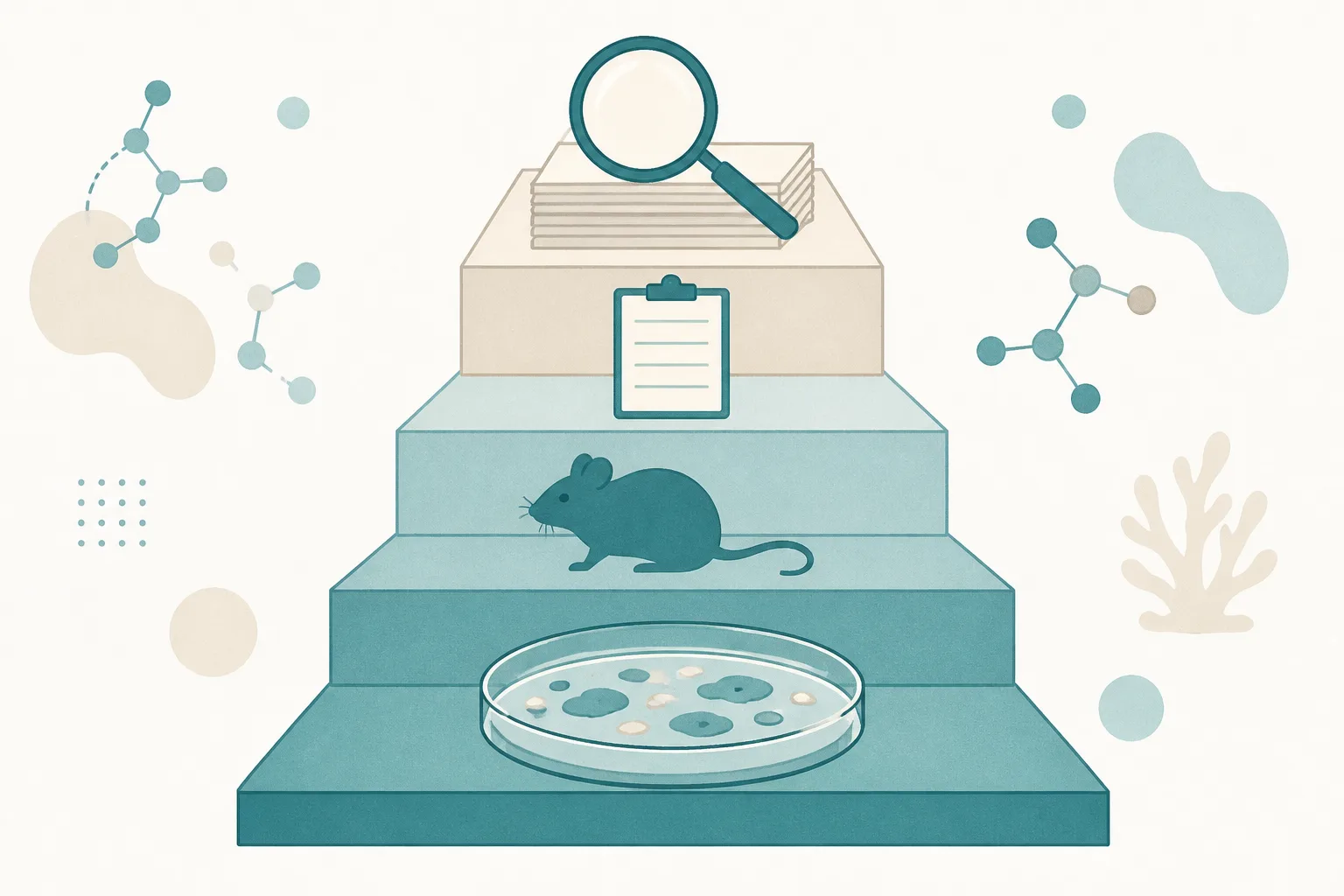
One study counts for more than another because of how it was designed, not because of who ran it or how confident its headline sounds. Researchers rank types of study by how well each one protects against being fooled, and that ranking is called the hierarchy of evidence, usually drawn as a pyramid. Studies near the top are better at telling a real effect from a coincidence. Studies near the bottom are useful for raising questions, but poor at settling them.
This article walks up the whole ladder, explains why it is built the way it is, and is candid about what the pyramid's critics get right. It also answers the question many readers of peptide material really have: where does the evidence for the typical research peptide actually sit? It places a whole category on the pyramid without attaching any claim to a named compound.
Not all evidence weighs the same
Think of a courtroom. A single eyewitness is evidence. So is a stack of witnesses who all say the same thing, and so is CCTV footage. And so, at the end, is an independent review that gathers all of it and weighs how much each piece can be trusted. Nobody would say these are equally convincing, and no one thinks it unfair to say so. The evidence pyramid is the same idea written down for science: a ranking of how convincing different kinds of evidence usually are.
The ranking exists because the main question in medicine and biology is almost always one of cause. Did this thing change that outcome, or did the outcome happen anyway? Many things can make an effect look real when it is not. People improve on their own. They behave differently when they know they are being watched. A group that gets a treatment may differ in age, health or habits from the group that does not. Study designs differ mainly in how well they cope with these traps 2.
The idea grew out of a movement called evidence-based medicine, which asks doctors to use the best available research alongside their own experience and the wishes of the person in front of them, rather than relying on habit or authority 4. The pyramid is its simplest picture of what 'best available' means.
The pyramid, rung by rung
Different guides draw the pyramid with slightly different rungs, but the order is stable. Here it is from the bottom up, with every term explained 12.
| Rung | What it is | Its main weakness |
|---|---|---|
| Laboratory (in vitro) studies | Experiments on cells or molecules in a dish or test tube | A dish is not a body; it leaves out blood flow, organs and the immune system |
| Animal studies | Experiments in living animals, such as mice or rats | Animals differ from humans, and many results do not carry over |
| Case reports and case series | Detailed descriptions of one patient, or a handful | No comparison group, so cause cannot be separated from coincidence |
| Observational studies | Researchers watch groups of people and record what happens, without assigning anything | Groups may differ in ways that distort the comparison |
| Randomised controlled trials | Participants are assigned by chance to a treatment or a comparison group and followed | Costly, sometimes small, and not always possible or ethical |
| Systematic reviews and meta-analyses | A structured search and combination of all the relevant studies on one question | Only as good as the studies they gather |
A few of those need a closer look. A case report describes what happened to one person, in detail. A case series does the same for a small group. Both are valuable for noticing something unusual, but with no comparison group, nobody can say what would have happened without the treatment. An observational study follows many people without changing anything, which is stronger, but the groups being compared were not formed by the researchers, so they may differ in hidden ways.
Why trials sit above observations
The step that moves a study from the observational rung to the trial rung is a single idea: randomisation. In a randomised controlled trial, a chance process, rather than a person's choice, decides who is in which group. A control group is the comparison group, who receive either nothing, the usual care or a look-alike with no active ingredient, called a placebo.
Randomisation matters because it solves, in advance, a problem that cannot be fully fixed afterwards. If people choose for themselves, those who choose a particular exposure often differ from those who do not: they may be healthier, more careful or more motivated. If chance assigns them, those differences are spread across the groups roughly evenly, including differences no one thought to measure. Any difference in outcome is then much more likely to come from the treatment itself 2.
Good trials add further protections. In a blinded trial, the participants, and often the researchers too, do not know who is in which group, so expectations cannot quietly colour what is reported or measured. These design features are what the pyramid is really ranking. The word 'trial' is not magic. It is shorthand for a bundle of safeguards.
Why reviews sit on top
No single study, however well designed, is the whole picture. A result can come from chance, from an unusual group of participants or from a quirk of one laboratory. A systematic review tackles this by searching for all the relevant studies on a question using a stated method, then judging how reliable each one is. A meta-analysis goes a step further and pools their numbers into a single estimate.
This is the courtroom's independent review 1: it does not add a new witness, it weighs all of them together and notes where they agree and where they conflict. If many separate studies point the same way, that agreement is harder to dismiss as an accident. If they disagree, a review can show how and why. Its weakness is built in: a review of poor studies is a poor review, however tidy its method.
What the critics of the pyramid get right
A ranking this simple has obvious limits, and it is worth stating them honestly. The first is that quality varies inside each rung. A large, carefully run observational study can be more trustworthy than a small trial with flawed methods. A widely used grading approach called GRADE accounts for this: it starts a body of evidence from its design, then lowers confidence for problems such as bias, inconsistent results or imprecise numbers, and can raise it in special cases such as a very large effect 3.
The second limit is that some questions cannot be answered by a trial. It would be unethical to randomly assign people to a suspected harm, and impractical to run a trial on a very rare event. Observational evidence is often the best available for these, and its place at a lower rung does not make it worthless.
The third is that the pyramid says less about relevance. A flawless trial in one kind of person may not tell you much about a different kind. And the fourth is that rank is not the same as truth: a top-rung study can be wrong, and a bottom-rung observation has sometimes started a line of research that turned out right. The pyramid sets how much weight to give a claim before looking at the details. It does not replace looking at the details.
Where most research-peptide evidence sits today
Here is the honest placement, for the category as a whole. Peptide medicines that have been through formal regulatory approval were tested in large controlled trials, so those sit near the top. They are the exception, and they are the products of years of deliberate, funded development.
Most substances sold or discussed as 'research peptides' are in a very different position. The typical evidence base is made of cell experiments and animal studies, often in rats or mice, sometimes with small numbers. For many compounds, a human report amounts to a handful of case descriptions or a small, short, uncontrolled study. Large, randomised, blinded human trials are rare to absent. That is simply where the pyramid places them.
It matters that the lower rungs are not the same as being wrong. Animal and cell work is how nearly every medicine starts. But it is a stage, and the step from animals to people is a known weak point. A systematic review that compared animal experiments with human trials of the same treatments found that the animal results did not reliably predict what the human trials showed 5. A mouse finding is a reason to ask a question, not an answer to it.
Using the pyramid when you read a claim
The pyramid is most useful as a short set of questions to put to any statement you meet. They are not a test that gives a pass or fail, only a way of calibrating how much weight a claim can bear.
- What kind of study is this? Find the species and the design: cells, animals, people, or a review of many studies.
- Was there a comparison group, and was it assigned by chance? If not, other explanations remain open.
- How many were studied, and for how long? Small, short studies are easily misled by chance.
- Is this one study or many? A single result, however striking, is one witness.
- Is the strength of the wording matched to the rung? 'Proves' is a strong word for a mouse study.
In one sentence
The hierarchy of evidence is the courtroom ranking written down: designs that guard best against being fooled sit higher, most research peptides rest on the lower rungs of cell and animal work, and the sensible response is to give a claim exactly as much weight as the rung it stands on can carry.
References
- New evidence pyramid
- Levels of Evidence (Systematic Reviews guide)
- GRADE: an emerging consensus on rating quality of evidence and strength of recommendations
- Evidence based medicine: what it is and what it isn't
- Comparison of treatment effects between animal experiments and clinical trials: systematic review