compounds explained simply
What Is TB-500?
The honest answer starts with a wrinkle in the name, so we will start there too. Here is what TB-500 is, what the natural molecule behind it genuinely does, and where the evidence stops.
TB-500 is a lab-made peptide sold as a form of thymosin beta-4, which is a natural peptide of 43 amino acids found in almost every cell in your body. A peptide is a short chain of amino acids, and amino acids are the small molecules living things build with. But there is a catch inside that sentence, and it is the most important thing on this page: the material sold as TB-500 is usually not the whole natural molecule. It is a shorter piece, built around the part that does the main job.
That is an awkward answer, and it would be tidier to leave the second half out. It cannot be left out. Almost everything written about this compound treats "TB-500" and "thymosin beta-4" as two names for one substance, and once you accept that, every claim built on top inherits a mistake nobody announced. The natural molecule is genuinely well understood. Whether the shortened product does anything in a person is a separate question, and nobody has answered it.
Is TB-500 the same thing as thymosin beta-4?
Usually not, and the two are not even the same kind of name.
Thymosin beta-4 is a defined molecule: 43 amino acids in a known, published order, the way a word is a known order of letters. Whatever you make of the name — it was first pulled out of the thymus gland, then found nearly everywhere in the body instead — it points at one specific chain anyone can look up.
"TB-500" points at a product. It is a commercial designation with no agreed definition in the chemical literature, so two suppliers using the name are not obliged to be selling the same molecule. What is generally sold under it is a construct built around the natural peptide's active region: a short stretch of about seven amino acids, near the middle of the chain, carrying most of its headline activity. The reason is arithmetic rather than anything sinister. Seven amino acids are far cheaper to make than 43, and researchers themselves established that much of the activity concentrates there 4.
Why a piece of a molecule is not the molecule
Think about a house key. The part that does the work is the row of teeth cut along one edge — that is what pushes the pins inside the lock. The rest is not decoration: the flat end is what you grip, and the body holds the teeth stiff and correctly spaced. Saw the key down to the toothed edge and you have the working part of a key, not a key. It might still turn that lock. It might also bend, slip, or be impossible to hold. Testing the whole key told you about the whole key.
That is the situation here, and it is more than a cautious analogy. When researchers cut the natural peptide into short sequences and tested them separately, they found its different reported effects sitting in different parts of the chain 4. A construct built around one active region would be expected to keep that activity and not the rest. That is not a worry somebody invented; it is what the dissection work found.
What does the natural molecule actually do?
Start with actin. Actin is one of the most abundant proteins in your cells, and it does two jobs at once: it is the internal scaffolding that gives a cell its shape, and it is the machinery a cell uses to move. It comes in two forms that convert back and forth — loose single units drifting about, and long fibres built from those units clicked together end to end.
Thymosin beta-4 looks after the loose units. It grabs them one at a time and keeps them out of the fibres until the cell calls for them 1. It maintains a reserve: a stockroom of ready-to-use parts that will not assemble themselves prematurely. Note that this is not a pushy role. The peptide does not drive building, it restrains it, and in restraining it keeps material available for the moment building is wanted.
This is settled cell biology, confirmed over decades — not the contested part of the story, and nothing further down this page casts doubt on it.
How does holding a reserve of actin connect to healing?
Healing is, to a surprising degree, a moving problem. Repair depends on cells travelling into the damaged area from elsewhere, and a cell moves by building actin scaffolding at its leading edge and dismantling it behind. If moving means building, a bigger ready supply of parts raises the ceiling on how fast a cell can move.
One early result made that concrete. The cells lining the inside of your blood vessels are called endothelial cells, and in laboratory dishes the natural peptide was reported to make them migrate in a directed way rather than drifting at random 2. That matters because endothelial cells moving in a direction is the first step in forming a new blood vessel, and new vessels are how a healing area gets supplied. Reviews of the animal work describe effects along these lines across several kinds of injury 3. The story hangs together — but coherent is a low bar, and not the same as demonstrated.
What has actually been tested, and in what?
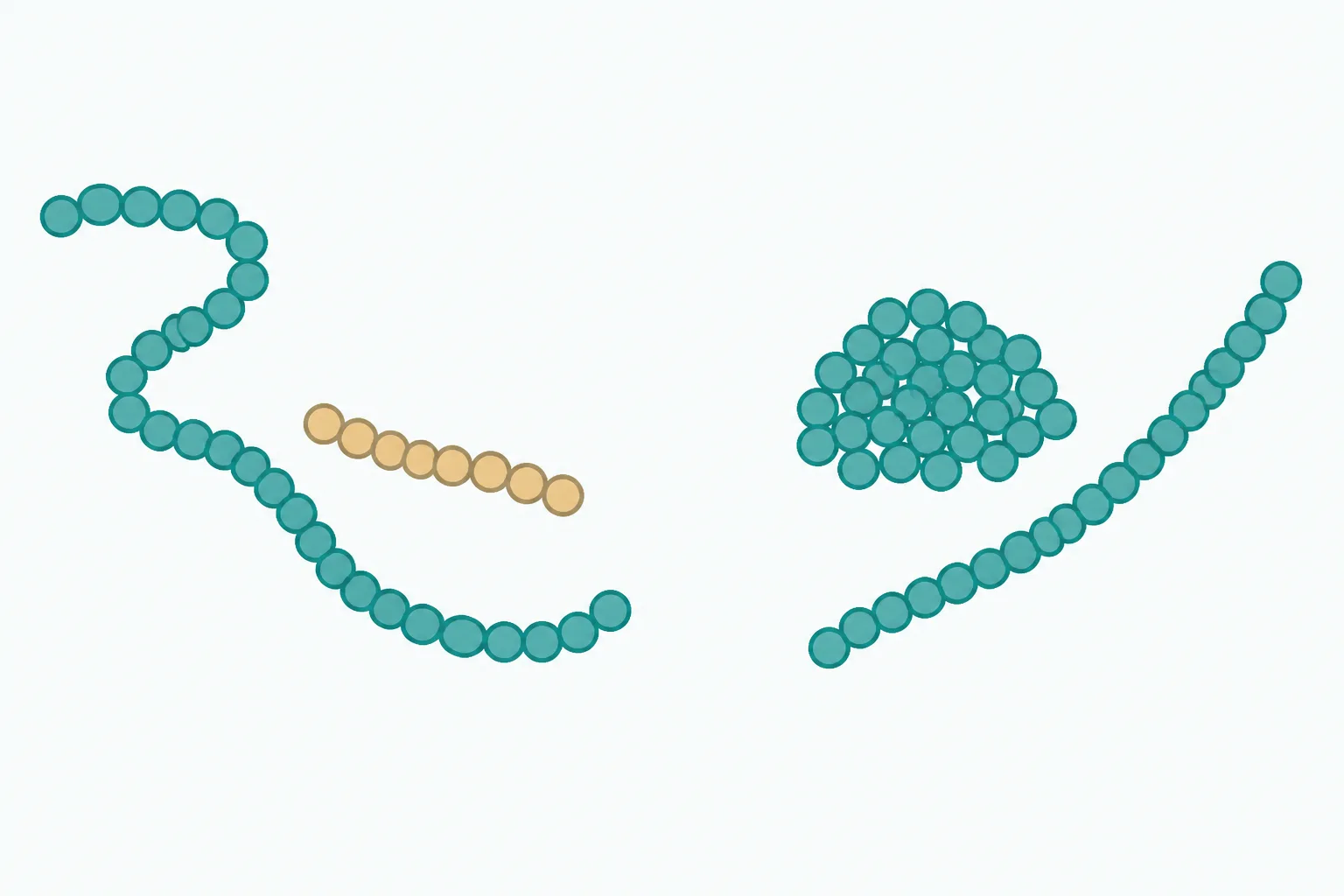
Rats, mice, and cells in a dish. That is the plain shape of the healing evidence, and it is neither a scandal nor a small detail. Injuries were made deliberately in rodents — skin wounds, damage to the eye surface, damage to heart muscle — and repair measured afterwards 3. Alongside that sits work done outside any animal: living cells kept in a shallow dish of nutrient liquid, watched to see what they do when something is added.
Here is the balancing half, and please do not skip it. Animal research is not a fake or lesser version of human research. It is an earlier stage of the same process, and nearly every medicine you have taken went through it first. A consistent finding in rodents is a good reason to run the human study, not a stand-in for having run it.
One complication gets used carelessly in both directions. The full natural molecule has been given to human volunteers in proper trials — for conditions of the eye surface, treated directly. That is real human testing and should not be waved away. It is also a different tissue and a different problem from the tendon, muscle and joint uses TB-500 is discussed for.
Which leaves the plain summary: there are no proper human trials of TB-500 for the uses it is discussed for. Not failed ones, not buried ones — none. The standard test is a randomized controlled trial, where volunteers are assigned by chance to the real thing or a dummy and the assessors do not know who got which. Nothing of that kind has been published. There is a companion explainer here on why the gap between a rodent result and a human one is wider than it looks.
What is genuinely not known
Plainly, and without theatre. These are ordinary gaps, and closing them is what the long expensive middle of drug development exists to do.
- Whether the shortened material does anything at all in a person. Every reported healing effect comes from an animal, from cells in a dish, or from the full natural molecule rather than the product sold under the shorter name.
- What a human body does with it. No published study measures how a person absorbs it, where it travels, or how quickly it is cleared out.
- What is actually in a given container, since the name has no fixed chemical definition and one supplier's material need not match another's.
- Whether it is safe over a long period. Animal healing studies run for days or weeks, and a problem that takes years to appear cannot appear in a study that finishes first.
- How it behaves alongside anything else a person might be taking. Nobody has looked.
One of those deserves its own paragraph, carefully. A central part of the proposed mechanism is encouraging new blood vessels to grow. In a tissue trying to repair itself that is helpful. It is not something anybody would want encouraged indiscriminately, everywhere in the body, over a long stretch of time — because some things grow better when they are better supplied with blood, and not all of them are things you would want to help along.
That is not a claim that this compound causes harm. Nothing of the sort has been shown, and implying it would be as dishonest as overselling the benefits. It is a reason the long-term safety question is serious rather than a formality, and why "nobody has reported a problem" carries less weight than it sounds, when hardly anybody has been followed long enough to report one.
Is it a medicine? Is it legal?
It is not a medicine, in the specific sense that word carries in law. A medicine is a substance a regulator has examined and then permitted to be sold for treating something. In the United States that regulator is the Food and Drug Administration; in Britain, the Medicines and Healthcare products Regulatory Agency; across the European Union, the European Medicines Agency. None has approved TB-500, or thymosin beta-4, for any use.
What it is sold as instead is a laboratory research chemical. Products in that category are labelled research use only, a legal classification rather than a statement about quality: the seller is not offering the material for use in people, and nobody has checked it the way a pharmacy medicine is checked. It is also banned in competitive sport, at all times rather than only in competition.
The honest summary is the useful one
Three things, and they belong together. There is a natural molecule whose everyday work inside your cells is well understood and not in dispute. There is a marketed product that is usually not quite that molecule. And there is no human evidence for the claims made about the product.
What makes this confusing to read about is that the first of those is used to lend weight to the third. The cell biology really is solid, and its solidity gets borrowed — quietly, often without anybody meaning to deceive — to make untested claims sound settled. Strong evidence for what a molecule does inside a cell is not evidence that giving somebody a fragment of it will heal an injury.
So when you meet the next confident sentence about this peptide, put three questions to it. Which molecule was in the experiment — the full natural one, or a shorter construct? What was it tested in: a person, a rodent, or a dish? And is the strength of the cell biology being used to carry a claim it does not reach? A reader holding "well-understood biology, unproven product" is in better shape than one told it definitely works, and better shape than one told it is nonsense. The uncomfortable middle is the accurate place to stand, and standing there costs you nothing.
References
- Thymosin beta4: actin-sequestering protein moonlights to repair injured tissues
- Thymosin beta4 stimulates directional migration of human umbilical vein endothelial cells
- Animal studies with thymosin beta4, a multifunctional tissue repair and regeneration peptide
- Biological activities of thymosin beta4 defined by active sites in short peptide sequences