compounds explained simply
What Is Growth Hormone?
Growth hormone has been sold as an anti-aging treatment for more than thirty years, largely on the strength of one small study. Here is what the hormone actually is, and why replacing a deficiency and topping up a healthy person are not the same thing at all.
For a healthy person hoping to slow down aging, the honest answer is no — not on the evidence there is. When researchers eventually ran the careful trials — healthy older people, a dummy treatment for comparison, nobody told who was getting which — growth hormone produced small changes in body composition, no demonstrated improvement in strength or in the ability to exercise, and significantly more side effects among the treated group than among the untreated one 2. That is a long way from reversing aging. But there is a second half to the answer, and it is really why this page exists: for a small number of people who genuinely cannot make enough of their own, growth hormone is ordinary, well-evidenced medicine. Both of those things are true, and they get mistaken for one another constantly.
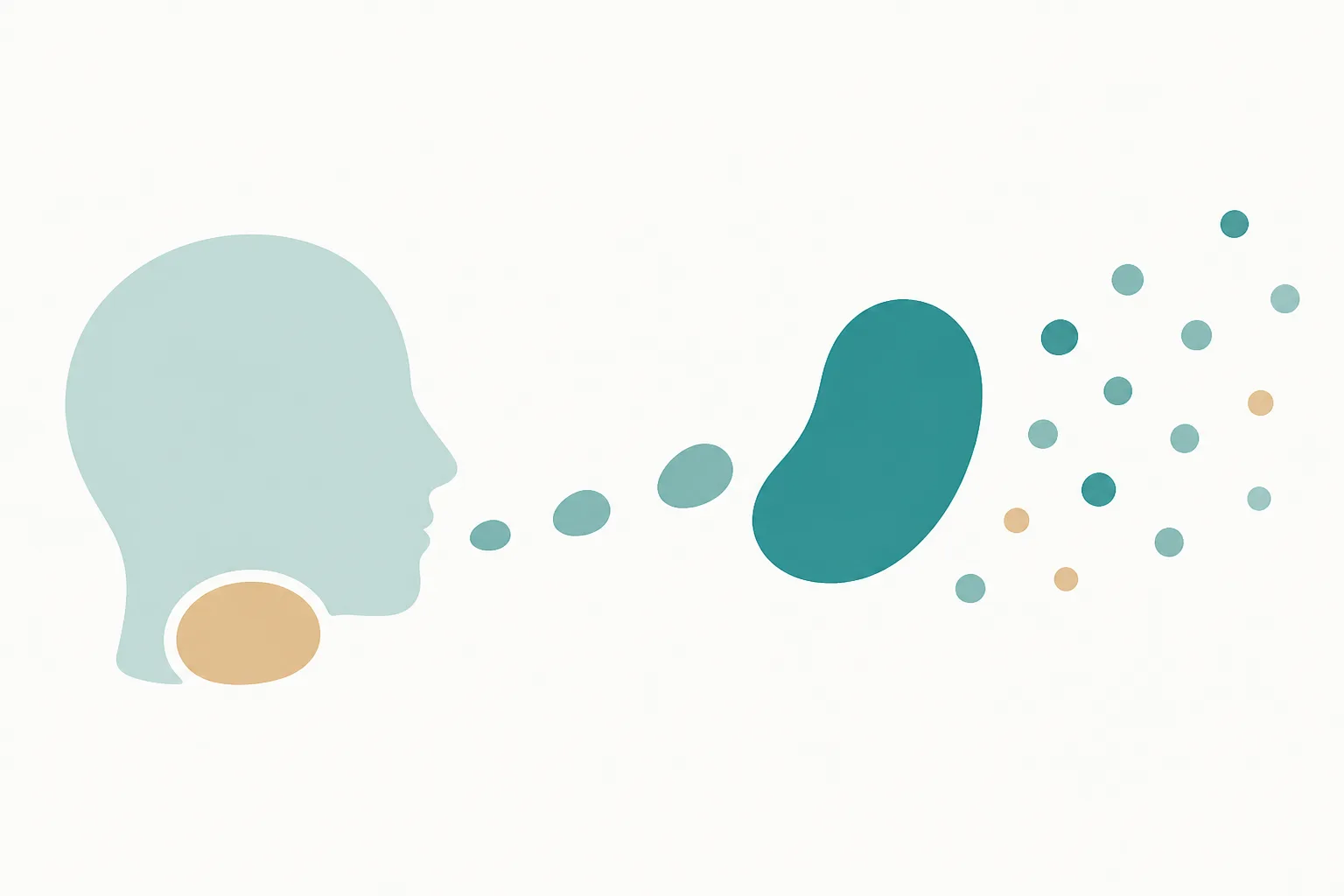
The hormone itself is nothing exotic. It is a protein your own body makes, released by the pituitary gland — a gland roughly the size of a pea, sitting at the base of your brain behind the bridge of your nose. It does not trickle out steadily. It arrives in bursts, and most of the big ones happen at night while you are asleep. In childhood it does the obvious job of driving growth. In adult life it keeps working on something quieter: how your body handles fat, and how it maintains muscle.
What is growth hormone, and where does it come from?
It helps to think of it less as a substance and more as an instruction. The pituitary releases growth hormone into the bloodstream in pulses — a sharp rise, then a long quiet stretch — and the largest ones arrive shortly after you fall asleep. That rhythm matters more than it sounds. A signal that comes and goes is read by the body quite differently from one simply present all the time.
In childhood the effect is the visible one: growth hormone is a large part of why a child gets taller, working on the growth plates near the ends of the long bones. Those plates close in the late teens and that job is finished. The hormone carries on, doing quieter work in an adult body — influencing how fat is stored and released, and helping keep muscle maintained.
How does it actually work?
By two routes at once, and knowing that explains a surprising amount of what follows. Some of growth hormone's effects are direct: it reaches a tissue, attaches to it, and something changes. But a great deal of the work is delegated. Growth hormone travels to the liver, and the liver responds by releasing a second messenger called IGF-1 — insulin-like growth factor 1, named because it looks, chemically, rather like insulin. IGF-1 then circulates and carries out much of the actual building. Growth hormone is closer to the order that goes out; IGF-1 is closer to the crew that turns up.
One more piece of background, because it is where most of the marketing lives. Growth hormone output falls gradually from early adulthood onward, in essentially everybody. An older adult makes considerably less of it than they did in early adulthood. That decline is universal and expected, and it is not in itself a disease — a distinction the next section is entirely about.
Treating a deficiency is not the same as topping someone up
This is the point the whole article exists to make, so it is worth slowing right down. Some people really do not make enough growth hormone. In adults this almost always has a cause you could point at: disease of the pituitary gland itself, surgery in that region, radiation treatment directed at or near the head, or a serious head injury. The gland is small and awkwardly placed, and things that happen nearby tend to affect it.
For those people, giving back the hormone they are missing is ordinary medicine. Adult growth hormone deficiency is a recognised diagnosis with real consequences, and its management is covered by a clinical practice guideline setting out who should be tested, how the diagnosis is established, and how treatment is monitored afterwards 4. There is nothing fringe about it. A hormone is missing and it is replaced, which is the same logic as thyroid medicine for a thyroid gland that has stopped working properly.
And that logic does not extend outward. Bringing a low level back up to normal and pushing a normal level higher are not two strengths of the same treatment. They are different things being done to different bodies. Giving thyroid medicine to someone whose thyroid has failed is ordinary care; giving it to someone whose thyroid is fine is not a more enthusiastic version of that care, it is a separate act with separate consequences. Growth hormone works the same way, and so does the evidence: results obtained in people who were deficient tell you very little about what happens in a person whose pituitary is doing its job.
The guideline is also specific about how deficiency gets established, and this is where the most consequential misunderstanding happens. It is diagnosed by testing — a stimulus is given, the pituitary's response is measured, and the result is compared against a defined threshold 4. It is not diagnosed from a list of symptoms. Tiredness, less muscle, more weight around the middle, flat mood: those are the presenting features of a great many ordinary conditions, and of a difficult year. And it is not diagnosed from age. The gradual decline everybody experiences is simply not what the word deficiency means here.
Hold those two categories apart and most of the noise in this subject settles down by itself. Evidence from patients who were deficient gets quoted in support of use in people who are not, and the quotation is honest about the first group and worthless about the second. When something is described as proven, the useful question is: proven in whom?
The 1990 study, and what happened next
The modern story starts with a single paper. In 1990, researchers reported what happened when men over sixty were given human growth hormone for six months. The treated men gained lean mass and lost fat, and the authors observed that the size of those changes was comparable to what accumulates over a decade or more of aging 1. It is easy to see why that sentence travelled.
Here are the details that usually get left out, and they were never hidden — they are in the paper. Twenty-one men took part. Only twelve of them received the hormone. The other nine received nothing at all: no dummy injection, no attempt to keep anybody in the dark about who was getting what. Everyone involved knew, including the people taking the measurements 1.
That is not an accusation. A small, short, unblinded study is a perfectly reasonable first step, and it is what a first step usually looks like. Its job is to find out whether an idea is worth the considerable expense of testing properly. The researchers were doing science in the normal order. What went wrong happened to the paper afterwards rather than inside it: it was read as proof that growth hormone reverses aging, and within a few years a whole commercial sector existed on the strength of twelve treated men studied for six months.
Then the proper experiments were done. A randomised trial in healthy older women and men used a placebo, kept everyone blinded, and measured function as well as body composition 3. A systematic review later pooled the controlled trials in healthy older adults and reported what they showed together 2. The picture that came back is much smaller than the one being sold: modest changes in body composition, no demonstrated improvement in strength or in the ability to exercise, and significantly more side effects among those treated.
- Swelling, from the body retaining fluid — the most consistently reported effect of the lot.
- Joint pain.
- Carpal tunnel syndrome — a nerve squeezed where it passes through the wrist, causing numbness, tingling and weakness in the hand. Plausibly a consequence of that same fluid retention.
- Raised blood sugar. Growth hormone works against insulin, the signal that moves sugar out of the blood, so this one is expected rather than surprising.
That list is what breaks the arithmetic. Side effects are not by themselves a reason to avoid a treatment — they get weighed against the benefit, and plenty of good medicines carry worse ones. But weighing needs something on the other side of the scale. Where the controlled trials find no demonstrated improvement in what a person can actually do, there is nothing there to set against them.
Muscle and water are not the same thing
One detail explains most of the gap between the impressive numbers and the unimpressive results, and it is refreshingly concrete. Lean mass is not a measurement of muscle. It is defined by subtraction: everything in the body that is neither fat nor bone. That includes muscle. It also includes water.
Growth hormone makes the body hold on to fluid, reliably, and to a degree sufficient to produce the swelling at the top of that side-effect list. Fluid held in tissue gets counted as lean mass, because the measurement cannot tell the two apart. So a reported gain is some tissue and some water mixed together, in a proportion nobody can read off the result.
Which is why strength is the honest test, and why it matters that strength did not follow 23. Water does not pull on a bone. If the extra lean mass were mostly working muscle, people would be expected to get stronger, and in the controlled trials they largely did not. The number went up. The thing the number was standing in for did not.
Is it a medicine? Is it legal?
It is a medicine, in the strict sense of the word: growth hormone is a prescription drug, approved for specific diagnosed conditions and obtained through a doctor for those conditions. That is what makes the rest of the picture clear-cut. Supplying or prescribing it for anti-aging or athletic purposes falls outside those approvals, and in many places — including the United States — that is unlawful rather than merely frowned upon. It is also banned in competitive sport, appearing on the World Anti-Doping Agency's prohibited list, which means an athlete who tests positive faces the usual consequences whatever their reasons were.
The lesson worth keeping
The most useful thing here is not really about growth hormone at all. It is about how one honest study became an industry. Nobody faked anything. A small group of researchers ran a reasonable first experiment, described it accurately, and published it in a respectable journal. The trouble was that a great many people stopped reading at the first result — and a first result is the least reliable one there will ever be on any question.
The better evidence was never hidden either. It was published in plain sight, by ordinary means, and anybody who wanted to look could have found it 23. It simply arrived later, said something smaller, and was far less exciting than what people had believed for a decade. Corrections travel more slowly than claims do, and they reach a smaller room.
So the habit worth taking away is to keep reading past the first striking finding, and to put three plain questions to anything that impresses you.
- How many people were in it? Twelve is a beginning, not an answer.
- Was there a fair comparison — a dummy treatment, with nobody knowing who received which?
- Was the thing measured something a person would actually notice, or a number standing in for it?
None of that requires a background in science. Those three questions separate a study worth following up from a study worth acting on, and in this case they were answerable from the very beginning.
References
- Effects of human growth hormone in men over 60 years old
- Systematic review: the safety and efficacy of growth hormone in the healthy elderly
- Growth hormone and sex steroid administration in healthy aged women and men: a randomized controlled trial
- Evaluation and treatment of adult growth hormone deficiency: an Endocrine Society clinical practice guideline