What Is Selank?
It began with a four-link fragment that your own immune system produces, discovered by accident in a Boston laboratory in 1970. Selank is what happened when Russian researchers took that fragment and made it last longer.
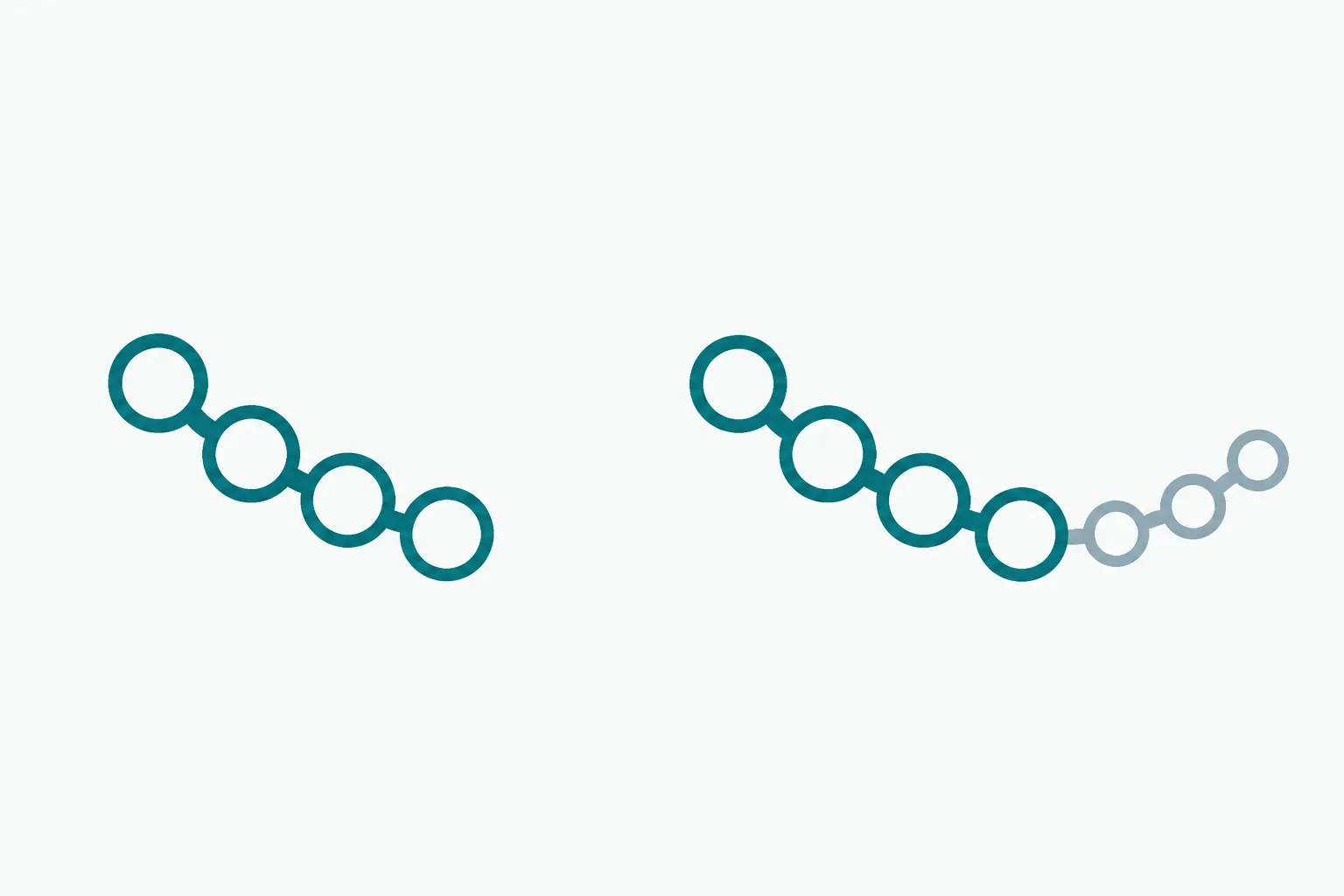
Selank is a peptide of seven amino acids, made in a laboratory. A peptide is a short chain of amino acids, and amino acids are the small building-block molecules that living things link together to make proteins. Four of Selank's seven links are copied from something your own body produces. The other three were added deliberately, for a reason that turns out to be the most interesting part of the story.
It was developed in Russia, and that fact does more work than it might appear to. It shapes what research exists, where it was published, what language it is in, and how much of it anyone outside that system has actually been able to examine. We will come back to that at length, because it is the honest answer to the question most people really want answered — how much should I believe about this?
This article explains the compound from the ground up: what the original natural fragment is, why anyone would modify it, what a neuropeptide is, what the research has looked at, and where the real limits of that research sit.
Start with tuftsin: what a naturally occurring fragment is
Your immune system makes antibodies: large Y-shaped proteins that latch onto things that should not be in you. An antibody is a big molecule, hundreds of amino acids long, folded into a precise shape.
In 1970, researchers at Tufts University in Massachusetts reported that when part of an antibody is cut in a particular place, a very short piece is released — four amino acids long — and that this small piece is not inert leftover material. It has a job of its own. It prompts certain white blood cells to engulf and destroy debris and invaders, a process called phagocytosis, from older words meaning cell-eating. They named the fragment tuftsin after the university 1.
That is what a naturally occurring fragment means: not a molecule the body builds from scratch for the purpose, but a small piece cut out of something larger, which turns out to carry a signal in its own right. It is a bit like tearing a paragraph out of a long document and finding that the paragraph alone is a perfectly good instruction.
The reason this matters for beginners is that it explains a design strategy you will see again and again in peptide research. If a big protein does several things at once, and one small piece of it seems responsible for one of those things, then making just that piece is an obvious thing to try.
How Selank was made from it
Natural tuftsin has a practical problem: it does not last. Your body is full of enzymes, which are protein machines whose job is to cut other molecules apart, and a four-link chain floating loose is dismantled very quickly. Something broken down in minutes is difficult to study and difficult to work with.
So researchers at the Institute of Molecular Genetics in Moscow, working with a pharmacology institute, added three more amino acids to one end of the tuftsin sequence. The addition was chosen because chains of that particular kind are awkward for the relevant enzymes to grip. The result is a seven-link peptide whose first four links are unchanged tuftsin and whose last three are, in effect, armour.
That word for this kind of modified copy is analogue: a molecule built to resemble a natural one closely enough to behave similarly, with deliberate changes. Almost all analogue design is some version of what happened here — keep the part that carries the signal, change the part that determines how long the molecule survives.
What is a neuropeptide?
Selank is generally described as a neuropeptide, so here is what that word means with nothing assumed.
Nerve cells communicate by releasing chemical messengers across the tiny gaps between them. The best known of those messengers are small, fast-acting molecules that carry signals in fractions of a second. But nerve cells also release short peptides, and these behave differently: they tend to act more slowly, spread further, and rather than delivering a single instruction, they adjust how strongly other signals are received. A neuropeptide is simply a peptide doing that job.
A rough analogy: if the fast messengers are individual words shouted between two people, neuropeptides are more like the volume knob and the room acoustics. They change how the conversation lands rather than saying anything themselves. This is why research on neuropeptides so often talks about modulating rather than causing.
One of the systems this compound has been studied against is the brain's main calming signal system, which is built around a messenger called GABA. Researchers reported that giving Selank to rats changed the activity of genes involved in that system in brain tissue 4. Note carefully what that is: a measurement of gene activity in animal tissue, which is several steps away from anything you could describe as an effect on a person.
What has the research examined?
Three strands, and it is worth keeping them separate rather than blending them into a single impression.
The first is immune and inflammatory biology, which is the strand closest to tuftsin's original known role. Researchers measured which inflammation-related genes were more or less active in the spleens of mice given the compound, and reported changes 2. The spleen is an organ heavily involved in immune activity, so that is a reasonable place to look.
The second is animal behaviour. Rats were placed in standard laboratory setups designed to produce measurable stress responses, and their behaviour was scored. One such study reported that the peptide altered those scores, and that it changed how the animals responded to an established sedative drug given alongside it 5. These are behavioural measurements in rodents under laboratory conditions built specifically to make differences visible.
The third is a small set of clinical studies in Russia, where the compound has been investigated as a treatment and where patients were scored on standard rating questionnaires 3. These studies exist and are real. They are also small, conducted within one country's research and regulatory system, and have not been repeated by independent groups elsewhere.
| Strand | Setting | What it can reasonably tell you |
|---|---|---|
| Immune and inflammatory | Mouse tissue, gene activity measured | That something measurable changes in an animal organ |
| Behavioural | Rats in standard laboratory stress setups | A reason for further study; not a human result |
| Clinical | Small studies in Russia, rating-scale scores | Little on its own until repeated by unconnected groups |
Where the research was done, and why it matters
Almost the entire literature on this compound was produced in Russia, by a small number of connected institutes, over roughly thirty years. A large share of it was published in Russian-language journals. Some of those journals are indexed internationally with an English abstract; many are not indexed at all.
This is not a claim that Russian research is unreliable. It is a plain statement about what is checkable. Science corrects itself through other people reading the methods closely and running the experiment again. When the methods sit behind a language barrier and a distribution barrier, that correction mechanism cannot operate. The findings are not disproven — they are unexamined, which is a different and less comfortable position.
There is a knock-on effect worth knowing about. English-language writing on this compound is frequently working from abstracts, translations, or from other English-language articles that were themselves working from abstracts. Each step drops caveats. A hedged result in the original becomes a firm claim three pages later, and nobody along that chain intended to mislead anyone.
So the useful posture is neither dismissal nor acceptance. There is a coherent design story here and a real body of published work. There is also almost no independent verification, and the volume of confident material online is far out of proportion to it.
Selank is a seven-amino-acid analogue of tuftsin, a natural immune fragment, redesigned to last longer in the body and studied mainly as a signalling molecule in the nervous system. The idea behind it is clean and easy to follow, which is part of why it is written about so confidently.
The state of the evidence is the harder thing to summarise honestly. The research exists, it spans decades, and it includes work in humans. It is also concentrated in one national research system and largely inaccessible in English, so the ordinary process by which findings get stress-tested has barely touched it. When you next read a firm sentence about this peptide, the question worth asking is not whether a study exists, but whether anyone outside the group that produced it has ever been able to look.
References
- Tuftsin: a natural phagocytosis stimulating peptide
- Expression of inflammation-related genes in mouse spleen under tuftsin analog Selank
- Efficacy and possible mechanisms of action of a new peptide anxiolytic Selank in the therapy of generalized anxiety disorders and neurasthenia
- Selank Administration Affects the Expression of Some Genes Involved in GABAergic Neurotransmission
- Peptide Selank Enhances the Effect of Diazepam in Reducing Anxiety in Unpredictable Chronic Mild Stress Conditions in Rats