What Is CJC-1295? And What Does DAC Mean?
Almost every page about this compound mentions "with DAC" and "without DAC" and then moves on as if you already knew. You almost certainly do not, and nobody explains it. It is a difference in how long the molecule lasts, and here is the whole of it.
CJC-1295 is a laboratory-made copy of a natural signalling molecule, modified so that it lasts vastly longer in the body than the original does. The natural molecule it copies is growth hormone releasing hormone. If that phrase means nothing to you yet, good — we are going to build it from nothing.
The other thing this page is here for is the DAC business. Every article about this compound splits it into "with DAC" and "without DAC" and then carries on as though the reader already understood the distinction. Hardly anyone explains it. It is not complicated, and it is not really about strength or potency. It is a difference in duration — how long the molecule survives before the body clears it away.
By the end of this you should be able to read any page about this compound and know exactly what it is claiming, which is a more durable thing to own than a verdict.
Growth hormone releasing hormone, from scratch
A hormone is a chemical message released by one part of the body that travels through the blood and changes the behaviour of a different part. The body runs a great deal of its business this way, and it very often does so in chains of command rather than single instructions.
Growth hormone is one link in such a chain. It is produced by the pituitary, a gland about the size of a pea sitting underneath the brain, and it influences growth, tissue repair and how the body handles fuel. But the pituitary does not decide on its own when to release it. It waits to be told.
The telling is done by the hypothalamus, a region of the brain directly above the pituitary, which releases a message of its own. That message is growth hormone releasing hormone — usually shortened to GHRH, and sometimes called growth hormone releasing factor. Its entire job is to instruct the pituitary to release growth hormone.
It took a long time to pin down. Researchers were confident such a signal existed for years before anyone isolated it, and it was finally identified in 1982 from an unusual source: a tumour that was producing the hormone in large quantities and causing overgrowth in the patient it came from 1. A rare accident of biology handed researchers enough material to work with.
One more detail matters for everything that follows. The natural GHRH molecule is forty-four amino acids long, but researchers found that only the first twenty-nine are needed to deliver the message. The rest can be left off. That shortened piece is the starting point for the compound this article is about.
What is an analogue?
An analogue is a molecule built to resemble a natural one closely enough to be recognised in the same way, but with deliberate alterations. Think of a spare key cut to open the same lock, but made from a tougher metal so it does not wear out.
The alterations almost always exist to fix a practical problem, and with peptides the problem is nearly always the same one: the natural molecule does not last. Your blood and tissues are full of enzymes — protein machines whose job is cutting other molecules apart — and a short peptide loose in circulation is dismantled fast. Natural GHRH lasts a matter of minutes.
So the twenty-nine-amino-acid fragment was given a small number of substitutions at the points where those enzymes normally cut. That buys some time. It does not buy much: the modified fragment on its own still has a working life measured in minutes, not hours.
So what does DAC actually mean?
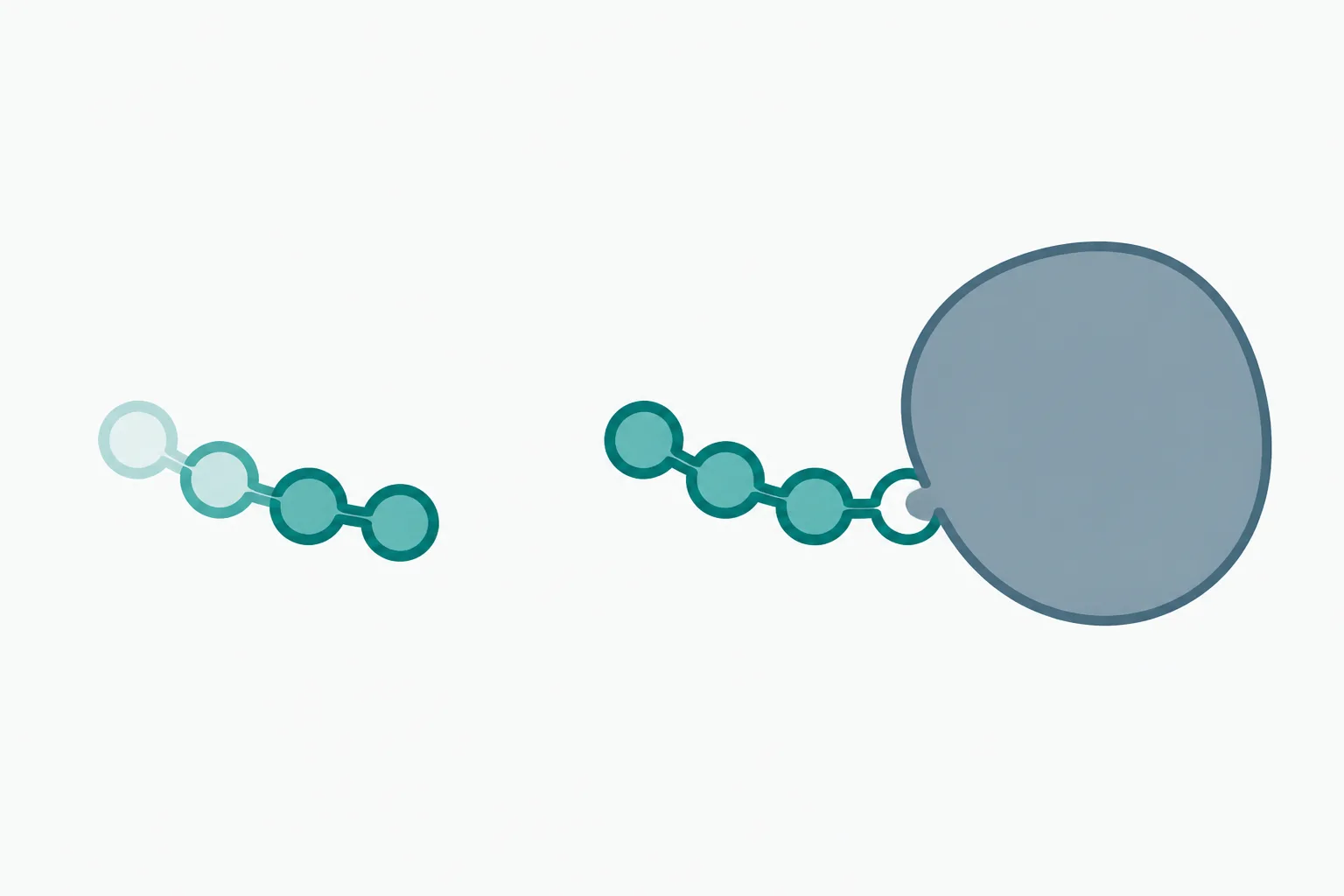
DAC stands for Drug Affinity Complex. Stripped of the jargon, it is a small chemical hook bolted onto one end of the peptide, and the hook is designed to grab hold of one specific thing.
That thing is albumin. Albumin is the most abundant protein in your blood — a large, sturdy molecule that acts as a general-purpose carrier, ferrying all sorts of substances around the body. Crucially, albumin is not disposed of quickly. A single albumin molecule circulates for something in the order of weeks.
So the hook does something rather elegant. Once the peptide is in the bloodstream, it latches onto a passing albumin molecule and effectively hitches a ride. Enzymes that would have taken the small peptide apart in minutes now have a much harder time reaching it, and the peptide is released gradually over a long period. The 2005 study that first described these albumin-linked versions in rats is where the name CJC-1295 was attached to the long-lasting one 2.
The difference is not subtle. In healthy adult volunteers, the with-DAC version was measured with a half-life of several days — meaning it takes days, not minutes, for half of what is present to be cleared — and elevated hormone measurements persisted for well over a week after a single administration 3. The plain peptide, without the hook, is gone from circulation before you have finished reading this section.
| Version | What it is | Roughly how long it lasts |
|---|---|---|
| Natural GHRH | The body's own forty-four-amino-acid signal | Minutes |
| The modified 1–29 fragment ("without DAC") | The signal-carrying portion, with substitutions to resist enzymes | Minutes |
| CJC-1295 with DAC | The same fragment plus a hook that binds to albumin in blood | Days |
Why do researchers care how long something lasts?
The obvious answer is convenience, and it is not the interesting one. The interesting answer is that duration can change what a signal means.
Growth hormone is not released in a steady trickle. It comes in bursts — pulses through the day and night, with the largest usually during sleep, separated by long quiet stretches. That pattern is not incidental. Bodies frequently read the shape of a signal, not just its presence. A thermostat clicking on and off says something different from a heater simply left running.
So a compound that switches the releasing signal on and leaves it on for days raises a real biological question: does the pulsing survive? Researchers checked. In a study designed specifically to look at this, the pulses of growth hormone release persisted rather than flattening out into a steady level, even while the stimulating signal was continuously present 4. That was a genuinely important finding, and it is the kind of question the duration change forces you to ask.
It is also why a long-acting version is not simply a more convenient short-acting one. It is a different intervention, and its effects have to be established separately rather than assumed.
What does the evidence actually amount to?
More than for most compounds discussed on this site, and still much less than most people assume.
There is animal work establishing that the albumin-linked version reaches the pituitary and acts there 2, and a study in mice genetically unable to make their own GHRH, where the compound restored normal growth 5. That last one is a clean demonstration that the molecule does the specific job it was designed to do.
There is also real human work, which is unusual in this field. Healthy volunteers received the compound and had their hormone levels tracked, showing sustained elevation of both growth hormone and a related marker over days 3. A companion study examined the pulsing question 4.
Now the limits, which are substantial. Those human studies are early-stage: their purpose was to establish what the compound does to measurements in the blood and whether it was tolerated over a short period, in small numbers of healthy people. They were not designed to show that anyone got better at anything, and they did not. Development never proceeded to the large trials that would be required for approval anywhere, and no regulator has approved it. So there is no long-term safety record, and no evidence at all about whether moving those blood markers translates into any benefit or harm over months and years.
The DAC distinction, which sounded like insider jargon at the top of this page, is one idea: a hook that binds the peptide to a long-lived carrier protein in the blood, turning minutes into days. Everything else people say about with-DAC and without-DAC follows from that single change.
And the evidence status is worth stating in one line, because it is easily lost among the technical detail. This compound has been shown to raise certain hormone measurements in healthy people for an extended period. That is a real finding. It is not the same as having been shown to do anybody any good, and the studies that would settle that question were never run.
References
- Growth hormone-releasing factor from a human pancreatic tumor that caused acromegaly
- Human growth hormone-releasing factor (hGRF)1-29-albumin bioconjugates activate the GRF receptor on the anterior pituitary in rats: identification of CJC-1295 as a long-lasting GRF analog
- Prolonged stimulation of growth hormone (GH) and insulin-like growth factor I secretion by CJC-1295, a long-acting analog of GH-releasing hormone, in healthy adults
- Pulsatile secretion of growth hormone (GH) persists during continuous stimulation by CJC-1295, a long-acting GH-releasing hormone analog
- Once-daily administration of CJC-1295, a long-acting growth hormone-releasing hormone (GHRH) analog, normalizes growth in the GHRH knockout mouse