What Is Epitalon?
A peptide of only four amino acids, taken from a gland the size of a grain of rice, and attached to some very large claims about ageing. The compound is easy to describe. The evidence behind it is the part that needs care.
Epitalon is a peptide made of four amino acids. A peptide is a short chain of amino acids, and amino acids are the small building-block molecules that living things link together to make proteins. Four links is short even by the standards of short things. Most of the peptides people read about are ten, fifteen, thirty units long. This one is barely a chain at all.
It comes out of a line of Russian research into the pineal gland, a pea-sized structure buried near the middle of the brain, and it is usually discussed alongside telomeres and ageing. Those are big claims for a very small molecule, so this article does two jobs. It explains, in plain terms, what the compound is and what the ideas behind it are. And it is honest about the state of the evidence, which is thinner and harder to check than almost anything else covered on this site.
That second job is the more important one. A beginner reading confident summaries elsewhere has no way to tell a large, replicated body of work from a small one produced almost entirely by a single team. Here, it is the second.
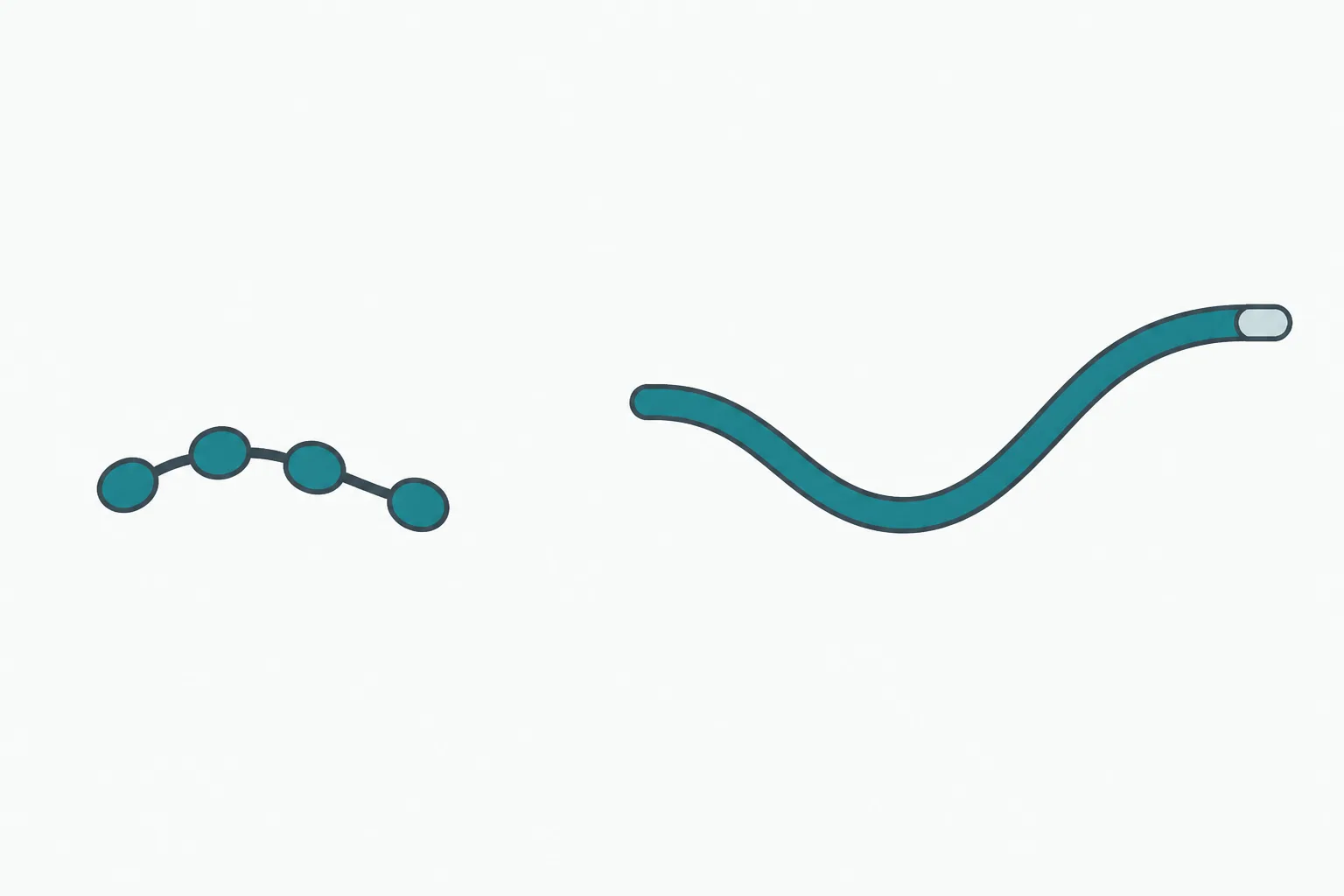
Four amino acids is very short indeed
It helps to have a sense of scale. A typical protein in your body is a chain of hundreds of amino acids folded into a specific shape. Insulin, one of the smaller well-known ones, is fifty-one. A peptide is anything short enough not to count as a protein, and most of the research peptides you will read about sit between about five and forty links.
Epitalon has four: alanine, glutamic acid, aspartic acid and glycine, in that order. That is where the alternative name AEDG comes from — the single-letter shorthand chemists use for each of those four. Four links is about as small as a molecule can be and still be called a peptide.
Shortness matters for a practical reason. Your body is extremely good at taking peptides apart. Enzymes — protein machines that cut other molecules — are constantly at work in blood and tissue, and a very short chain generally has a very short life once it is loose in the body. This is why almost no peptide survives being swallowed, and it is also why a compound this small raises an obvious question that the published work has not clearly answered: how long does it last, and where does it get to before it is dismantled?
Where it came from: the pineal gland
The pineal gland is a small cone-shaped structure roughly the size of a grain of rice, sitting deep in the brain. Its best-understood job is producing melatonin, the hormone that rises in the evening and falls in the morning and helps set the daily rhythm of sleeping and waking. It has attracted a lot of speculative attention over the centuries, some of it scientific and some of it not.
In the Soviet Union from the 1970s onward, researchers at what became the St Petersburg Institute of Bioregulation and Gerontology worked on preparations made from animal tissue. One of them, Epithalamin, was an extract of pineal glands taken from cattle. Extract is the key word: it was not a single defined molecule but a mixture, prepared from ground-up tissue, containing many peptides at once.
Reports from that era described this extract extending the lifespan of fruit flies, mice and rats 3. Epitalon was the next step — an attempt to identify a short sequence that could stand in for the mixture, and then make it synthetically in a laboratory instead of harvesting glands. That progression, from crude extract to defined synthetic molecule, is a genuinely sensible piece of pharmacology and the same route many real medicines have taken.
Telomeres, explained plainly
Telomeres are the reason this compound gets discussed in the context of ageing, so they are worth understanding on their own terms.
Your DNA is packaged into long strands called chromosomes. At each end of a chromosome sits a repeated stretch of DNA that carries no instructions for anything — it is there purely to protect the useful part behind it. The standard comparison is the plastic tip on the end of a shoelace: it is not the lace, but without it the lace frays.
Every time a cell divides, it has to copy all of its DNA, and the copying machinery cannot quite reach the very end of the strand. A small amount is lost each time. So the caps get shorter with each division. This was demonstrated in human cells in 1990, in a study that watched telomeres shrink as cells were grown through repeated divisions 1. Eventually the caps get too short, and the cell stops dividing altogether.
There is an enzyme that can rebuild them, called telomerase. Most ordinary adult cells keep it switched largely off. Some cells — those that must keep dividing indefinitely — keep it on. The obvious thought, which has occurred to a great many people, is that switching telomerase on more widely might slow some aspects of ageing.
It is worth saying that this thought has an unresolved shadow. Cells that divide without limit are also what cancer is, and many cancers do keep telomerase switched on. Nobody has shown that this compound causes such a problem, and in fact some of the animal work reports the opposite — fewer spontaneous tumours in treated mice than untreated ones 45. But it is the reason serious researchers treat telomere lengthening as a two-sided question rather than a straightforwardly good thing.
What have the studies actually looked at?
Broadly four kinds of experiment. Cells in a dish, where human cells were grown in nutrient liquid and reported to show telomerase activity and longer telomeres after exposure to the peptide 2. Fruit flies, mice and rats, where lifespan and various markers of ageing were measured 34. Tumour development in mice bred to be prone to it, where treated animals were reported to develop fewer tumours 5. And some small human observations, mostly conducted in Russia and mostly reported in Russian-language journals.
| Kind of study | What was reported | What it can tell you |
|---|---|---|
| Human cells in a dish | Telomerase activity and telomere lengthening | That something happens to isolated cells; nothing about a whole body |
| Fruit flies, mice, rats | Longer average lifespan, altered ageing markers | A reason to test further, not a human result |
| Tumour-prone mice | Fewer spontaneous tumours than untreated animals | Reassuring in that specific strain of mouse only |
| Small human reports | Various, mostly from one institute | Very little on their own, without independent repetition |
Why this evidence base is unusually hard to check
Here is the part that other summaries tend to leave out, and it is the single most useful thing on this page.
First, the concentration problem. Nearly all of the research on this compound over several decades traces back to one institute and a small circle of collaborators 2345. A long list of papers can look like a field's worth of agreement when it is really one continuing programme. What science relies on to catch mistakes is other people, with no stake in the result, running the experiment again and getting the same answer. There is very little of that here.
Second, the access problem. A meaningful share of the work was published in Russian, in journals that are not widely indexed and are difficult to obtain. That is not a judgement about the quality of Russian science. It is a practical statement: if you cannot read the methods, you cannot assess the study, and neither can most of the researchers who would otherwise be checking it.
Third, the era problem. Much of the foundational work dates from a period when standards for reporting animal experiments were looser everywhere in the world. Details that reviewers now insist on — how animals were assigned to groups, whether the people measuring the outcome knew which group was which — are often simply absent.
Put those together and you get a compound with a large reputation resting on a small, self-contained and partly inaccessible body of work. That is not the same as saying the findings are wrong. It is saying that nobody outside that circle is in a position to know, and that the confident claims circulating about this peptide are far firmer than what supports them.
Epitalon is a four-amino-acid synthetic peptide, descended from a glandular extract, associated with a real and interesting biological idea about telomeres. The animal and cell work reporting effects exists and is genuine published research. What is missing is everything that would let anyone outside the originating group be confident about it.
There is a useful general lesson here, worth more than the details of any single compound. When you are judging a claim, do not only count the studies. Ask who did them, whether anyone unconnected has repeated the work, and whether you could read the methods if you wanted to. A hundred papers from one building tell you less than three from three different countries. That is not cynicism about scientists. It is simply how error gets caught, and where it cannot operate, uncertainty stays much larger than the reference list makes it look.
References
- Telomeres shorten during ageing of human fibroblasts
- Epithalon peptide induces telomerase activity and telomere elongation in human somatic cells
- Pineal peptide preparation epithalamin increases the lifespan of fruit flies, mice and rats
- Effect of Epitalon on biomarkers of aging, life span and spontaneous tumor incidence in female Swiss-derived SHR mice
- Inhibitory effect of the peptide epitalon on the development of spontaneous mammary tumors in HER-2/neu transgenic mice