What Is a Feedback Loop? How the Body Keeps Its Own Thermostat
A feedback loop is a signal that turns down its own source. It is how the body keeps hormone levels steady instead of letting them run away, and it explains why the word "suppression" appears in research papers.
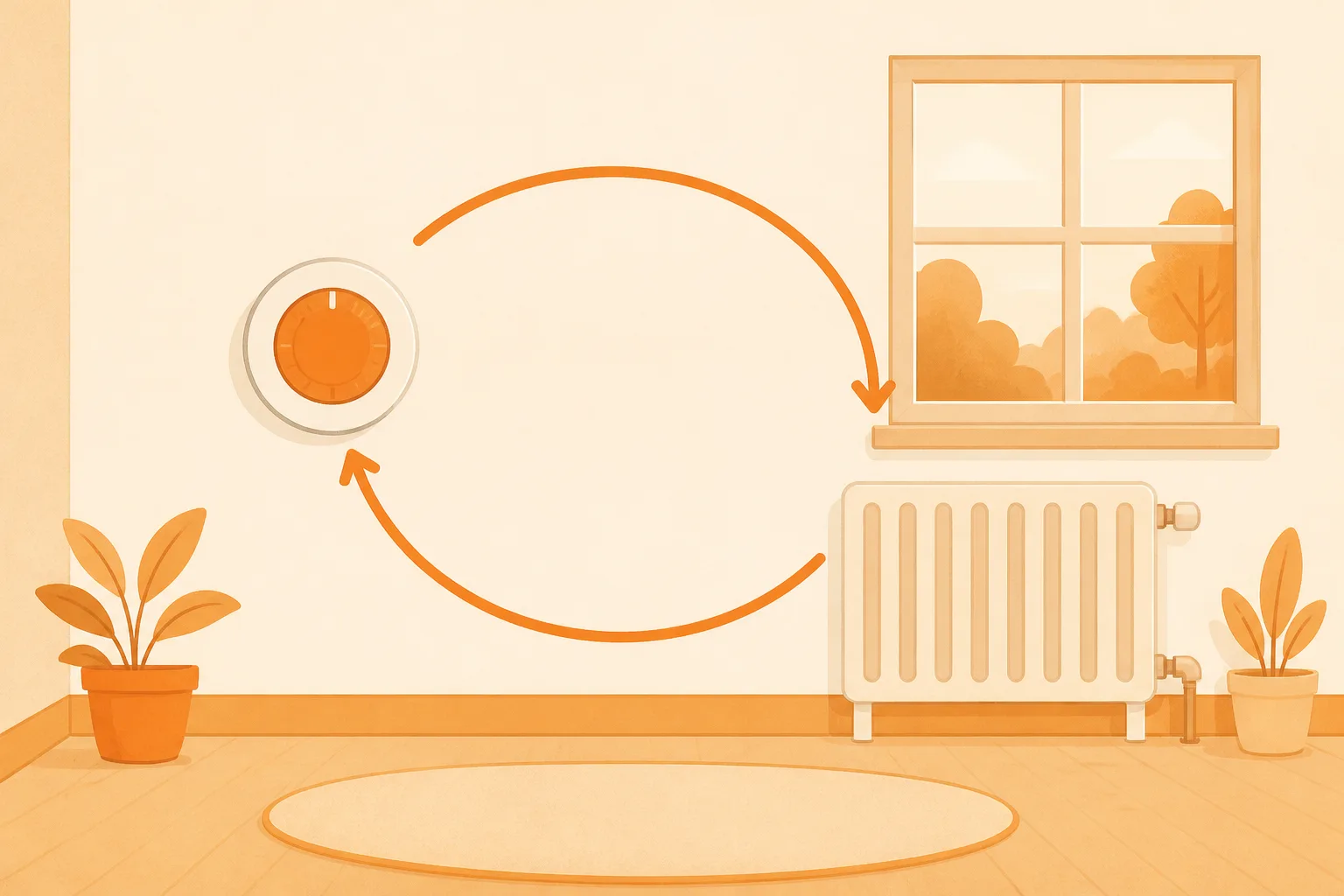
A feedback loop is a signal that, once it has done its job, turns down the thing that sent it. The classic picture is a home thermostat: the furnace warms the room, the warmth of the room tells the thermostat to switch the furnace off, and the result is a steady temperature rather than a runaway one. The body uses the same trick to stop hormone levels from simply rising forever.
This idea sits underneath a great deal of hormone science, and it is also behind a word that turns up in research articles about peptides: suppression. Once you understand the loop, that word stops being mysterious. This article explains how feedback works, walks through two textbook examples, and ends on what the research literature means when it talks about suppressing a system. It is an explanation of physiology, not advice about using anything.
A signal that turns down its own source
The body has a problem to solve. It relies on chemical messages called hormones, which are substances released by glands into the blood to give instructions to cells elsewhere. If a gland released its hormone whenever it was able to, with nothing telling it to stop, the level would climb and climb. If it never released any, the level would collapse. Neither would keep the body running.
The solution is to let the outcome report back. The effect of the hormone, or the level of the hormone itself, is detected by the system that controls the gland, and that information adjusts how much more is sent. The process is steered by its own results. That is what the word feedback means: information about the output being fed back to the input.
Physiologists call the steady state this achieves homeostasis, from the Greek for "staying the same". It does not mean nothing ever changes. It means that variables such as temperature, blood sugar and hormone levels are kept within a narrow, healthy range, and pushed back whenever they drift 13.
The thermostat, in detail
The thermostat is worth taking slowly, because every feedback loop has the same parts. There is a sensor, which measures the thing being controlled: the thermometer in the thermostat. There is a set point, the target the system aims for: the temperature you have chosen. There is a control centre, which compares the reading with the set point and decides what to do. And there is an effector, which acts to change things: the furnace 1.
When the room is colder than the set point, the control centre switches the furnace on. The room warms. When the sensor reports that the room has reached the set point, the control centre switches the furnace off. The room cools a little, the furnace comes on again, and the temperature wobbles gently around the target. The key feature is that the effect, warmth, reduces the cause, heating. That is why it is called negative feedback: negative here does not mean bad, it means opposing. The result works against the process that produced it.
Now replace the room with the body. The sensor is a cell or a gland that detects a level. The control centre is often in the brain. The effector is a gland that releases a hormone. Every loop in this article is a variation on that diagram.
Negative feedback: the thyroid example
The thyroid is a gland in the neck that produces hormones controlling how fast the body's cells use energy. Its control system is among the best-known examples of a hormone loop, and it has three stages, each with its own hormone 24.
At the top is a small region of the brain called the hypothalamus. It releases a signalling molecule that travels a very short distance to the pituitary gland, a pea-sized gland just underneath. The pituitary responds by releasing a hormone that travels in the blood to the thyroid. The thyroid then releases its own hormones, which act on cells throughout the body.
Here is the feedback. The thyroid hormones in the blood are detected back at the hypothalamus and pituitary. When they are plentiful, those upper stages reduce their own signals, so the thyroid is told to make less. When they are scarce, the signals increase. It is a thermostat in which the thyroid hormone is the temperature, and the pituitary and hypothalamus are the thermostat 4.
| Thermostat part | Room heating | Thyroid loop |
|---|---|---|
| Sensor and control centre | Thermostat on the wall | Hypothalamus and pituitary, detecting thyroid hormone in the blood |
| Effector | Furnace | Thyroid gland |
| Output | Warmth | Thyroid hormone |
| Feedback | Warm room switches furnace off | High thyroid hormone turns down the signals that drive the thyroid |
Blood sugar: a second loop
The same principle governs the amount of sugar, called glucose, in the blood. Glucose is the fuel cells burn, and the body needs the level kept within a narrow range 1.
After a meal, glucose in the blood rises. Cells in the pancreas, an organ behind the stomach, detect that rise and release a hormone called insulin. Insulin helps cells take up glucose from the blood, and signals the liver to store some. As glucose falls back towards the set point, the pancreas releases less insulin. The result of the process, lower glucose, reduces the process, insulin release.
The loop works in the opposite direction too. When glucose falls too low, a different hormone, glucagon, is released from other pancreatic cells and prompts the liver to release stored sugar into the blood. Two hormones pulling in opposite directions let the body correct a drift either way, much as a heater and an air conditioner together hold a room at one temperature.
The pituitary as the house's control panel
You will have noticed the pituitary gland appearing in the thyroid loop. This tiny gland, about the size of a pea and sitting at the base of the brain, relays instructions from the hypothalamus above it to many glands further away. Many hormone systems are arranged as a chain: hypothalamus, then pituitary, then a target gland, then the body's cells 2.
Growth hormone follows this pattern. A signalling molecule from the hypothalamus prompts the pituitary to release growth hormone, which acts on tissues and also prompts the liver to produce another signalling substance. That substance, together with growth hormone itself, feeds back to the upper stages to turn the system down. A second hypothalamic signal acts as a brake. The system as a whole holds growth hormone within a range, rising and falling through the day rather than climbing without end. Growth hormone is mentioned here only as an example of the pattern, and a separate article covers it on its own.
The upshot is that wherever a hormone is controlled by a chain, there are usually several points where a feedback signal can arrive. A message can be listened for at the pituitary, at the hypothalamus, or at both.
Positive feedback: the rare amplifying loop
Negative feedback keeps things steady. Positive feedback does the opposite: the result of a process makes the process stronger. It is rare in the body, and with good reason, because a loop that amplifies itself will keep going until something finishes it 1.
Two textbook cases show how it works. In blood clotting, the first platelets that gather at a wound release chemicals that attract more platelets, which release more chemicals, until the wound is sealed. In childbirth, the pressure of the baby on the cervix prompts the release of the hormone oxytocin, which strengthens contractions, which increases the pressure, which prompts more oxytocin, until the baby is born 1.
The pattern in both is a loop that is meant to run to a conclusion and then stop, because the event it drives ends. That is why positive feedback is the exception: it suits an event, not a steady state.
Why the word "suppression" turns up in research papers
Readers of peptide research meet the word suppression, and it can sound alarming. With the loop in mind, it is easy to decode.
In a feedback system, anything that looks to the sensor like "plenty of the output" makes the control centre turn its own signals down. The turning-down is a normal, expected part of the design. When a paper says a system was suppressed, it generally means that the upper stages of a loop reduced their activity because the level they monitor was high. It is a description of the loop doing what it is built to do.
It matters which tier of evidence a paper is describing. Feedback in textbook physiology is well established across many species, including people. Claims about a specific research compound acting on a specific loop are a separate matter, and the supporting evidence may come from cells in a dish, from animals, or from a small number of human studies. Those are different rungs, and a careful reader keeps them apart rather than merging them into one claim.
So the word "suppression" is best read as a pointer to the loop. It tells you which part of the thermostat the researchers are describing, not that something has gone wrong.
In one sentence
A feedback loop is the body's thermostat: a signal that, once it has done its work, quietly turns down its own source, which is why hormone levels hold steady instead of running away.