the lab in plain words
What Does "Sterile" Actually Mean?
Sterile means nothing alive is present. It is a stronger word than clean or disinfected, it is measured as a probability rather than a certainty, and it describes a sealed container — not one that has been opened.
Sterile means that nothing alive is present. No bacteria, no fungi, no viruses, and none of the tough dormant forms some bacteria use to survive hard times, called spores. It is an all-or-nothing word. Something is not a little bit sterile, or mostly sterile. It either has no living microorganisms in it, or it does not qualify.
That makes sterile a much stronger word than the ones it usually gets mixed up with, such as clean or disinfected. It also makes it a word about a particular moment and a particular state: a sealed container, as it left the place where it was made. This article explains what the word means, how that state is produced during manufacture, and how easily it ends. It is an explanation, not a set of handling instructions.
Clean, disinfected, sterile: three different promises
These three words are used loosely in everyday speech, but in hospitals and laboratories they mean quite different things, and the gap between them is large. United States infection-control guidance sets them out plainly 1.
Cleaning is the removal of visible dirt: grime, residue, organic material, usually with water and detergent. It is the first step before anything else, because dirt shields microorganisms from whatever comes next. But a clean surface can still be covered in living bacteria.
Disinfection goes further. It kills many or all of the microorganisms that cause disease, but not bacterial spores 1. Spores are the reason this distinction matters. They are a dormant, armoured form some bacteria switch into, and they shrug off treatments that kill ordinary cells. A disinfected item can therefore still carry life, waiting.
Sterilisation is the process that destroys or removes all forms of microbial life, spores included 1. The same guidance makes a point worth repeating: sterile is intended as an absolute word, and it is a mistake to talk about something being partially sterile 1.
| Word | What has been done | Can living organisms remain? |
|---|---|---|
| Clean | Visible dirt and residue removed | Yes, plenty |
| Disinfected | Most harmful microorganisms killed | Yes, especially spores |
| Sterile | All microbial life destroyed or removed | No — that is the definition |
An absolute word, measured as a probability
Here is a puzzle. If sterile means absolutely nothing alive, how would anyone know? You cannot look inside a sealed container without opening it. And the obvious way to check for bacteria, growing a sample to see if anything appears, uses up the item being tested. Test every container that way and you have nothing left to sell.
So sterility is not proved container by container. It is built into the process and expressed as a likelihood. The measure has a formal name, the sterility assurance level, which is the probability that a single living microorganism survives on an item after sterilisation. The widely used standard is one in a million 2. In plain terms: the process is designed and checked so that, at worst, about one item in every million might not be sterile.
Two things about that figure are worth knowing. First, it is a design target for a process, not a count anyone has made. Second, the infection-control guidance itself notes that the choice of one in a million was essentially arbitrary rather than derived from any observed harm 2. It is a convention that has held because it is very demanding, not because the number is magic.
Think of it like a car's brakes. No one tests every car by crashing it. Instead the design is proven, the factory is controlled, and a sample is checked. The confidence you have in any one car comes from the process that made it.
How sterility is achieved during manufacture
There are two broad routes, and which one a manufacturer uses depends mostly on whether the product can survive being heated.
The first route is called terminal sterilisation. Terminal here means at the end. The product is put into its final container and sealed, and only then is the sealed container treated to kill everything inside it. The usual treatment is steam under pressure, which regulators favour where a product can take it because it is reliable, consistent and very effective 2. Other methods include radiation and certain gases. The strength of this route is that nothing can get in after the killing step, because the container was already closed.
Many products cannot take that kind of heat. Peptides and proteins are among them, because heat can damage or unfold the molecules themselves. For these, manufacturers use the second route, called aseptic processing. Aseptic means without contamination. The liquid product and each container part are sterilised separately, and then they are brought together and sealed in an extremely clean, tightly controlled environment. Because there is no final killing step once the container is closed, everything depends on nothing getting in during that assembly 3.
A liquid that cannot be heated is usually made sterile by filtering it. Sterile filtration means pushing the liquid through a membrane with pores far smaller than a bacterium, so that microorganisms are held back while the liquid passes through. It is a physical sieve rather than a killing step, and it is one of the main tools of aseptic processing 3.
Both routes sit inside detailed manufacturing rules. The European rules for making sterile medicines, substantially revised in 2022, require manufacturers to build an overall strategy for controlling contamination across the whole facility, rather than relying on a final test to catch problems 4. That shift says something important: in sterile manufacturing, the process is the proof.
What sterile does not mean
Because sterile is such a strong word, people often assume it covers more than it does. It is a promise about one thing only: living microorganisms.
- It does not mean endotoxin-free. Endotoxin is a molecule left behind by certain bacteria, and it is not alive, so killing bacteria does not remove it.
- It does not mean pure. A sterile liquid can contain any amount of other substances, as long as none of them are alive.
- It does not confirm identity. Whether a substance is what the label says is a separate test entirely.
- It does not mean safe in a person. Sterility removes one kind of risk. It says nothing about the substance itself.
- It does not apply unless it is claimed. Many laboratory materials are never described as sterile, and a container that makes no such claim should not be assumed to meet it.
The first of those is the one most often misunderstood, so it is worth a sentence more. Endotoxin is heat-stable, and ordinary steam sterilisation does not significantly destroy it 5. A liquid can therefore be made fully sterile and still carry the leftovers of the bacteria that were killed. The previous article in this set explains why.
How sterility is lost
Here is the part people most often miss. Sterility is not a property that belongs to a substance the way its colour does. It is a state, and the state depends entirely on an unbroken barrier between the inside of the container and the outside world.
The air around us, every surface, and our own skin carry microorganisms all the time. That is normal and mostly harmless. But it means that the moment a seal is broken, the inside of a container is no longer separated from all of that. Whatever happens next, the contents have met the outside world, and the promise on the label described a state that no longer exists.
Sterility can also end without anyone opening anything. A cracked container, a damaged seal, a stopper that has been pierced, or packaging that has been crushed or soaked can all break the barrier. And because microorganisms are invisible, a container that has lost its sterility looks exactly like one that has not.
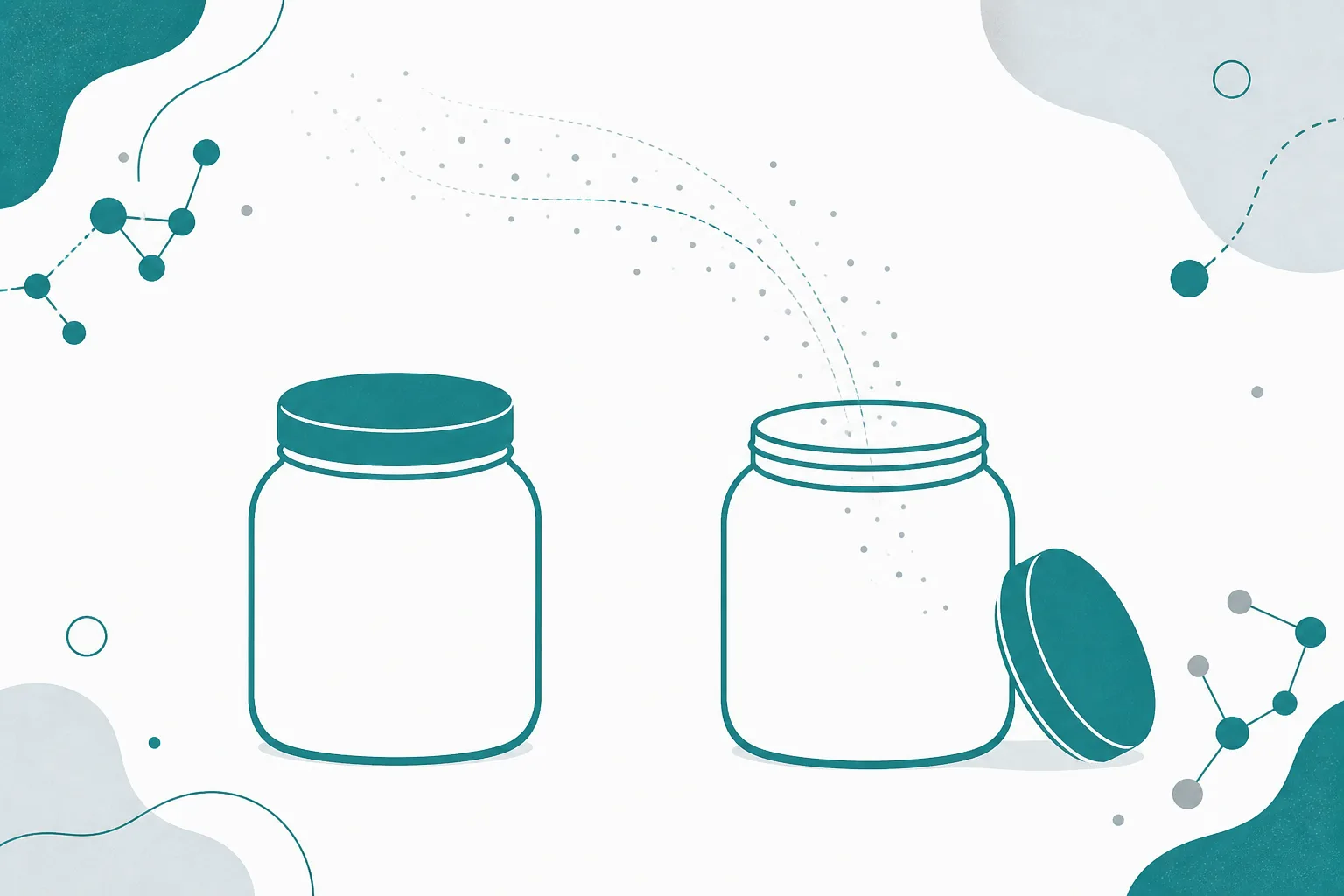
Think of a jar of jam. Sealed in the factory, it can sit in a cupboard for a long time. Once opened, it is a different object: still jam, but now exposed to the kitchen, and on a clock. A sterile label is like the factory seal. It is an accurate description of the jar as it was sealed. It cannot describe the jar after the lid comes off.
The one picture to keep
Keep the sealed jar. Sterile means nothing alive is inside, and that promise is made by the process that sealed it, measured as a one-in-a-million standard rather than checked item by item. It is stronger than clean and stronger than disinfected. It is also narrower than it sounds: it says nothing about endotoxin, purity or identity.
And it belongs to the sealed state. The word describes a jar with its lid on. Once the lid comes off, the label is describing the past.
References
- Guideline for Disinfection and Sterilization in Healthcare Facilities (2008): Introduction, Methods, Definition of Terms
- Guideline for Disinfection and Sterilization in Healthcare Facilities (2008): Sterilization
- Sterile Drug Products Produced by Aseptic Processing — Current Good Manufacturing Practice
- EU Guidelines for Good Manufacturing Practice, Annex 1: Manufacture of Sterile Medicinal Products
- Endotoxins from a Pharmacopoeial Point of View