What Is a Cyclic Peptide? Necklace vs Bracelet, Explained
A cyclic peptide is a peptide whose chain has been closed into a loop. Same beads, no loose ends, and a shape that is harder to unpick and easier to hold still.
A cyclic peptide is a peptide whose chain has been closed into a ring, so that it no longer has two loose ends. 'Cyclic' simply means 'forming a circle'. The beads are the same kind of beads, and they are joined in the same way. The difference is only that the chain has been fastened round on itself.
Use the picture from earlier in this series: a peptide is a necklace of beads, and each bead is a small building block called an amino acid. An ordinary peptide, called a linear peptide, is a necklace with the clasp undone, laid out in a line with a start and an end. A cyclic peptide is the same necklace fastened into a bracelet. That one change turns out to matter a great deal, because loops behave differently from lines. This article explains how, and also clears up one very common misunderstanding about what a ring can and cannot do.
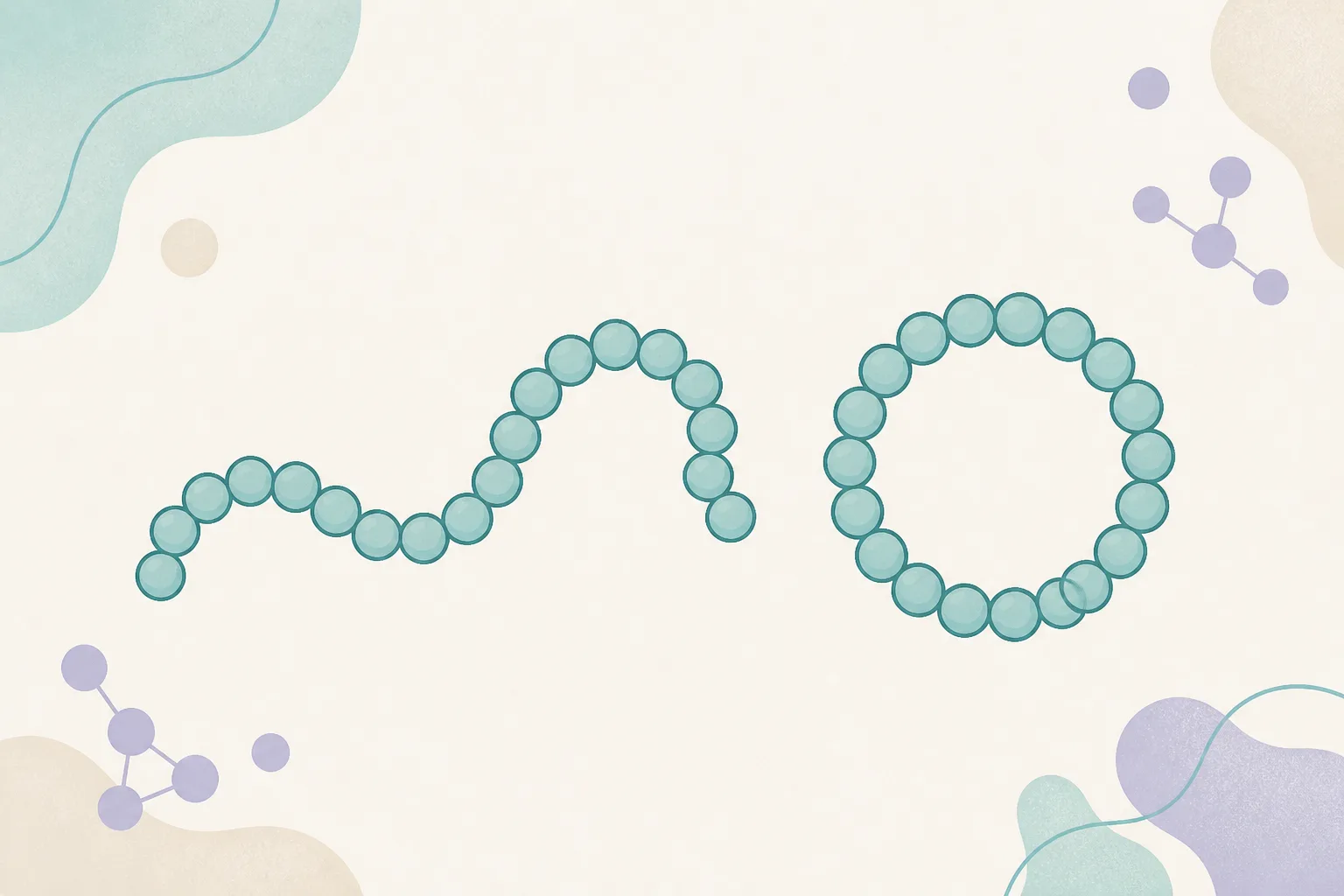
A chain with its ends joined
Start with the ordinary case. In a linear peptide, the beads are joined one after another by a link called a peptide bond. Because the chain has a direction, its two ends are not the same. One end carries a small chemical group called an amino group, and is known as the N-terminus. The other carries a different group, called a carboxyl group, and is known as the C-terminus. You can think of them as the head and the tail of the chain.
Those two ends are chemically active. They are where the chain can be attacked, where it can pick up unwanted extra pieces, and where it is, in a sense, unfinished. A cyclic peptide takes away both problems at once by joining head to tail, or by tying two other points together. There is nothing left dangling.
Closing a ring also changes the weight slightly, which is a nice way to see the idea in numbers. Joining the two ends releases one molecule of water, just as joining any two beads does. So a cyclic peptide made by head-to-tail closure weighs about 18 daltons less than its linear twin with the same beads. A dalton is the tiny unit molecules are weighed in, and the previous article in this series explains it. That small drop on a datasheet is one of the quiet signs that a ring is present.
The ways a loop can be closed
There is more than one way to fasten a bracelet, and chemists use several for peptides.
The most direct is head-to-tail closure. The first bead is joined to the last with an ordinary peptide bond, and the result is a perfect circle with no tail at all. This is the neatest form, and it is the one most people picture when they hear the word cyclic.
A second, very common way is a disulfide bridge. One of the twenty standard amino acids, cysteine, carries a sulfur atom on its side. Two cysteines in the same chain can link through their sulfur atoms, forming a short bridge between two points of the chain. The part of the chain between the two cysteines is pulled into a loop, while the rest can remain as a loose tail. Several natural hormones are built this way, with a ring and a short tail hanging off it.
A third group uses the side of one bead to link to the side of another, or to one of the ends. Each bead has a main chain that forms the necklace and a short side piece that sticks out. When the side pieces are tied together, or tied to an end, the chain folds into a ring that may also keep a tail. Laboratory chemists design many such links, including ones that go beyond what nature does.
| Way of closing | What gets joined | Picture |
|---|---|---|
| Head-to-tail | The first bead to the last bead, by an ordinary peptide bond | A bracelet with no clasp showing |
| Disulfide bridge | Two cysteine beads, through their sulfur atoms | A ring with a tail hanging off it |
| Side-to-side or side-to-end link | The sticking-out side pieces of two beads, or one side piece and an end | A necklace tied across itself |
Why enzymes find a ring harder to chew
The body, and any biological sample, contains enzymes. An enzyme is a protein that speeds up one particular chemical job, and a large family of enzymes has the job of cutting peptides into pieces. They are the scissors of the cell.
Some of these scissors work from the outside in. They grab an end of the chain and snip off one bead at a time, working inward, much like someone unpicking a necklace by pulling at the loose thread. Other scissors cut in the middle, wherever they find a spot they recognise. A linear peptide is open to both kinds. A cyclic peptide has no ends to grab, so the first kind of scissors find nothing to hold. The second kind can still cut, but only at the right spots, and a tightly held ring can hide those spots.
The result is that a loop is often more stable than the line with the same beads, in the sense that it takes longer to be broken down. That is one of the main reasons researchers study cyclic peptides, and reviews of the field list resistance to breakdown among the properties that make them attractive 1. Note the careful wording, though. More resistant is not the same as immune, and how much a particular ring resists depends on its sequence and shape. Stability is also only one property among many.
Why a fixed shape can fit a receptor better
A receptor is a protein, usually on the surface of a cell, that acts like a lock. Other molecules fit into it like keys, and when the right one fits, the receptor passes on a signal. How tightly a key fits, and how selectively, depends on its shape.
A linear peptide is floppy. A short string of beads wriggles through a huge number of shapes, and only a small share of those shapes match any particular lock. A bit like trying to push a piece of cooked spaghetti into a keyhole, most of the movement is wasted. A ring has far fewer ways to bend, because closing the loop removes much of the freedom. If the shape it is held in happens to match the lock, it presents itself ready-made, and binds more tightly and more selectively. This is the central idea behind the term conformational constraint, which just means holding a molecule in a chosen shape.
There is a catch worth stating plainly. A ring that holds the wrong shape is no better than a floppy line, and may be worse. Cyclising a peptide does not automatically improve its fit. It narrows the options, and whether the narrowed shape is useful has to be shown for each one.
Nature's cyclic peptides and the ones made in labs
Cyclic peptides are not a laboratory curiosity. Nature produces them in bulk. Some of the best known are made by bacteria and fungi as chemical weapons against competitors, and some are hormones in animals, including the short signalling peptides oxytocin and vasopressin, each of which is a small ring closed by a disulfide bridge with a short tail.
One review of the field reports that, as of its 2017 publication, over forty cyclic peptide drugs were in clinical use, and that the vast majority of approved ones were derived from natural products such as antimicrobials or human peptide hormones 1. That figure is a snapshot from that year and has certainly moved since, so treat it as an indication of scale rather than a current count. The point it makes holds up: for a long time, medicine mostly borrowed cyclic peptides from nature rather than inventing new ones.
The same review describes how that is changing. Newer techniques, including rational design and a laboratory method that mimics evolution, allow researchers to generate cyclic peptides aimed at targets for which nature supplies no ready-made answer 1. Whether any given laboratory-made ring turns out to be useful is, as always, a question for evidence rather than for the name.
What a ring does not do: the cell-membrane myth
Here is the misunderstanding most worth correcting. Because cyclic peptides are tougher and tidier, people sometimes assume they can therefore slip into cells, or be swallowed and absorbed, the way small molecules can. That does not follow.
A cell is wrapped in a thin oily skin, the membrane. Getting through it depends mainly on a molecule's size and on how much of its surface likes water. Large, water-loving molecules stay out. Most peptides, linear or cyclic, are too big and too water-loving to cross it easily. A discussion of the field's design trade-offs notes that molecules heavier than about 5,000 daltons typically struggle with poor membrane permeability, and that the attraction of in-between sizes is to combine some of the strengths of small molecules with those of larger ones 2. Making a ring changes shape, but it does not shrink the chain or change how many water-loving groups it carries.
A few cyclic peptides do manage to get through membranes, and researchers study why. They are the exceptions, and each one has to be examined individually, not assumed from the word cyclic. A broader review of peptides as medicines makes the same general point: the strengths of peptides in selectivity come with weaknesses in stability and in getting to where they need to go 3.
How you can tell from a name or datasheet
If a compound is cyclic, there are usually clues. None is foolproof on its own, but together they are quite reliable.
- The word itself. A description may say 'cyclic' outright, or write 'cyclo' in front of the sequence, or place the sequence inside brackets with a small 'c' before it.
- A pair of numbered cysteines. A note such as 'disulfide bridge between Cys2 and Cys7' means two cysteine beads are tied together, forming a loop.
- A structure diagram. A drawn ring is the plainest sign of all, and a ring with a short tail suggests a disulfide bridge.
- A slightly lower molecular weight than the linear version. A head-to-tail ring is lighter by about one water, and a disulfide bridge is lighter by about two hydrogen atoms.
It is also useful to notice what the word does not tell you. 'Cyclic' says nothing about purity, about how much is in a vial, or about what the compound does. It is a statement of shape and nothing more.
In one sentence
A cyclic peptide is the necklace fastened into a bracelet: the same beads with no loose ends, which makes it harder for end-chewing enzymes to unpick and easier to hold in one shape, but which does not on its own make it able to enter a cell.