What Does 'Acetate' Mean on a Peptide Label? Salt Forms Explained
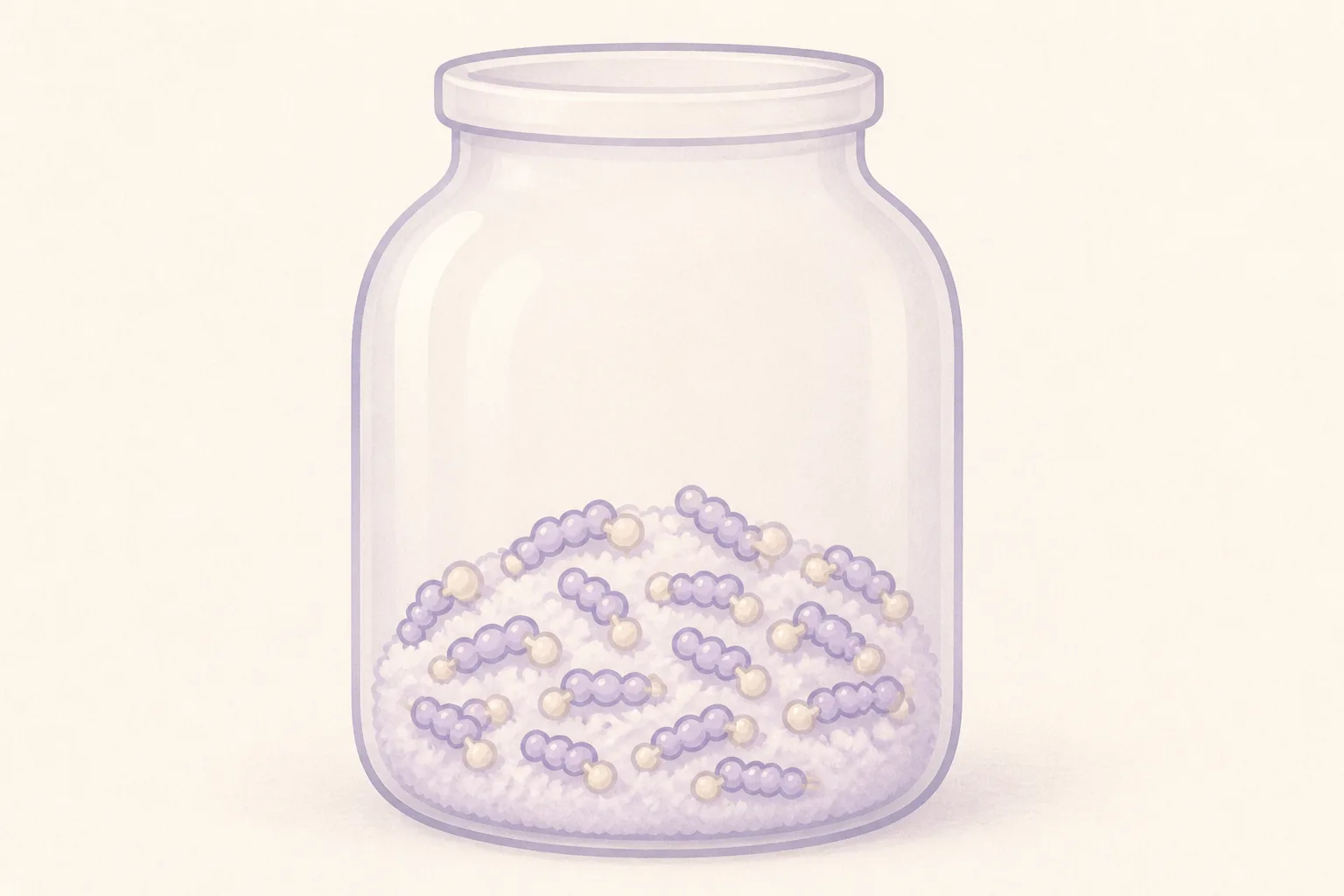
'Acetate' after a peptide's name describes a small partner ion that sits alongside the chain in the dry powder. The chain is the same; the partner is simply named on the label.
No, a peptide labelled 'acetate' is not a different peptide. The chain of amino acids is the same. The word names a small partner particle, called a counter-ion, that is packed in the dry powder alongside the chain. The label is telling you how the powder is put together, not what the peptide is.
The picture to keep is a dance partnership. A peptide chain usually carries a positive electrical charge, and in a dry powder a charged chain will not stand on its own. It needs a small, oppositely charged partner to take its hand. Acetate is one such partner. Trifluoroacetate, usually shortened to TFA, is another. Chloride is a third. This article explains what that means in plain words, why the partner adds weight, and what it does and does not change. It is a neutral explanation of a label term and not a comparison of products.
The word after the name
You may have seen peptide names followed by an extra word: '... acetate', '... TFA', '... hydrochloride'. Medicines work the same way. Many approved peptide medicines carry names that end in 'acetate', such as octreotide acetate or leuprolide acetate, and the pattern is exactly the one described here. The second word is not a new ingredient added to the first. It is part of the full chemical name of the substance as it exists in the container.
It also helps to separate two words that sound alike. Acetate is a separate, free-standing particle that sits beside the chain, held there by electrical attraction. Acetylation is something quite different: it means a small chemical group called an acetyl group has been bonded directly onto the peptide, becoming a permanent part of the chain itself. A peptide described as 'acetylated' has been modified. A peptide described as 'acetate' has not been modified at all; it just has a partner. The spellings are close, but the ideas are far apart.
Why a charged molecule needs a partner
To see why the partner is there, begin with charge. Atoms and molecules can carry a small electrical charge, either positive or negative, a bit like the static that makes a balloon stick to a wall. Opposite charges attract, and like charges push apart.
Peptides pick up charge in specific places. The front end of the chain has a chemical group that readily takes on a positive charge in water, and so do the side pieces of a few particular amino acids, namely lysine, arginine and histidine. A peptide rich in those beads carries several positive charges and is called cationic, meaning positively charged. One that has none of them may be close to neutral overall.
Now picture a chain with a handful of positive charges, packed as a dry powder. All those charges would repel one another and the substance would be restless and unstable. It settles into a calm, orderly solid only if each positive charge is paired with a negative charge somewhere nearby. The partner supplies that. The pair taken together is neutral, which is the state a stable powder prefers.
What a salt is, in kitchen terms
The word salt has a broader meaning in chemistry than the thing in your kitchen, but the kitchen version is the perfect example. Table salt is a positively charged particle, sodium, paired with a negatively charged one, chloride. Neither alone would be a pleasant thing to find in a jar. Together they form a stable, tidy crystal that sits quietly on a shelf and dissolves in water.
A peptide salt is the same arrangement with a bigger positive partner. The positive side is the peptide chain, the negative side is a small particle such as acetate, and the two are bound by attraction. When the powder is dissolved in water, the pairs separate again, and the chain and its former partner float around independently. This matters: it is why the partner in a salt form is generally a feature of the dry powder, not a lasting attachment to the chain.
Acetate, TFA, hydrochloride: different partners, same peptide
There are several partners in common use, and each has an origin and a weight.
Acetate comes from acetic acid, the sour component of vinegar. It is a small particle, built from two carbons, two oxygens and three hydrogens. It is also a normal part of ordinary biochemistry. Chloride, the partner in a hydrochloride salt, comes from hydrochloric acid, and it is even smaller. TFA, short for trifluoroacetate, is the odd one out: it comes from trifluoroacetic acid, a strong, harsh acid used as a tool in the making of peptides, and it is larger because three of its hydrogens have been swapped for heavier fluorine atoms.
Here is how TFA ends up in so many powders. Most synthetic peptides are built on a solid support, bead by bead, using a method called solid-phase synthesis. At the end, the finished chain must be cut free using a strong acid, and TFA is the usual one. Purification by a technique called HPLC, which sorts molecules by how they travel through a column, typically uses TFA in the liquid as well. As a consequence, a freshly made cationic peptide is mainly obtained as a TFA salt 1. If the maker wants a different partner, it has to be swapped in afterwards, and researchers have compared several ways of doing that exchange 12.
| Partner | Where it comes from | Approximate weight (daltons) | Where you tend to meet it |
|---|---|---|---|
| Chloride (hydrochloride salt) | Hydrochloric acid | 35 | A common swapped-in partner |
| Acetate | Acetic acid, the acid in vinegar | 59 | A common swapped-in partner; many approved peptide medicines are acetate salts |
| Trifluoroacetate (TFA) | Trifluoroacetic acid, used in synthesis and purification | 113 | The usual by-product of making a peptide in the laboratory |
Why the partner adds weight to the vial
The partner is a real particle with a real weight, so it counts on the scale. A peptide with several positive charges may carry several partners, one per charge, and together they can make up a noticeable share of the total powder.
Think of a bracelet with a charm hanging from every link. If you weigh the whole thing, you are weighing the bracelet and every charm. The powder in a vial is the same: the peptide chain plus its partners, and usually a little trapped water as well. The previous article in this series explains molecular weight, and this is the practical consequence of it. The molecular weight of the peptide itself is one number. The weight of the powder that contains it is larger.
For that reason, the weight of powder in a vial is not the same thing as the weight of peptide in it. The fraction of the powder that is actually peptide has its own name, and a separate line on some certificates. The partners are one of the reasons that line is not 100 percent. Different partners have different weights, which is why two vials of the same peptide can differ in how much of their contents is chain and how much is partner, even when both are labelled with the same milligrams.
Does the salt form change what the peptide is?
In terms of identity, no. The chain is the same chain. Dissolve any of the salt forms and the chain is released, and the partner floats away to become one of many ions in the liquid. Chemically, the peptide that matters is the same.
In terms of practical details, sometimes yes, and it depends on what is being done with it. Three kinds of evidence are worth keeping separate.
On measurement: TFA gives a strong signal in a technique called infrared spectroscopy that can overlap the signal from the peptide chain and hide it, so researchers who study the shape of a peptide this way often remove TFA first 12. This is a finding about an analytical method.
On cell cultures: in one study using cells grown in dishes from rat and mouse tissue, TFA at very low concentrations reduced cell numbers, and the TFA and hydrochloride salts of the same peptides gave different results 3. This is in vitro work, in cultured cells, and it shows that the partner can matter in a sensitive experiment. It is not evidence about what happens in a living animal or a person.
On the exchange itself: swapping partners is not free of risk to the peptide. One study found that strongly acidic conditions used to exchange TFA for chloride could alter a peptide's structure if the acid was too concentrated 2.
None of this says one partner is better than another in general. It says that the partner is a variable, that in some experiments it must be controlled, and that this is why a careful certificate or datasheet states which one is present.
What to look for on a label or certificate
If a document is well prepared, it will answer a few simple questions, and it is useful to know what they are so that their absence is also informative.
- Is the partner named? A name such as 'acetate', 'TFA' or 'hydrochloride' after the peptide tells you the salt form. Silence does not mean there is no partner, only that it has not been stated.
- Does the document say what the molecular weight refers to: the bare chain, or the chain together with its partners?
- Is there a separate figure for how much of the powder is peptide, as opposed to partner and water?
- Does the claimed salt form match what the supplier could plausibly have made? A document that names a partner but gives no supporting measurement offers a statement, not evidence.
None of these questions needs a chemistry degree. They are the same questions you would put to any list of ingredients: what is in it, how much, and does the paper say how it was checked.
In one sentence
Acetate on a peptide label names the small oppositely charged partner that holds hands with the chain in the dry powder: the same peptide with a named partner, a partner that adds weight to the vial, and one of several partners, alongside TFA and chloride, that a careful document will identify.
References
- Elimination and exchange of trifluoroacetate counter-ion from cationic peptides: a critical evaluation of different approaches
- Optimization of the hydrochloric acid concentration used for trifluoroacetate removal from synthetic peptides
- Trifluoroacetate, a contaminant in purified proteins, inhibits proliferation of osteoblasts and chondrocytes