how your body uses them
What Are Collagen Peptides?
This is probably the most-asked peptide question there is, and it deserves better than either a sales pitch or a debunking. Here is what collagen peptides are, what the human trials actually found, and which parts are still guesswork.
Modestly, according to real human trials — the measured effects are small, the studies are small and short, and most were paid for by companies that sell the ingredient. That is the fair one-sentence answer, and the rest of this page is the reasoning behind it. Collagen peptides are collagen that has been broken into short pieces. Collagen is the main structural protein in your body: the tough, ropey material that gives skin its stretch, holds tendons and ligaments together, and forms part of the framework inside bone. A peptide is a short chain of amino acids, the small molecules all living things build proteins from. Broken down far enough, collagen dissolves in cold water instead of sitting in lumps. That is the whole product.
What is a collagen peptide?
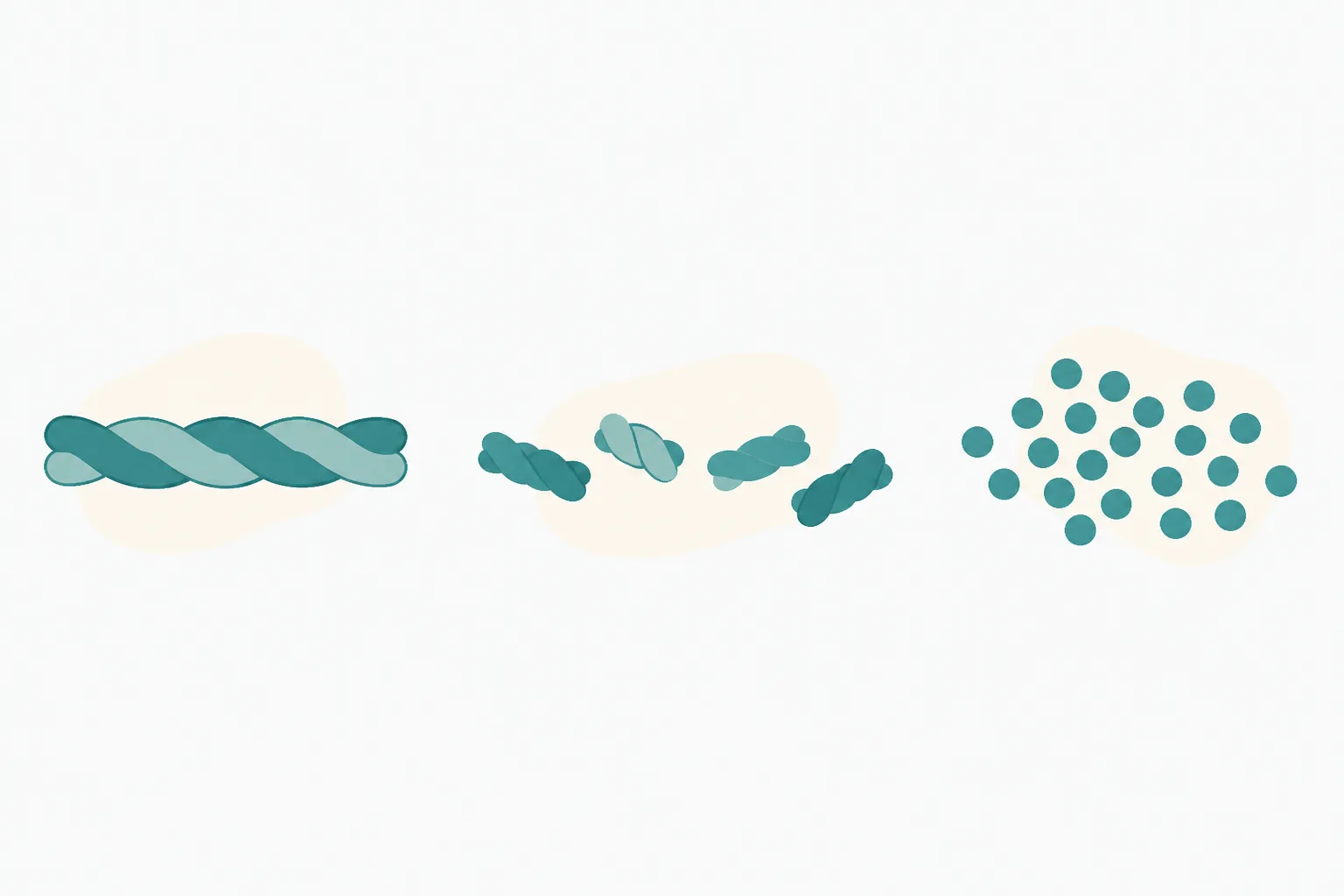
Start with the collagen, because the peptide part only describes how far it has been cut up. Collagen is the most abundant protein in your body, and it is structural: its job is to hold things in shape rather than to carry messages. Its design is genuinely rope-like. Three long protein strands wind around one another, and those triple ropes bundle into fibers. It is the same trick that makes a rope stronger than the threads inside it.
Now the cutting. Collagen in that natural form does not dissolve in water; it is not built to. To make a usable powder, manufacturers break collagen-rich material down with heat, water and enzymes — enzymes being proteins whose job is to speed up one particular reaction, here snipping protein chains into shorter ones.
How far the cutting goes decides what you get. Cut the ropes partway and you have gelatin, which dissolves in hot water and sets into a wobble as it cools. Cut them further and the pieces are too short to lock together at all. They dissolve in cold water and stay dissolved. Those short pieces are sold as collagen peptides, hydrolyzed collagen, or collagen hydrolysate — three names for one material.
So collagen, gelatin and collagen peptides are not three substances. They are one substance at three lengths, which is why a study using gelatin can still be relevant here.
The obvious objection: your body takes protein apart anyway
A fair article has to stop here and raise the strongest argument against its own subject.
When you eat any protein, your body does not absorb it as protein. Enzymes in your stomach and small intestine work along the chains and cut them apart. What crosses into your bloodstream is mostly single amino acids and very short fragments. The long chain that went in does not come out the other side intact.
Nothing that arrives is labeled. Your body does not stamp a batch of amino acids "collagen" and route them toward your skin. It does not know or care what they were part of an hour earlier. They join a general pool of loose parts, and your cells build whatever they currently need out of that pool, following instructions written in your own genes.
Picture a builder taking a delivery of loose bricks. The bricks may have come from a demolished church, but nothing about them says so, and the builder is going to use them for whatever is on the plan today. Eating collagen to build collagen sounds a little like eating a church to build a church.
So the skeptical position is not cynicism. It follows directly from how digestion works. On the face of it, collagen should be much like any other protein — a supply of amino acids, no more targeted than the protein in beans or eggs. Anyone raising that objection has understood something real, and if the story ended there, these products would have nothing special about them.
So why is anyone still interested?
Because the tidy picture above turns out to be slightly too tidy. Digestion is thorough, but it is not perfectly thorough.
Research suggests that some very short fragments of collagen — pairs and triples of amino acids joined together — can survive the trip through the gut and appear in the blood afterward 3. The ones usually named contain proline and a modified form of it called hydroxyproline, which is common in collagen and rare almost everywhere else. That rarity is useful: a researcher who finds these fragments in blood can be fairly confident where they came from.
That measurement leads to a hypothesis — a proposed explanation that fits the evidence so far and has not been confirmed. The proposal is that these surviving fragments act as a signal rather than as raw material. On that view, a cell that builds collagen meets a recognizable collagen fragment in the blood and treats it as information — roughly, "collagen is being broken down somewhere, so make more" — rather than as a brick to lay.
Be exact about that last paragraph. Two claims are involved, and they do not have the same standing. That short fragments show up in the blood is a measurement. That those fragments instruct cells to build is a proposed explanation. It is plausible, it is actively studied, and it is not an established fact. Anyone stating it as settled biology is going further than the evidence goes.
One more strand of work sits alongside this. In one study, people were given gelatin enriched with vitamin C — a vitamin your body needs to assemble collagen properly — before short bouts of activity, and researchers measured markers of collagen building in their blood. Those markers rose 4. Read that carefully. A blood marker suggesting collagen-building activity has increased is not the same thing as a measurably stronger tendon. It is a signpost, not a destination.
What do the human trials actually show?
Here is where collagen peptides differ from most compounds discussed on this site. There are randomized, placebo-controlled trials in real people. That is a genuinely higher standard of evidence than "promising results in mice," and it deserves saying before the criticisms start.
Three words are doing the work there. Randomized means volunteers were sorted into groups by chance, so the groups start out comparable. Placebo-controlled means one group got a dummy version — same look, no active ingredient — because people improve for all sorts of reasons, including expecting to. Double-blind means neither the volunteers nor the researchers assessing them knew who was in which group. That design exists because it is hard to fool.
One double-blind, placebo-controlled trial gave women either collagen peptides or a placebo, then measured their skin with instruments rather than asking how it felt. It reported improved skin elasticity in the collagen group relative to placebo 1. The instruments matter, because "my skin feels better" is exactly the judgment a placebo moves most easily.
A second randomized controlled trial worked with older men with sarcopenia — the gradual loss of muscle mass and strength that comes with age. Every participant did resistance training. Half also received collagen peptides and half a placebo. The collagen group gained more fat-free mass and more strength than the placebo group 2.
Notice what that design does and does not show. Everyone trained, and training is the thing with overwhelming evidence behind it. The question was narrow: does the supplement add anything on top of the exercise? A yes there is not a claim that a powder builds muscle by itself.
Now the limitations, stated without sneering, because these are ordinary features of early research rather than evidence of bad faith.
- The trials are generally small, and a chance result is easier to mistake for a real one when few people are involved.
- They are short. Skin, tendon and bone change slowly, and a study ending in weeks cannot say what happens over years.
- The measured effects are modest — detectable by instruments rather than obvious in a mirror.
- Much of the work uses one company's particular preparation, so it is not automatically true of everything sold under the same words.
- Funding frequently comes from businesses that sell the ingredient being tested.
That last point deserves careful handling, because it is easy to swing too far in either direction with it.
Collagen is an unusual protein
One more fact is worth knowing, and it is purely a fact about composition. Proteins are built from a set of twenty amino acids, and most use a fairly varied mix. Collagen does not. It leans heavily on glycine, the smallest of the twenty, and on proline. That follows from its rope-like structure: the three strands can only wind together tightly if the smallest possible amino acid sits at the repeating positions where they press against each other. Bulkier ones would not fit, so glycine turns up again and again.
The flip side is that collagen leaves things out. It contains no tryptophan at all. Tryptophan is one of the amino acids your body cannot make for itself, which is what essential means here — a statement about supply, not importance. A protein containing all of those is called complete. Collagen, missing one, is not a complete protein on its own 3.
That is a description of a molecule, not a recommendation about anybody's diet. The useful takeaway is narrower and more interesting: collagen is chemically peculiar, and its peculiarity is exactly why fragments of it are recognizable in blood in the first place.
So where does that leave the question?
In an honest middle, which is a real position rather than a way of avoiding one.
Three things are true at once. This is one of the few peptide-related products with genuine randomized human trials behind it. The effects those trials report are modest rather than dramatic. And the mechanism — the actual chain of events between swallowing something and measuring a change — is still being worked out.
Both of the loud positions get something wrong. The marketing skips the smallness of the effects and the unfinished mechanism, and talks as though eating collagen straightforwardly becomes collagen. The dismissal stops at the digestion objection, treats it as the end of the argument, and never engages with the trials that were actually run. Each side holds a real piece of the picture and mistakes it for the whole.
What you can carry away is the habit of separating three questions that usually arrive glued together. Does any of it survive digestion? Partly, in short fragments. Does something measurable change in a controlled trial? In several trials, yes, by a small amount. Do we know why? Not yet.
A reader who knows that much is genuinely ahead of both the advertising and the debunking. It is a less satisfying place to stand than either. It also happens to be where the evidence currently is.
References
- Oral supplementation of specific collagen peptides has beneficial effects on human skin physiology: a double-blind, placebo-controlled study
- Collagen peptide supplementation in combination with resistance training improves body composition and increases muscle strength in elderly sarcopenic men: a randomised controlled trial
- Significant Amounts of Functional Collagen Peptides Can Be Incorporated in the Diet While Maintaining Indispensable Amino Acid Balance
- Vitamin C-enriched gelatin supplementation before intermittent activity augments collagen synthesis