How Does a Peptide Get Its Name? Codes, INNs and Brands
One molecule can carry a research code, an official generic name and a brand name. They do three different jobs, much as a nickname, a passport name and a stage name all point at one person.
A single peptide can have a research code, an official generic name and a brand name, because each one is written by a different party for a different job. The code is the discoverer's private label, the generic name is a shared international name for the substance itself, and the brand name belongs to a company. Once you know which is which, the strings of letters on a datasheet stop looking random.
This article is about the words, not the letters. It does not explain how to read an amino acid sequence; it explains how a molecule gets from a bench label to a name that pharmacists in different countries recognise, what the endings tell you, and why many research peptides never receive an official name at all. Prescription medicines are mentioned only as examples of how names are built.
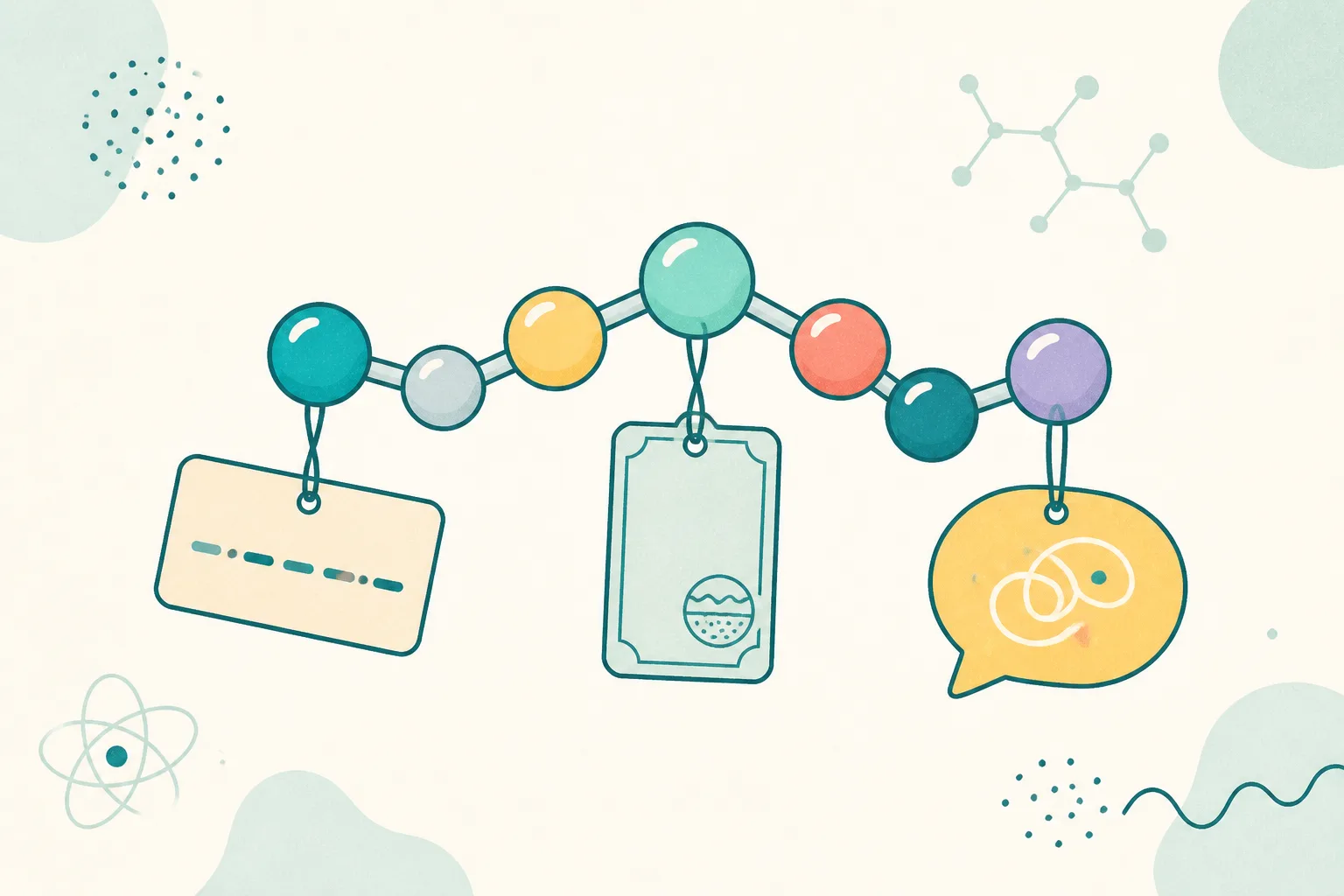
Three names for one molecule
Think of a person. Their family calls them by a nickname, their passport carries a formal name that is the same in every country they visit, and if they perform, they may also have a stage name that belongs to their career. All three point to one individual, and none is wrong. They simply serve different audiences.
A molecule is named in just the same way. The nickname is the research code, used inside the lab that made it. The passport name is the International Nonproprietary Name, or INN, which is the same worldwide. The stage name is the brand name, which a company chooses to sell a particular product. Nonproprietary here just means that nobody owns it: the opposite of a trademark.
Lab codes: letters and numbers from the discovery bench
The first name a molecule gets is usually a code. A research group needs some way to refer to a compound long before anyone has decided what it is for, so it labels it with a short run of letters and numbers. Companies often start the code with their own initials, followed by a serial number, so a single code can reveal who made the compound and roughly when. Academic groups do the same thing with their own conventions.
Codes are not designed for the public. They have no rules, they are not coordinated between organisations, and nothing stops two groups from using similar-looking codes for unrelated molecules. Some codes are partly descriptive, such as a number added after an abbreviation of what the compound does, but even then the number is just a catalogue entry. A code like this is perfectly good in the paper that introduced it. It is much less useful once the compound is discussed by thousands of people.
Many of the names you meet in the research-peptide world are of this kind: a handful of letters, a hyphen and a number. As far as the published INN lists show, they are not official names. They are labels that stuck, which is why they can look so different from the more regular-sounding names of licensed medicines.
The INN: one official name for the whole world
An INN identifies a pharmaceutical substance by a unique name that is globally recognised and is public property. It is also called a generic name 1. The system was started by a World Health Assembly resolution in 1950, and the first list was published in 1953. By the time of the 2017 guidance, the cumulative list stood at roughly 9,300 names, growing by about 160 each year 1.
The aim is practical and rather humble: every health professional, in every country, should be able to name the same substance the same way. INNs are placed in the public domain so that they can be used freely and cannot be owned. They are also meant to be distinctive in sound and spelling so they are not confused with other names 1. A drug name that is easy to mistake for another one is a safety problem, not just an irritation.
How does a name get chosen? The process runs in steps. A manufacturer or inventor makes a request. The World Health Organization checks the suggestion against its rules and against existing names and trademarks, and a panel of experts agrees on a single name. That name is first published as a proposed INN, with a four-month window in which anyone can object. When the period has passed, and any objections are resolved, it becomes a recommended INN 1. The United States has its own matching list, the United States Adopted Names, run by a council that follows similar principles, and in practice the two usually agree 2.
What the endings tell you: -tide, -relin, -glutide, -morelin
Most INNs are built from two parts: a fantasy prefix that is made up to be distinctive, and a common stem that signals what kind of substance it is 1. A stem is just a recognisable word-ending shared by related substances. The idea is that a pharmacist who has never met a particular name can still tell roughly which family it belongs to from the ending alone.
The World Health Organization's list of stems gives -tide for peptides and glycopeptides, and points to special groups within that family, including -relin, -tocin and -pressin 1. The -relin stem is used for peptides related to the releasing hormones that signal the pituitary gland, and -morelin is a sub-stem for those that prompt growth hormone release. The -glutide sub-stem sits under -tide too and is used for peptides modelled on a gut hormone called GLP-1. The -tocin and -pressin stems mark relatives of two natural hormones, oxytocin and vasopressin.
| Stem | Family it signals | Example of an INN using it |
|---|---|---|
| -tide | Peptides and glycopeptides in general | tirzepatide, retatrutide |
| -glutide | Peptides modelled on GLP-1 | semaglutide |
| -relin | Peptides related to pituitary-releasing hormones | gonadorelin |
| -morelin | Peptides prompting growth hormone release | ipamorelin, sermorelin |
| -tocin | Relatives of oxytocin | oxytocin itself |
| -mab | Antibodies, which are much larger than peptides | (a different family altogether) |
Two cautions. First, a stem is a family label, not a quality mark; it tells you about chemistry and origin, nothing about whether a substance is safe. Second, the endings only appear on names that have been officially assigned. A compound with a code and no INN carries no stem, however peptide-like it is.
Brand names and why they differ between countries
A brand name is a trademark, owned by the company selling a product. Unlike an INN, it is product specific, can change from country to country, and may even be used for two different active ingredients in different places. The American naming council makes the contrast in one sentence: the generic name of an active ingredient does not change across national boundaries, companies or product lines 2.
There is one firm rule. To avoid confusion that could harm patients, trademarks cannot be derived from INNs and must not contain their common stems 1. The reason is that stems are a shared resource. If one company's brand name used up a stem, it would limit the names available for the next substance in the family. So brand names tend to sound unlike the generic name on purpose.
Brand names matter for the history of a product, but they say nothing about what a substance is. Two products from different companies can contain the same active substance and carry entirely different brands, which is exactly why the generic name exists.
Why some research peptides never get an INN
An INN does not appear on its own. The World Health Organization assigns them to compounds upon request, as the medicinal-chemistry literature on INN publications puts it 3, and the request normally comes from a manufacturer or inventor who is taking a compound towards development. If nobody applies, no name is chosen.
There are also content rules. INNs are selected in principle only for single, well-defined substances that can be pinned down by a chemical name or formula. The programme's policy is not to select names for mixtures, and substances that are not fully characterised are included only in exceptional cases 1. A blend of two peptides sold as one product therefore cannot receive one INN. And the INN usually names only the active part of a molecule. When a salt is involved, the user creates a modified name, so that a single INN can cover several salt forms 1.
A worked example: from code to INN to brand
To see the whole path, take an invented peptide, so that no real product is implied. A research company synthesises a new chain of amino acids and labels it PX-204, with its own initials and the next serial number. For a while it is only ever called that.
Suppose the compound is modelled on the gut hormone GLP-1 and the company decides to develop it. It files an INN request. The experts propose a name with a made-up prefix and the -glutide stem, say pexaglutide, an invented name for illustration. The proposed name is published, the four-month objection period passes, and it becomes recommended. From then on, every paper and regulator in every country can use the same word.
Much later, if a product is ever launched, the company picks a brand name that looks and sounds nothing like pexaglutide and does not contain its stem. In another country the same product might trade under a different brand name. Throughout, the molecule is the same, but there are now three names, written by three different parties for three different purposes.
Most research peptides stop at the first step. They keep their code or a descriptive name, because they have never gone through the later steps. That is not a flaw. It simply means the official apparatus of naming has not been engaged, and the code is the only name there is. Nothing here is guidance about using any substance. Material sold for laboratory research use only has not been assessed by a medicines regulator.