compounds explained simply round three
What Is Semaglutide?
Semaglutide is one molecule sold under several names. It is a copy of a gut hormone with three small edits, and those edits are the whole reason it lasts a week. Here is the molecule itself, what it copies, what it is approved for, and what it is not.
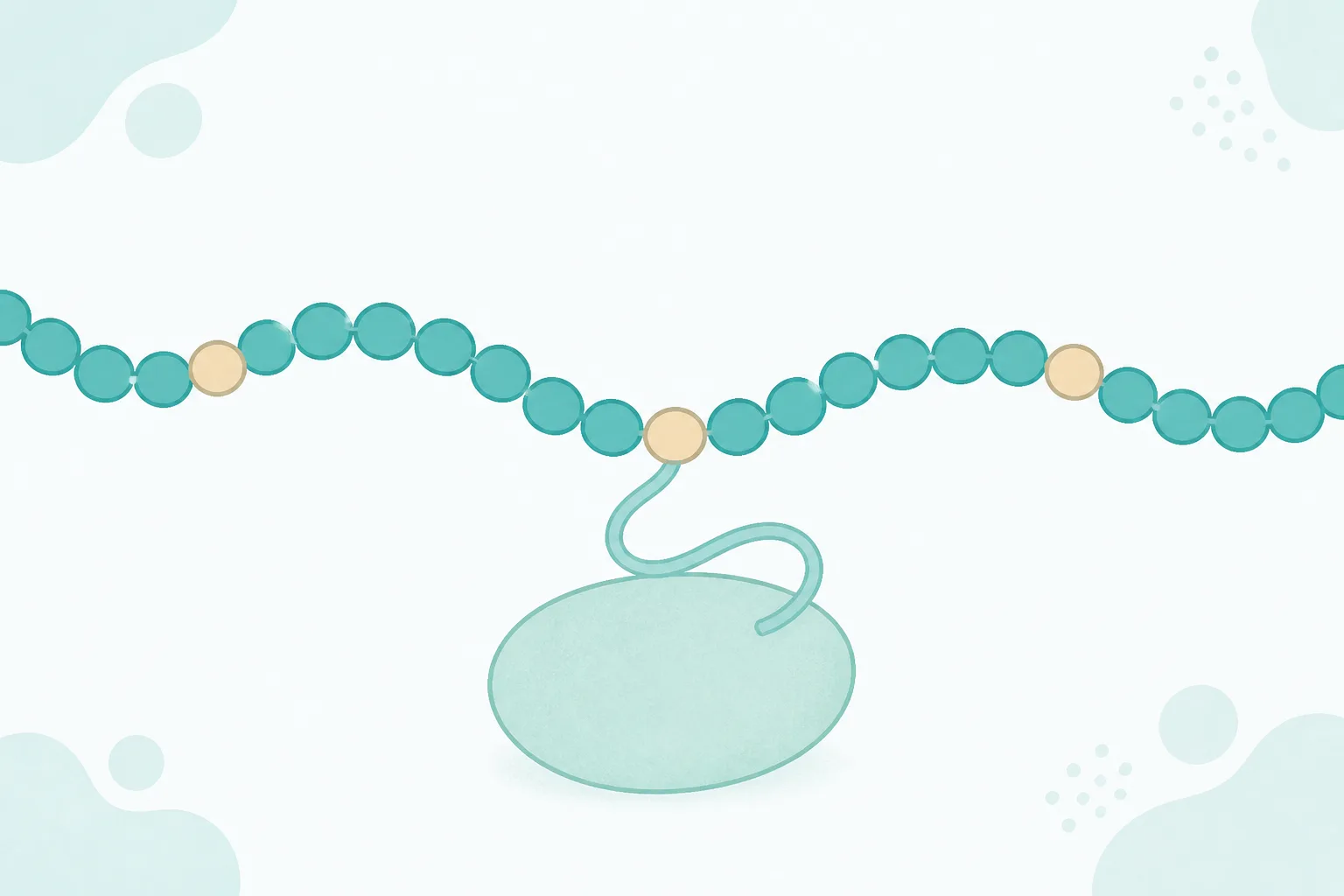
Semaglutide is a laboratory-made copy of GLP-1, a hormone your gut releases after you eat, with three small changes that let it last about a week in the body instead of about two minutes. It is a single molecule. Several prescription medicines contain it, under different brand names, and each of those products is approved for a particular purpose. That is the short answer.
If you have read our page on GLP-1 medications, you already know the family: what the natural hormone does, why appetite falls, and what the large trials found. This page does not go over that ground again. It zooms in on one member of the family and asks a narrower question. What is this particular molecule, exactly, and why is it built the way it is?
What does the name tell you?
Drug names look random, but many of them are built from parts, a bit like surnames that tell you which family someone belongs to. The ending of a medicine's official name often signals what kind of molecule it is. Names ending in "-glutide" belong to the family of copies of glucagon-like peptides, the group GLP-1 belongs to. So before you know anything else, the word semaglutide has already told you it is a relative of that gut hormone.
There is a second naming layer, and it causes a lot of confusion. The official name, semaglutide, is the name of the molecule. Brand names such as Ozempic and Wegovy are names of products — a particular manufactured medicine, in a particular form, approved for a particular purpose. Two products with different brand names can contain exactly the same molecule. They differ in what they are approved to treat and how they are supplied, not in what the active ingredient is.
A useful comparison is flour. The same flour can go into a loaf and into a cake. Nobody would say bread and cake are different flours. They are different products made from the same thing, for different occasions.
What is it a copy of?
It copies GLP-1, short for glucagon-like peptide-1. A peptide is a short chain of amino acids, the small building blocks that link together end to end to make proteins. A hormone is a chemical message carried in the blood from one part of the body to another. GLP-1 is both: a short chain, released by cells in the lining of your intestine when food arrives, that tells other parts of the body a meal is under way 2.
To pass on that message, GLP-1 fits a receptor, which is a structure on the surface of a cell shaped to catch one particular molecule. When GLP-1 settles into its receptor, the cell responds. Semaglutide was designed to fit that same receptor and switch it on in the same way. In the language of pharmacology, it is a GLP-1 receptor agonist: a molecule that fits the GLP-1 receptor and turns it on.
How close is the copy? Very close. The chemists who designed it describe its chain as almost entirely matching the natural human hormone 1. If you lined the two up letter by letter, you would have to look carefully to find where they differ. That closeness is the point. The body already knows what to do with this shape. The designers did not want to change the message. They wanted to change how long it survives.
Three small edits, and what each one does
The natural hormone has two weaknesses. An enzyme in the blood, a protein whose job is to cut other molecules, snips GLP-1 near its front end within minutes. And a chain this small is filtered out of the blood by the kidneys very quickly. Semaglutide fixes both problems with three changes 1.
| The edit | What it does | An everyday comparison |
|---|---|---|
| One building block near the front is swapped for an unusual one | The cutting enzyme no longer recognises the spot it normally grips, so it cannot snip the chain | Changing the shape of a keyhole so a particular pair of scissors cannot get a grip |
| A second building block is swapped so the next change can only attach in one place | Makes sure the tail goes on in exactly the right spot, and nowhere else | Taping over every hook on a coat rack except one |
| A long fatty tail is attached through a short linker | The tail holds on loosely to albumin, a large protein in the blood, which shelters the molecule | A small boat tied to a big ship, carried along instead of drifting off |
None of these edits makes the molecule do something new. They are protective. The first stops it being cut. The third stops it being cleared away. The second is a piece of careful engineering that makes the third one work properly.
Why does it last a week?
The fatty tail is the main reason, and the idea behind it is rather neat. Albumin is the most common protein in your blood. It is large, it is everywhere, and it acts as a general carrier, ferrying fats and other substances around the body. It also stays in circulation for a long time, and it is too big to pass through the kidney's filter.
Semaglutide's tail lets it cling to albumin. While it is holding on, two good things happen. The kidneys cannot filter it out, because it is effectively part of something far too big to pass. And the cutting enzymes have a harder time reaching it. Every so often it lets go, drifts free for a while, meets a receptor, and then grabs hold of albumin again 1.
Scientists describe how long something lasts using its half-life, which is the time it takes for half of it to disappear from the blood. For your own GLP-1, that is a couple of minutes. For semaglutide it is roughly a week 1. That is why the medicines built on it are given once a week rather than continuously. The difference is not strength. It is staying power.
Here is an everyday way to hold it in your head. Your own GLP-1 is like a sparkler: bright, useful, and gone almost as soon as it is lit. Semaglutide is the same light in a slow-burning candle. The flame is the same kind of flame. It just keeps going.
What is it approved for?
Approval means a medicines regulator has reviewed the evidence for a specific product, for a specific purpose, and agreed it may be sold for that purpose. It is never a blanket approval of a molecule for anything at all. In Europe that job belongs to the European Medicines Agency, and in the United States to the Food and Drug Administration.
In the European Union, a semaglutide product was first authorised in 2018 for adults whose type 2 diabetes is not well controlled, alongside diet and exercise 3. A second product was authorised in 2022 for weight management in adults with obesity, or with overweight plus at least one weight-related health problem, again alongside diet and physical activity, and later for some adolescents as well 4. In 2024 the US regulator added a further use for one product: lowering the risk of heart attack, stroke and death from heart disease in adults who already have heart disease and also have obesity or overweight 5.
| Product | Approved for | Where and when first |
|---|---|---|
| Ozempic | Type 2 diabetes in adults, alongside diet and exercise | European Union, 2018 |
| Wegovy | Weight management in adults with obesity, or overweight with a related health problem | United States, 2021; European Union, 2022 |
| Wegovy | Lowering the risk of serious heart problems in adults with heart disease and obesity or overweight | United States, 2024 |
A tablet form also exists. Getting a peptide to survive being swallowed is unusually hard, and that version relies on an added ingredient that helps a small share of the molecule cross the stomach wall. It is a separate product with its own approval, and it is the exception rather than the rule.
What did the big trials look at?
Our page on GLP-1 medications walks through the evidence in detail, so here is only the outline. One large trial compared semaglutide with a placebo, an inactive look-alike, in adults with obesity or overweight and no diabetes. After sixty-eight weeks, average body-weight change was about fifteen percent in the treated group against about two percent on placebo 6. A much larger trial then followed more than seventeen thousand people with heart disease and excess weight for years, and counted heart attacks, strokes and heart-related deaths. Those events happened about a fifth less often in the treated group 7.
What matters for this page is what those trials tested: a specific approved product, made to a defined standard, given under medical supervision. The results describe that product. They do not attach themselves to the word semaglutide wherever it happens to be printed.
What semaglutide is not
A lot of confusion around this molecule comes from people filing it in the wrong drawer. The most common mix-up is with insulin, the hormone that moves sugar out of the blood. Semaglutide is not insulin. It encourages the pancreas to release more of its own insulin, and only when blood sugar is already high 2. A few more drawers it does not belong in:
- It is not the natural hormone. It is a close copy with deliberate edits, which is exactly why it behaves so differently over time.
- It is not a stimulant or a so-called fat burner. It does not speed anything up. Its main effect on appetite runs through the brain's own signalling.
- It is not a permanent reset. It acts while it is present. When it is gone, the body goes back to responding as it did before.
- It is not the same thing as powder sold under its name. A name on a label says what something is supposed to be. It says nothing about whether it was made, tested and stored the way the approved product was.
That last point deserves one more sentence. Every approval described above belongs to a specific manufactured product, not to the molecule's name. Material sold as a research substance may share the name, but no regulator has assessed it, and none of the trial results were produced with it.
The one-sentence version
Semaglutide is your own meal-time gut hormone, copied almost exactly, with three careful edits that stop the body cutting it up and filtering it out, so the same message keeps arriving for a week.
Once you see it that way, the other compounds in this group get easier to read. Some copy two hormones in one molecule. One copies three. Others copy entirely different hormones, like a message to the pituitary gland or a signal that darkens the skin. Each time, the same three questions do most of the work. What does it copy? What was changed, and why? And has any regulator actually approved it, for anything?
References
- Discovery of the Once-Weekly Glucagon-Like Peptide-1 (GLP-1) Analogue Semaglutide
- Mechanisms of Action and Therapeutic Application of Glucagon-like Peptide-1
- Ozempic (semaglutide): European public assessment report
- Wegovy (semaglutide): European public assessment report
- FDA Approves First Treatment to Reduce Risk of Serious Heart Problems Specifically in Adults with Obesity or Overweight
- Once-Weekly Semaglutide in Adults with Overweight or Obesity
- Semaglutide and Cardiovascular Outcomes in Obesity without Diabetes